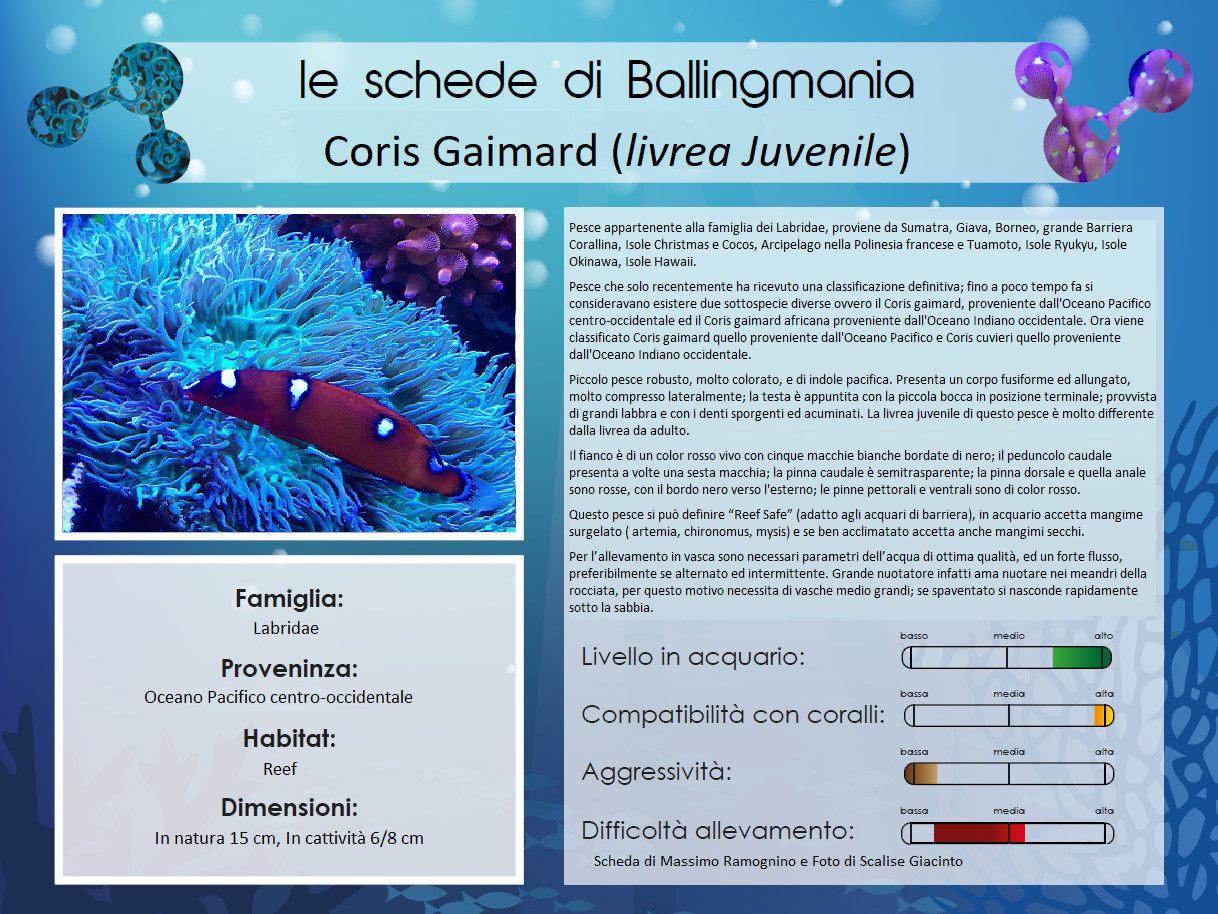
Coris gaimard (livrea juvenile)
Currently accepted name: Coris gaimard
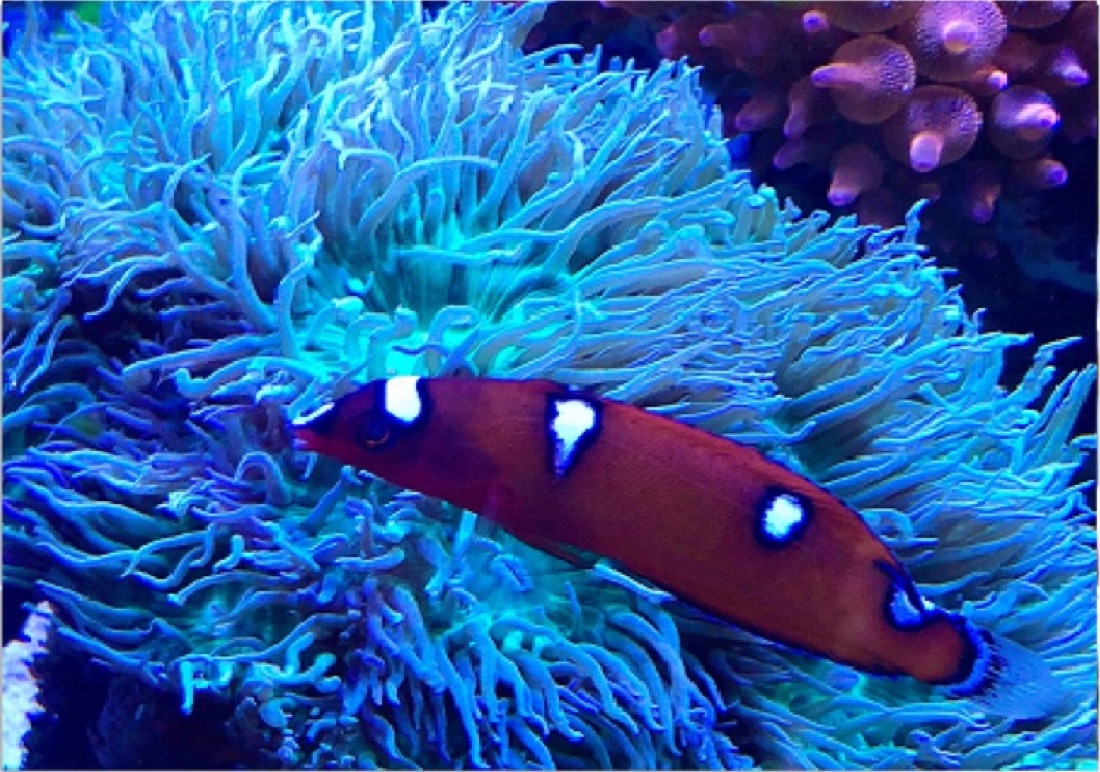
It belongs to the family Labridae. 1 It is a tropical Pacific wrasse that changes appearance greatly as it grows: as a juvenile it is reddish orange with five white saddles edged with black, while as an adult it has a dark body dotted with blue and a yellow tail. 3 The juvenile in the photo is therefore a transitional stage of a fish that can reach 40 cm. 2 3
At a glance
Data from the scientific sources listed at the bottom.
Depth in the wild
0–50 m
Size
up to 40 cm
maximum total length; the common size is 20 cm
Conservation
IUCN Red List: least concern (2008). Red List data taken from FishBase. 2 It does not appear in the CITES lists checked on Species+. 7
Where it lives
From Christmas and Cocos-Keeling Islands, in the eastern Indian Ocean, to the Society Islands and the Tuamotus; north to Japan and Hawaii, south to Australia. In the Indian Ocean it is replaced by Coris cuvieri. 2 In Australia it reaches as far as Bermagui, in New South Wales, on the east coast. 3
How to recognise it
Tap a number on the photo: the key explains what to look for.
Life in the wild
What it eats
Carnivore: it eats mainly molluscs, crabs and hermit crabs, sometimes tunicates and foraminifera. 2 In a study in Japan the smallest fish preyed on small crustaceans and the largest on molluscs and crabs. From 5 cm upwards they also flip over gravel to look for prey hidden underneath, and as they grow they do so more often and with larger stones. 6 The Waikiki Aquarium also lists worms, sea urchins and brittle stars. 5
In the aquarium
From the experience of the BallingMania community.
A fish belonging to the family Labridae; it comes from Sumatra, Java, Borneo, the Great Barrier Reef, the Christmas and Cocos Islands, the archipelagos of French Polynesia and the Tuamotus, the Ryukyu Islands, the Okinawa Islands and the Hawaiian Islands.
A fish that has only recently received a definitive classification; until recently two different subspecies were thought to exist, namely Coris gaimard, from the central-western Pacific Ocean, and Coris gaimard africana, from the western Indian Ocean. Now the one from the Pacific Ocean is classified as Coris gaimard and the one from the western Indian Ocean as Coris cuvieri.
A small, hardy, very colourful fish with a peaceful temperament. It has a spindle-shaped, elongated body, strongly compressed laterally; the head is pointed, with the small mouth at the tip; it has large lips and protruding, sharp teeth. The juvenile livery of this fish is very different from the adult livery.
The flank is a bright red with five white spots edged with black; the caudal peduncle sometimes has a sixth spot; the caudal fin is semi-transparent; the dorsal and anal fins are red, with a black outer edge; the pectoral and pelvic fins are red.
This fish can be called "Reef Safe" (suitable for reef aquariums); in the aquarium it accepts frozen food (Artemia, chironomus, mysis) and, if well acclimatised, it also accepts dry foods.
To keep it in a tank, excellent water quality is needed, and a strong flow, preferably alternating and intermittent. A great swimmer: in fact it loves swimming through the recesses of the rockwork, which is why it needs medium-to-large tanks; if frightened it quickly hides under the sand.
Species sheet by Massimo Ramognino and photo by Scalise Giacinto
Did you know?
Sources
- WoRMS Editorial Board (2026). Coris gaimard (Quoy & Gaimard, 1824). World Register of Marine Species.
- Froese R., Pauly D. (eds.) (2026). Coris gaimard, African coris. FishBase.
- Bray D.J. (2026). Clown Wrasse, Coris gaimard. Fishes of Australia.
- McGrouther M. (2021). Clown Wrasse, Coris gaimard (Quoy & Gaimard, 1824). Australian Museum.
- Waikīkī Aquarium (2026). Yellowtail Coris Wrasse. Waikīkī Aquarium.
- Shibuno T., Hashimoto H., Gushima K. (1994). Changes with Growth in Feeding Habits and Gravel Turning Behavior of the Wrasse, Coris gaimard. Japanese Journal of Ichthyology.
- UNEP-WCMC (2026). Search for Coris gaimard in the CITES lists. Species+.
Sources checked on 5 November 2026. Community texts and ratings are kept separate from the scientific data.