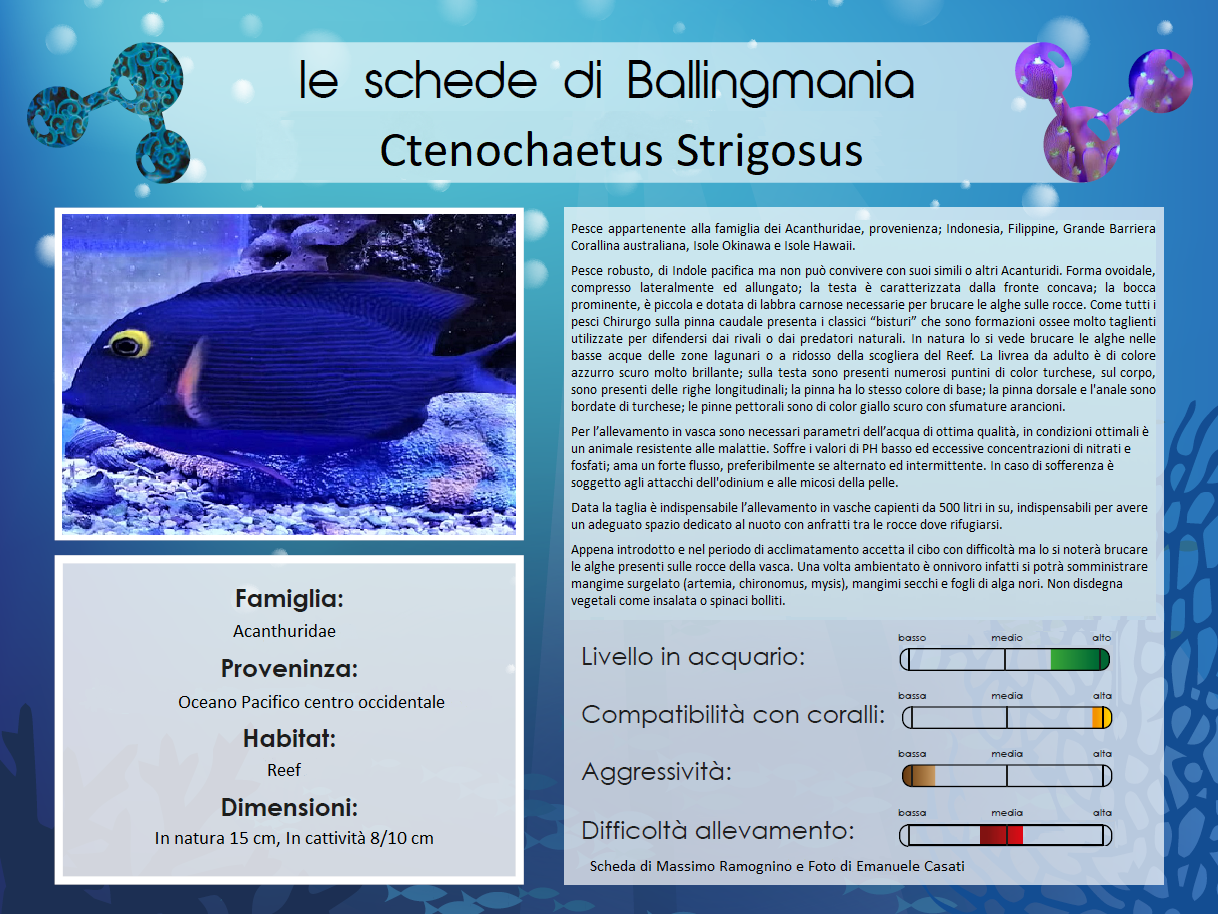
Ctenochaetus strigosus
Kole tang
The kole tang, or goldring surgeonfish, known in Italian as pesce chirurgo occhio giallo 6, is a surgeonfish (Acanthuridae) 1 that lives only in Hawaii and at Johnston Atoll and reaches about 15 cm. 2 It uses its comb-like teeth to gather detritus from the bottom. 2 Eating it is risky: it has been linked to cases of ciguatera. 2 7
At a glance
Data from the scientific sources listed at the bottom.
Depth in the wild
1–113 m
Size
up to 15.4 cm
maximum standard length, without the tail fin
Temperature in the wild
21–27 °C
Where it lives
Only the Hawaiian archipelago and Johnston Atoll; FishBase notes that records from other countries concern other species. 2 In the western Pacific, from the Ogasawara Islands and the Philippines to the Great Barrier Reef, New Caledonia, Samoa and the Marshall Islands, lives instead the similar Ctenochaetus cyanocheilus. 3 4 5
Conservation
IUCN Red List: least concern (2010). Red List data taken from FishBase. 2 It does not appear in the CITES lists checked on Species+. 12 It is the second most collected species for the aquarium hobby in West Hawai'i: 30,901 fish, 9.5% of the total, in fiscal year 2017. There, commercial aquarium collectors may take at most 5 fish over 10 cm per person per day. 10 Between 1999/2000 and 2017/2018 the number of fish grew by 85% in areas closed to collection and by 97% in open areas. 10 Long-term surveys, however, had found declines of 17% to 71% at four sites, not attributed with certainty to collection. 9 A 2025 State proposal sets a limit of 12,775 fish a year for that area. 11
How to recognise it
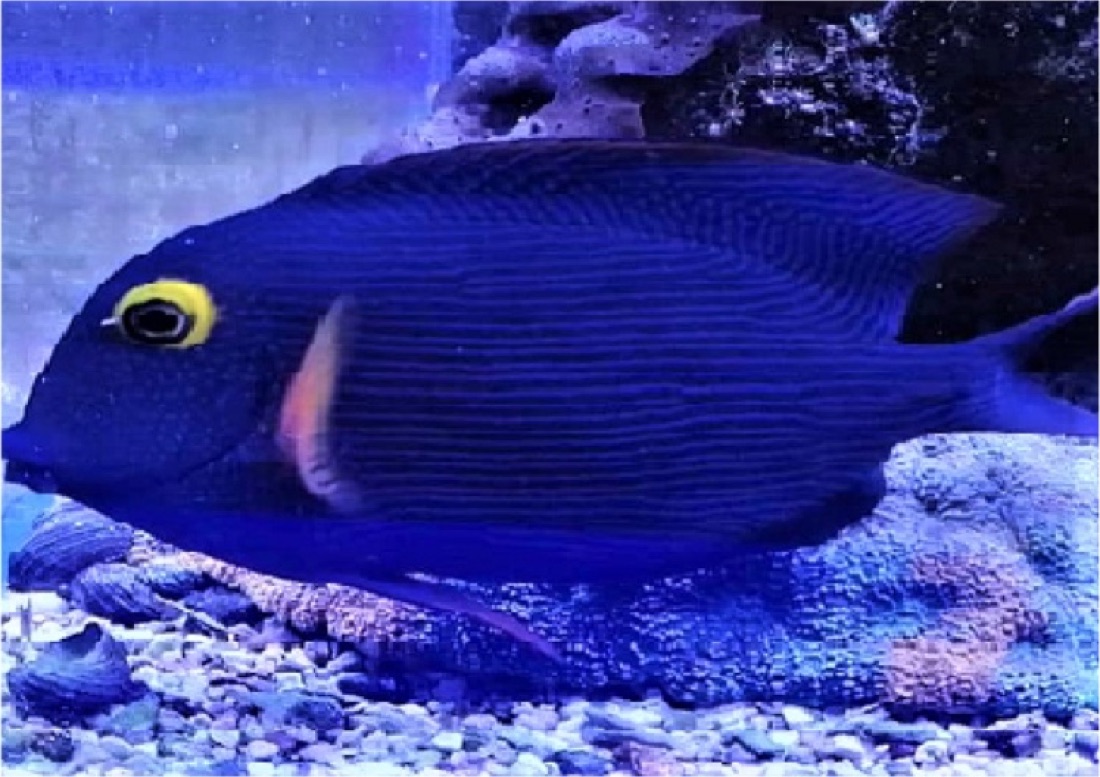
Tap a number on the photo: the key explains what to look for.
Life in the wild
In the aquarium
From the experience of the BallingMania community.
A fish belonging to the family Acanthuridae, origin: Indonesia, the Philippines, the Australian Great Barrier Reef, the Okinawa Islands and the Hawaiian Islands.
A hardy fish with a peaceful temperament, but it cannot live with others of its kind or other Acanthurids. Oval in shape, laterally compressed and elongated; the head is characterised by a concave forehead; the mouth is prominent, small and has fleshy lips needed to graze on algae on the rocks. Like all surgeonfish, on the caudal fin it has the classic "scalpels", which are very sharp bony structures used to defend itself from rivals or natural predators. In the wild it can be seen grazing on algae in the shallow waters of lagoon areas or close to the reef cliff. The adult livery is a very bright dark blue; on the head there are numerous turquoise dots, and on the body there are lengthwise lines; the fin has the same base colour; the dorsal and anal fins are edged with turquoise; the pectoral fins are dark yellow with orange shading.
To keep it in a tank, excellent water quality is needed; in optimal conditions it is an animal resistant to disease. It suffers from low pH and excessive concentrations of nitrate and phosphate; it loves a strong flow, preferably alternating and intermittent. When stressed it is prone to attacks of Oodinium and to fungal skin infections.
Given its size, it must be kept in large tanks from 500 litres upwards, essential to have adequate room for swimming with crevices among the rocks to take refuge in.
Once introduced and during acclimatisation it accepts food with difficulty, but it will be seen grazing on the algae on the rocks in the tank. Once settled in it is omnivorous: in fact it can be given frozen food (Artemia, chironomus, mysis), dry foods and sheets of Nori seaweed. It does not refuse vegetables such as lettuce or boiled spinach.
Species sheet by Massimo Ramognino and photo by Emanuele Casati
Did you know?
Sources
- WoRMS Editorial Board (2026). Ctenochaetus strigosus (Bennett, 1828). World Register of Marine Species.
- Froese R., Pauly D. (eds.) (2026). Ctenochaetus strigosus, Spotted surgeonfish. FishBase.
- Froese R., Pauly D. (eds.) (2026). Ctenochaetus cyanocheilus. FishBase.
- Reef Life Survey (2026). Ctenochaetus cyanocheilus. Reef Life Survey.
- WoRMS Editorial Board (2026). Ctenochaetus cyanocheilus Randall & Clements, 2001. World Register of Marine Species.
- GBIF Secretariat, da Catalogue of Life (2026). Ctenochaetus strigosus, nomi comuni. GBIF.
- Campbell B., Nakagawa L.K., Kobayashi M.N., Hokama Y. (1987). Gambierdiscus toxicus in gut content of the surgeonfish Ctenochaetus strigosus (herbivore) and its relationship to toxicity. Toxicon.
- Work T.M., Aeby G.S. (2014). Skin pathology in Hawaiian goldring surgeonfish, Ctenochaetus strigosus (Bennett). Journal of Fish Diseases.
- Walsh W.J. (2013). Background Paper on West Hawai'i Aquarium 'White List'. Hawai'i Division of Aquatic Resources.
- Hawai'i Department of Land and Natural Resources (2020). Findings and Recommendations of Effectiveness of the West Hawai'i Regional Fishery Management Area. State of Hawai'i.
- Hawai'i Division of Aquatic Resources (2025). Request for Approval to Hold Public Hearings on Draft Administrative Rules, Aquarium Fishery Management. State of Hawai'i.
- UNEP-WCMC, Segretariato CITES (2026). Search for Ctenochaetus strigosus in the CITES lists. Species+.
Sources checked on 5 November 2026. Community texts and ratings are kept separate from the scientific data.