At a glance
Data from the scientific sources listed at the bottom.
Depth in the wild
10–25 m
Size
up to 8.5 cm
maximum total length according to Fishes of Australia [4]; FishBase gives 15.2 cm (standard length) [2]; in Donaldson's study males averaged 4.8 cm and females 4.3 cm [5]
Temperature in the wild
24–28 °C
Where it lives
Indo-Pacific, from the Red Sea to East London in South Africa and east to the Marquesas, north to the Marianas and south to New Caledonia; eastern Pacific, from the Gulf of California to Colombia and the Galápagos. 2 In Australia it reaches as far as Sydney. 4 In Guam it is rare. 6
How to recognise it
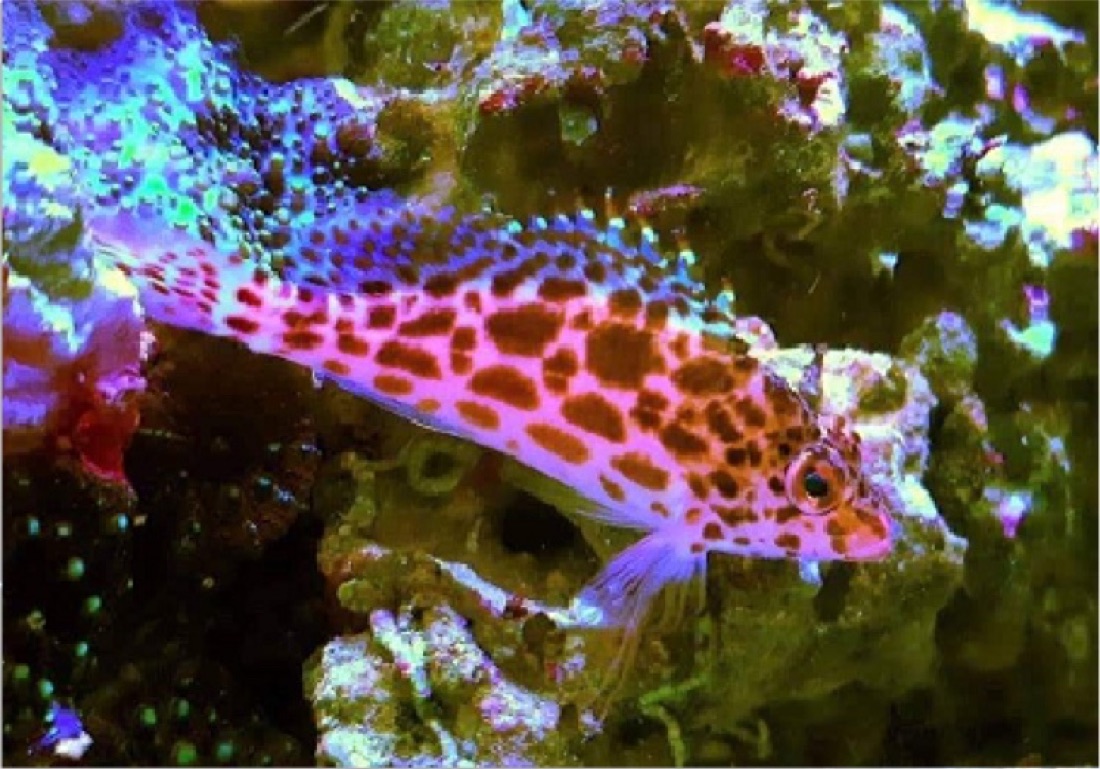
Tap a number on the photo: the key explains what to look for.
- 1Large spots on the body reddish brown, close together, in rows along the flanks 3 4
- 2Small spots on the head numerous and small 2 3
- 3Tufts on the dorsal fin cirri at the tips of the membranes between the spines 3
- 4Spotted tail spots on the tail fin too 4
- 5Pectoral fin lower rays unbranched and thickened 3 4
Life in the wild
Where it is found
Coral-rich areas in lagoons, channels and outer reefs, from 1 to 40 m. 2 4 It rests on, in or under hard and soft corals. 2 It occupies Pocillopora corals where other hawkfish are absent; at Cabo San Lucas, in Mexico, it was seen among the branches at 2-3 m. 6 Depending on the area it can also live away from corals. 5
What it eats
On Gorgona Island, in the eastern Pacific, crustaceans were the main prey (73% relative importance, present in 89% of stomachs): copepods were the most numerous and decapods the most important by weight; there were also small molluscs and fish. 7 FishBase confirms crustaceans and small fish. 2
Behaviour
Males defend a territory in which the females live. 2 5 Like other hawkfish it has no swim bladder and uses the thickened lower rays of its pectoral fins to stay still on the bottom where the water moves. 3 The edge of the preopercle, a cheek bone, is coarsely serrated; 3 4 FishBase classes it as harmless to humans. 2
Reproduction
It is probably a hermaphrodite that is born female and can become male. 4 It lives in small harems: at Nauru and Lizard Island one male with two females, in the Gulf of California up to seven. 5 Courtship begins towards sunset and spawning takes place in mid-water, 5 after a rise of 0.3-1 m. 2 In season it appears to spawn every day. 5
In the aquarium
From the experience of the BallingMania community.
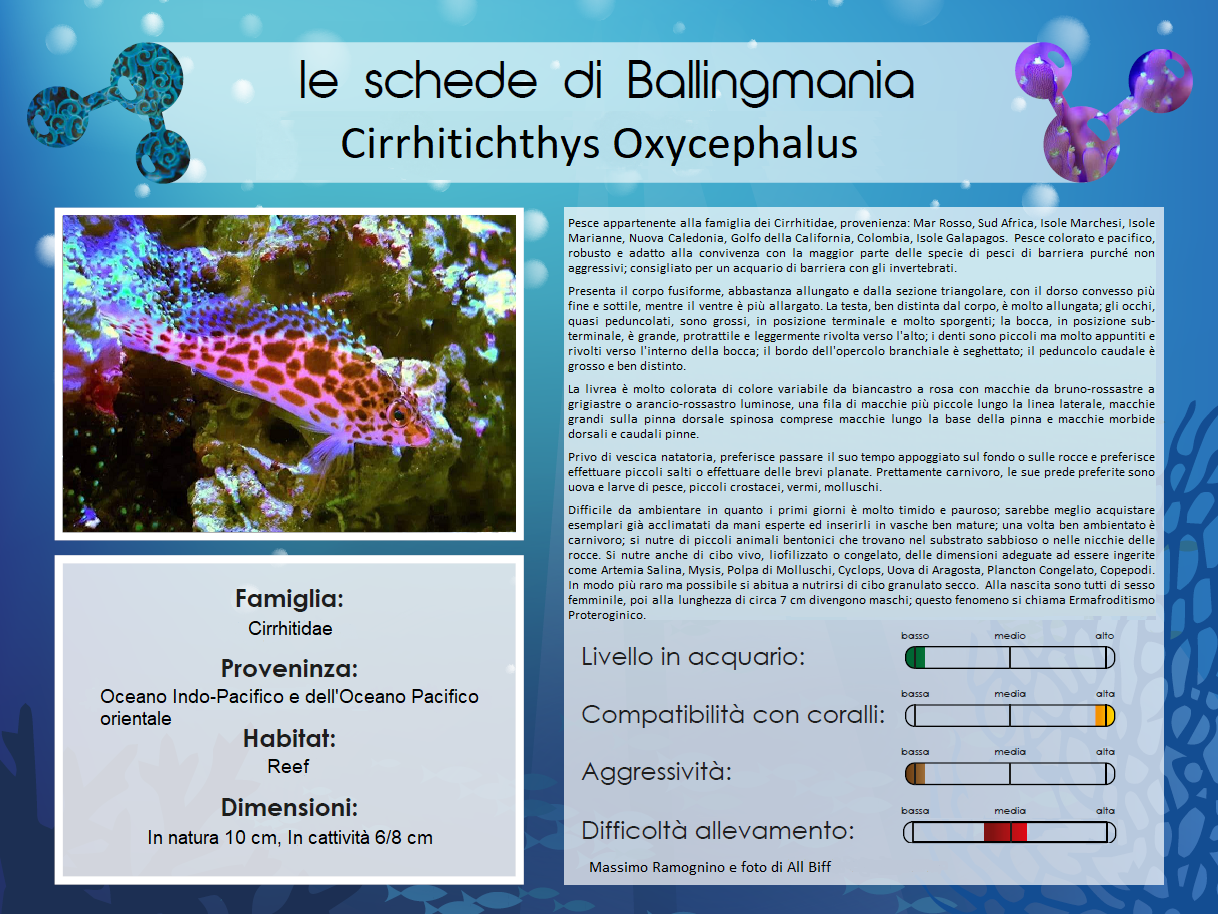
A fish belonging to the family Cirrhitidae, origin: the Red Sea, South Africa, the Marquesas Islands, the Mariana Islands, New Caledonia, the Gulf of California, Colombia and the Galápagos Islands. A colourful, peaceful and hardy fish, suitable for living with most reef fish species as long as they are not aggressive; recommended for a reef aquarium with invertebrates.
It has a spindle-shaped body, fairly elongated and triangular in cross-section, with a convex, narrower and thinner back, while the belly is wider. The head, clearly distinct from the body, is very elongated; the eyes, almost stalked, are large, at the tip and very protruding; the mouth, slightly below the tip, is large, protractile and turned slightly upwards; the teeth are small but very sharp and point towards the inside of the mouth; the edge of the gill cover is serrated; the caudal peduncle is thick and clearly distinct.
The livery is very colourful, varying from whitish to pink with reddish-brown to greyish or bright reddish-orange spots, a row of smaller spots along the lateral line, large spots on the spiny dorsal fin, including spots along the base of the fin, and spots on the soft dorsal and caudal fins.
Lacking a swim bladder, it prefers to spend its time resting on the bottom or on the rocks, and it prefers to make small hops or short glides. Strictly carnivorous, its favourite prey are fish eggs and larvae, small crustaceans, worms and molluscs.
Difficult to settle in, as in the first days it is very shy and fearful; it would be better to buy specimens already acclimatised by expert hands and introduce them into well-matured tanks; once well settled in it is carnivorous; it feeds on small bottom-dwelling animals found in the sandy substrate or in the niches of the rocks. It also feeds on live, freeze-dried or frozen food of a suitable size to be swallowed, such as brine shrimp, Mysis, mollusc flesh, Cyclops, lobster eggs, frozen plankton and copepods. More rarely, but possibly, it gets used to eating dry granular food. At birth they are all female, then at a length of about 7 cm they become males; this phenomenon is called protogynous hermaphroditism.
Massimo Ramognino and photo by All Biff
Did you know?
Sources
- WoRMS Editorial Board (2026). Cirrhitichthys oxycephalus (Bleeker, 1855). World Register of Marine Species.
- Froese R., Pauly D. (eds.) (2026). Cirrhitichthys oxycephalus, Coral hawkfish. FishBase.
- Randall J.E., in Carpenter K.E., Niem V.H. (eds.) (2001). Cirrhitidae. The living marine resources of the Western Central Pacific, vol. 5. FAO.
- Bray D.J. (2025). Spotted Hawkfish, Cirrhitichthys oxycephalus, in Fishes of Australia. Museums Victoria.
- Donaldson T.J. (1990). Reproductive Behavior and Social Organization of Some Pacific Hawkfishes (Cirrhitidae). Japanese Journal of Ichthyology.
- Donaldson T.J., Myers R.F. (1988). First record of the hawkfish Cirrhitichthys oxycephalus from Guam, Mariana Islands. Micronesica.
- Palacios-Narváez S., Valencia B., Giraldo A. (2020). Diet of the coral hawkfish Cirrhitichthys oxycephalus (Family: Cirrhitidae) in a fringing coral reef of the Eastern Tropical Pacific. Coral Reefs.
- GBIF Secretariat (2026). Cirrhitichthys oxycephalus, common names and IUCN Red List category. GBIF.
- UNEP-WCMC (2026). Search for Cirrhitichthys oxycephalus in the CITES lists. Species+.
Sources checked on 5 November 2026. Community texts and ratings are kept separate from the scientific data.