
Chrysiptera parasema
Yellowtail damselfish
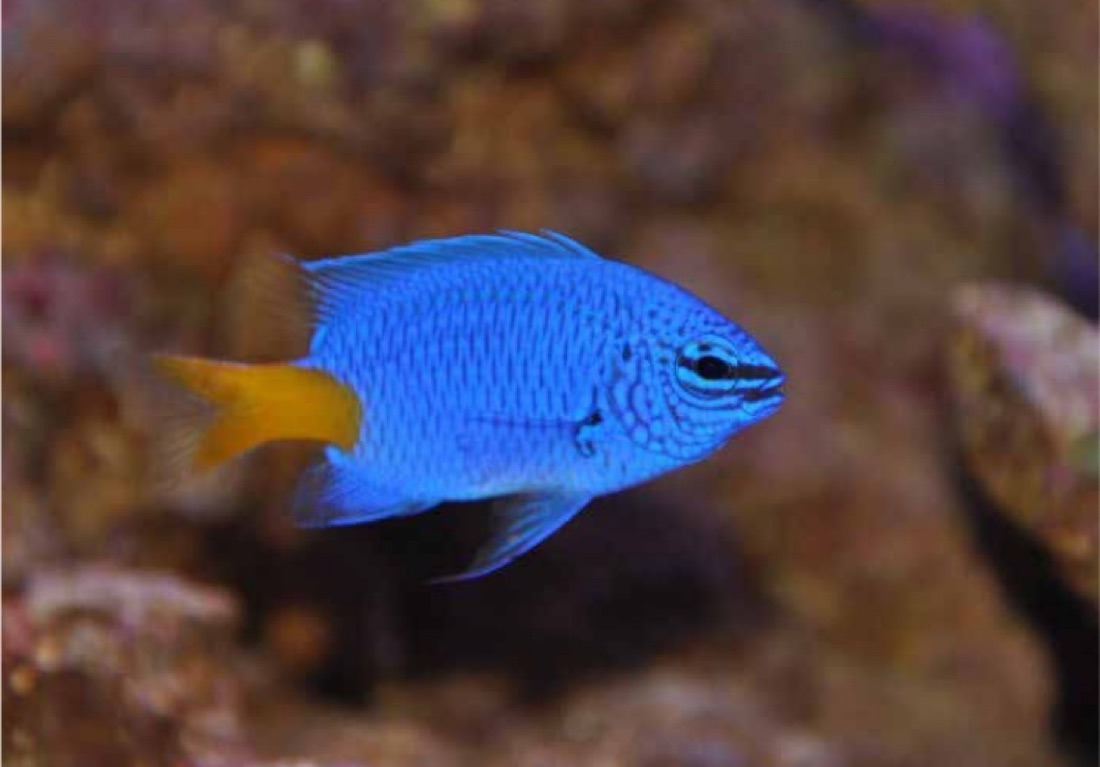
A small blue damselfish whose yellow rear part reaches the tail, at most 7 cm long, recorded in Italian as damigella coda dorata. 1 3 11 It lives in small groups on Acropora corals in sheltered lagoons of the western Pacific. 2 It is among the marine fish most imported for aquariums and has been bred in captivity. 5 9
At a glance
Data from the scientific sources listed at the bottom.
Depth in the wild
1–16 m
Size
up to 7 cm
maximum total length (males or unsexed specimens)
Conservation
IUCN Red List: least concern (2021). Red List data taken from FishBase and from the review of the European trade, which reports a declining population. 2 10 It does not appear in the CITES lists checked on Species+. 12 About 254,000 specimens were imported into the European Union between 2014 and 2021, with yearly quantities falling sharply: from 68,649 in 2014 to 2,374 in 2021. 10
Where it lives
Western Pacific, including the Solomon Islands, northern Papua New Guinea, the Philippines and the Ryukyu Islands. There is a doubtful record from the Great Barrier Reef off Cairns. 2
How to recognise it
Tap a number on the photo: the key explains what to look for.
Life in the wild
Where it is found
Coral-rich areas in sheltered lagoons and reefs close to the coast. 2 At Okinawa it was found only on inner reefs, tied to various branching and corymbose forms of Acropora. 7 At Kimbe Bay (Papua New Guinea) it lives between 6 and 15 m, and in an experiment depth did not affect the growth and survival of newly settled juveniles. 6
What it eats
FishBase lists it among zooplankton feeders, without stating the exact prey. 4
In the aquarium
From the experience of the BallingMania community.
The yellowtail damselfish is a community fish; it adapts to any situation and is suitable for beginner aquarists. It prefers to live in a community with at least 4 other specimens; as in the wild, it is a fish that lives among corals, especially SPS, where it also finds shelter at night. It is an omnivorous fish and gets used to dry food easily; once placed in the aquarium it needs a couple of days to settle. Given its temperament and size, it should always be introduced first. Compared with other species, it is one of the few marine fish that can be bred in captivity today.
Photo by: Lubomír Klátil
What studies say about keeping it
Data from an aquaculture study, not advice for a home aquarium. In the first successful breeding, in 80-litre tanks, the pairs began spawning after 3 months. At 28 °C the eggs hatched after 96 hours, in the first 2 hours of darkness. A first food enriched with polyunsaturated fatty acids and continuous light for 24 hours proved essential for larval survival. 5
Did you know?
Sources
- WoRMS Editorial Board (2026). Chrysiptera parasema (Fowler, 1918). World Register of Marine Species.
- Froese R., Pauly D. (eds.) (2026). Chrysiptera parasema, Goldtail demoiselle. FishBase.
- Froese R., Pauly D. (eds.) (2026). Chrysiptera parasema, field guide entry. FishBase.
- Froese R., Pauly D. (eds.) (2026). Food items reported for Chrysiptera parasema. FishBase.
- Olivotto I., Cardinali M., Barbaresi L., Maradonna F., Carnevali O. (2003). Coral reef fish breeding: the secrets of each species. Aquaculture.
- Srinivasan M. (2003). Depth distributions of coral reef fishes: the influence of microhabitat structure, settlement, and post-settlement processes. Oecologia.
- Nanami A. (2025). Broad-scale spatial distribution, microhabitat association and habitat partitioning of damselfishes (family Pomacentridae) on an Okinawan coral reef. PeerJ.
- Hanson K.A., Mauland B.A., Shastri A., Wisenden B.D. (2024). Yellowtail damselfish Chrysiptera parasema can associate predation risk with the acoustic call of a heterospecific damselfish following pairing with conspecific alarm cues. Journal of Fish Biology.
- Rhyne A.L., Tlusty M.F., Szczebak J.T., Holmberg R.J. (2017). Expanding our understanding of the trade in marine aquarium animals. PeerJ.
- Biondo M.V., Burki R.P., Aguayo F., Calado R. (2024). An Updated Review of the Marine Ornamental Fish Trade in the European Union. Animals.
- GBIF Secretariat (2026). Chrysiptera parasema, nomi comuni. GBIF.
- UNEP-WCMC (2026). Search for Chrysiptera parasema in the CITES lists. Species+.
Sources checked on 5 November 2026. Community texts and ratings are kept separate from the scientific data.