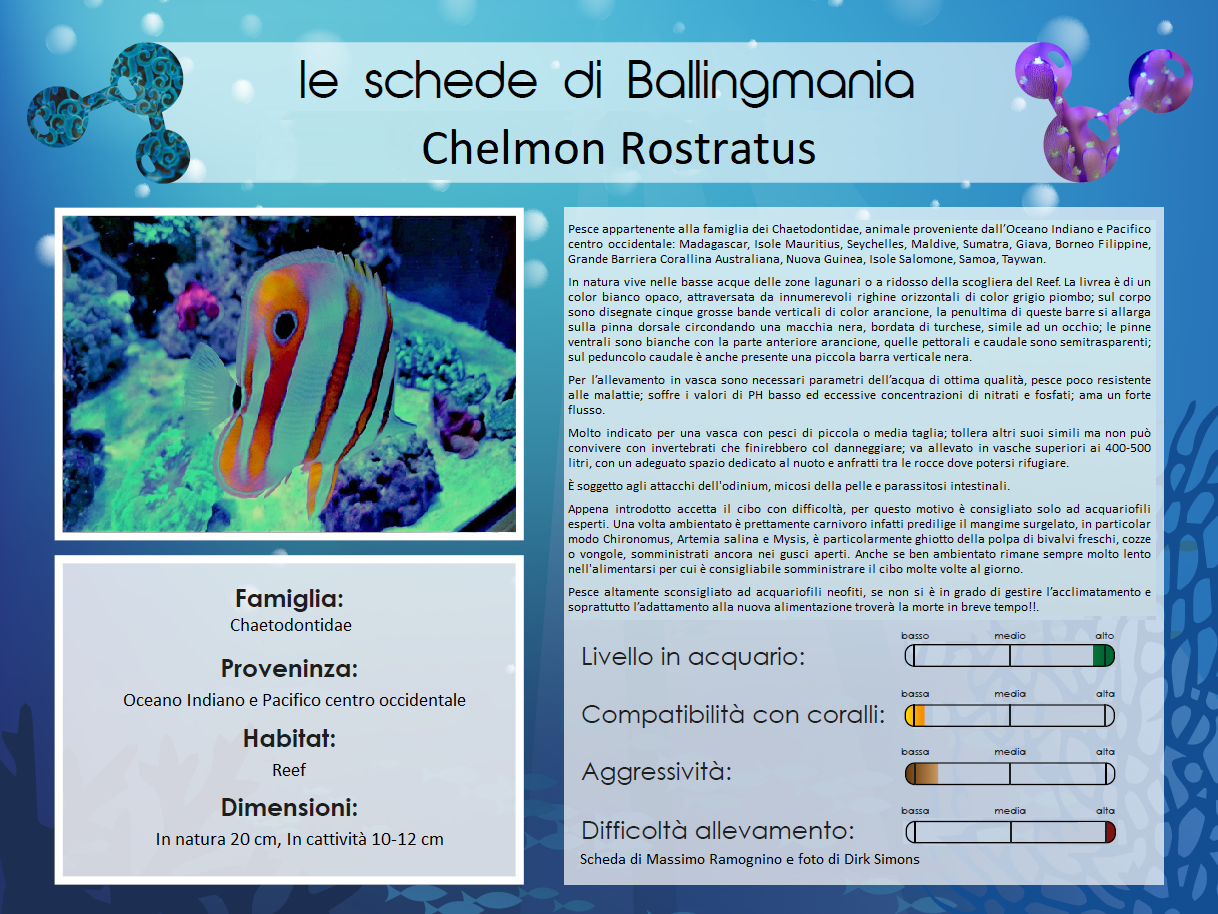
Chelmon rostratus
Copperband butterflyfish
The copperband butterflyfish, known in Italian as pesce farfalla dal rostro 6, is a western Pacific butterflyfish (Chaetodontidae) 1 with a beak-like elongated snout. 2 5 It has orange bars on the body and a false eyespot on the dorsal fin. 5 It lives on rocky coasts and shallow coral reefs, also in bays and estuaries. 2 5
At a glance
Data from the scientific sources listed at the bottom.
Depth in the wild
1–25 m
Size
up to 20 cm
maximum total length
Conservation
IUCN Red List: least concern (2009). Red List data taken from FishBase and GBIF. 2 6 It does not appear in the CITES lists checked on Species+. 7 It is of minor importance to fisheries and is often exported for the aquarium trade. 2 4
Where it lives
From the Andaman Sea through the Indo-Malay region to southern Japan and Australia. 2 4 In Australia it is recorded from Exmouth Gulf and the northern Great Barrier Reef to Botany Bay, near Sydney. 5
How to recognise it
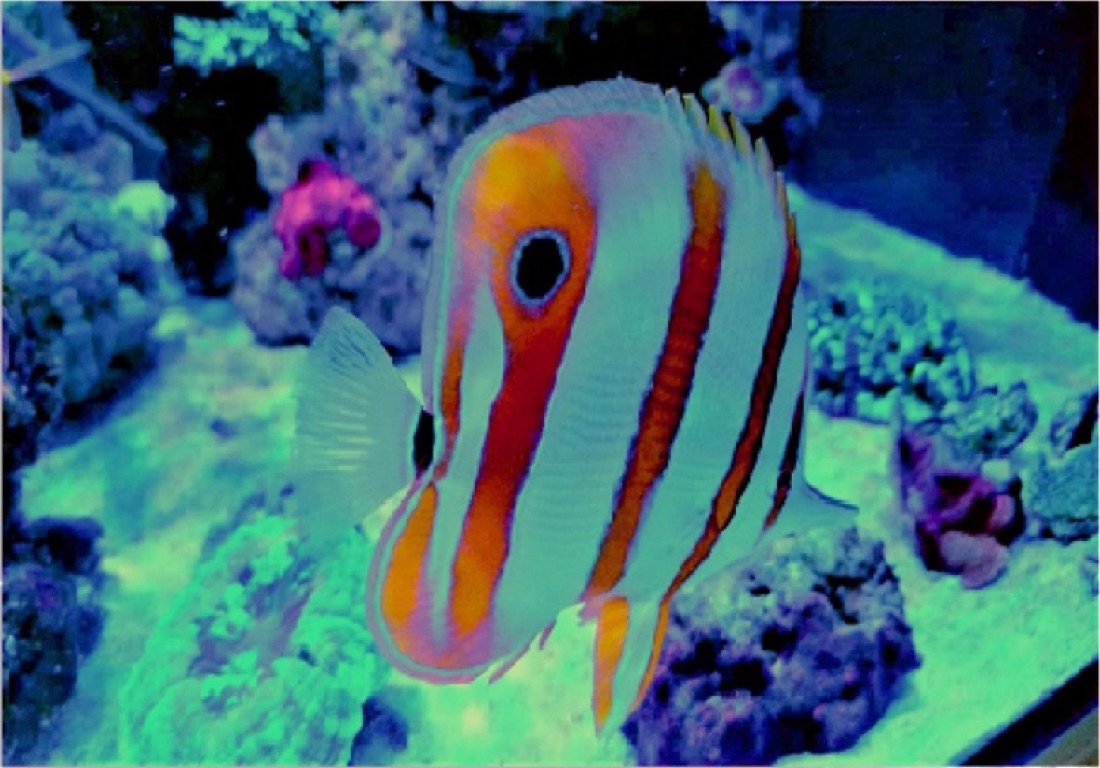
Tap a number on the photo: the key explains what to look for.
Life in the wild
In the aquarium
From the experience of the BallingMania community.
A fish belonging to the family Chaetodontidae, an animal coming from the Indian Ocean and the central-western Pacific: Madagascar, Mauritius, the Seychelles, the Maldives, Sumatra, Java, Borneo, the Philippines, the Australian Great Barrier Reef, New Guinea, the Solomon Islands, Samoa and Taiwan.
In the wild it lives in the shallow waters of lagoon areas or close to the reef cliff. The livery is a matt white, crossed by countless thin horizontal lead-grey lines; on the body there are five large vertical orange bands; the second-to-last of these bars widens onto the dorsal fin, surrounding a black spot edged with turquoise that looks like an eye; the pelvic fins are white with an orange front part, while the pectoral and caudal fins are semi-transparent; on the caudal peduncle there is also a small black vertical bar.
To keep it in a tank, excellent water quality is needed; not a very hardy fish
Species sheet by Massimo Ramognino and photo by Dirk Simons
Did you know?
Sources
- WoRMS Editorial Board (2026). Chelmon rostratus (Linnaeus, 1758). World Register of Marine Species.
- Froese R., Pauly D. (eds.) (2026). Chelmon rostratus, Copperband butterflyfish. FishBase.
- Pyle R., in Carpenter K.E., Niem V.H. (eds.) (2001). Chaetodontidae. The living marine resources of the Western Central Pacific, vol. 5. FAO.
- Pyle R., in Carpenter K.E., Niem V.H. (eds.) (2001). Chelmon rostratus. The living marine resources of the Western Central Pacific, vol. 5. FAO.
- Bray D.J. (2020). Chelmon rostratus, in Fishes of Australia. Museums Victoria.
- GBIF Secretariat (2026). Chelmon rostratus, common names and IUCN Red List category. GBIF.
- UNEP-WCMC (2026). Search for Chelmon rostratus in the CITES lists. Species+.
- Ferry-Graham L.A., Wainwright P.C., Bellwood D.R. (2001). Prey capture in long-jawed butterflyfishes (Chaetodontidae): the functional basis of novel feeding habits. Journal of Experimental Marine Biology and Ecology.
Sources checked on 5 November 2026. Community texts and ratings are kept separate from the scientific data.