
Chiloscyllium punctatum
Brownbanded bamboo shark
The brownbanded bamboo shark, known in Italian as squalo bambù fasciato 5, is a small bottom-dwelling shark of the family Hemiscylliidae 1, common along the coasts of the western Indo-Pacific. 2 3 Juveniles have striking dark bands, which usually disappear in adults. 3 It lays eggs and breeds in captivity; it is kept in many public aquariums. 3
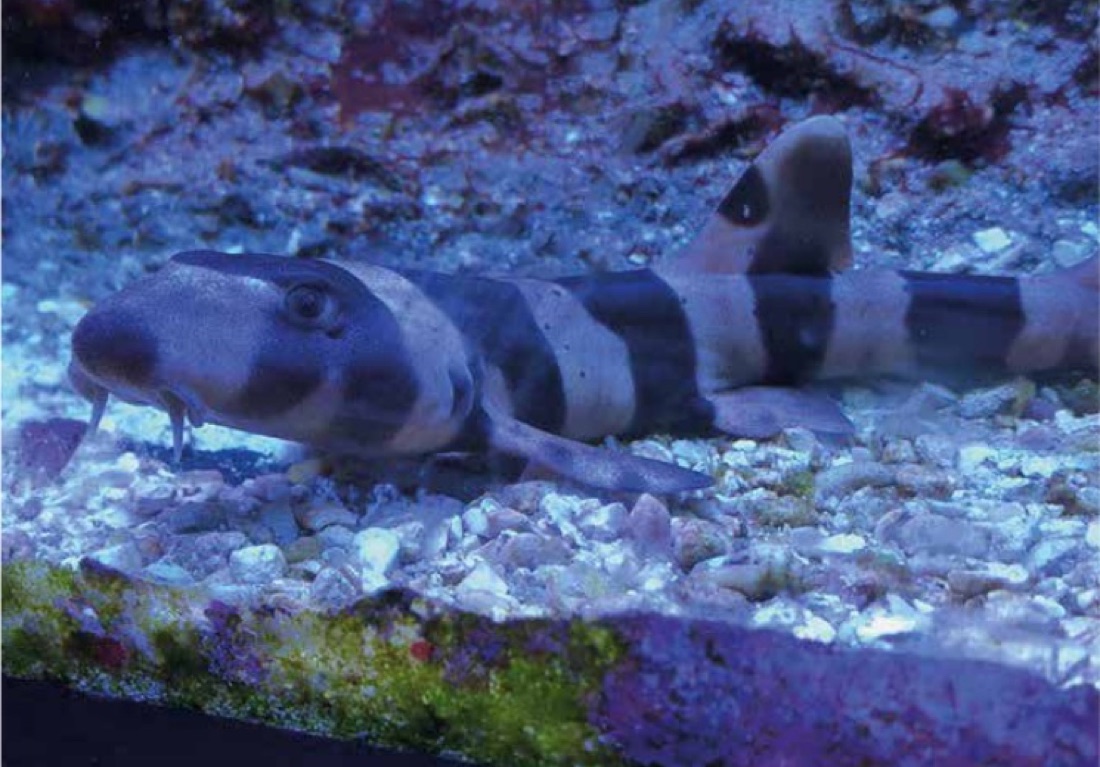
At a glance
Data from the scientific sources listed at the bottom.
Depth in the wild
0–85 m
Size
up to 105 cm
maximum total length according to FAO; the other sources are given in the curiosities
Temperature in the wild
19.8–31.8 °C
Where it lives
Western Indo-Pacific: the east coast of India and the Andaman Islands, Malaysia, Singapore, Thailand, Indonesia, Vietnam, China, Taiwan, Japan, the Philippines, the south coast of New Guinea and northern Australia. 2 3
Conservation
IUCN Red List: near threatened (2023). Red List data taken from FishBase and GBIF. 2 6 It does not appear in the CITES lists checked on Species+. 7 It is the shark most caught by commercial coastal fisheries in South-East Asia. 8 A study in Malaysia found genetically separate populations between the main areas examined and warns that, because of heavy fishing pressure, it could move to Vulnerable in South-East Asia. 12
How to recognise it
Tap a number on the photo: the key explains what to look for.
Life in the wild
In the aquarium
From the experience of the BallingMania community.
A shark of the family Hemiscylliidae commonly known as the “Bamboo Shark”, with barbels that look very much like whiskers.
It is the shark best suited to aquarium life, although as an adult it exceeds 1 metre in length; so, for obvious reasons, except in the juvenile phase, when it can be kept in home aquariums of no less than 500/600 litres anyway, it needs very large tanks in proportion to its size, fitted with equipment able to handle its organic load. Specimens only a few days old can be found on the market, as well as the shark's eggs themselves, which, once hatched, give the onlooker a wonderful sight and experience. At birth it measures 10 to 15 cm; in the juvenile phase it can live with other fish, always of a size in proportion to its own; it is mainly active at night, and during the day it prefers to stay sheltered among the rocks.
Very difficult to settle in; in the first days of life it is particularly hard to feed and to wean onto dead food. Once this difficult hurdle is overcome it is a particularly greedy fish, like all sharks; it feeds mainly on frozen food and fresh fish, and vitamin and iodine supplements are also advisable to prevent deficiencies. Not very resistant to disease in the early phase and very prone to bacterial and skin infections, so it is not recommended for beginners and is advised only for experienced aquarists.
photo by: Salvatore Riccardo
What studies say about keeping it
Data from public aquariums, not advice for a home aquarium. FAO reports that it is displayed in many public aquariums in Australia, Canada, Mexico, Europe and the United States and that it breeds in captivity. 3 At the Osaka Aquarium Kaiyukan, in the largest tank, 10 adult males and 11 adult females were living in August 2017. The females laid eggs continuously, but about half of the eggs were eaten by other fish; 10-50 were collected a month and about a third did not develop normally. 10
Did you know?
Sources
- Froese R., Pauly D. (eds.), via WoRMS (2026). Chiloscyllium punctatum Müller & Henle, 1838. World Register of Marine Species.
- Froese R., Pauly D. (eds.) (2026). Chiloscyllium punctatum, Brownbanded bambooshark. FishBase.
- Compagno L.J.V. (2001). Sharks of the World. Vol. 2: Bullhead, mackerel and carpet sharks. FAO.
- Reef Life Survey (2026). Chiloscyllium punctatum, Grey Carpetshark. Reef Life Survey.
- GBIF Secretariat (2026). Chiloscyllium punctatum, nomi comuni. GBIF.
- GBIF Secretariat (2026). Chiloscyllium punctatum, IUCN Red List category. GBIF.
- UNEP-WCMC (2026). Search for Chiloscyllium punctatum in the CITES lists. Species+.
- Fahmi, Kurniawan W., Tibbetts I.R., Oktaviyani S., Dudgeon C.L., Bennett M.B. (2021). Age and growth of the tropical oviparous shark, Chiloscyllium punctatum in Indonesian waters. Journal of Fish Biology.
- Fahmi, Tibbetts I.R., Bennett M.B., Dudgeon C.L. (2021). Delimiting cryptic species within the brown-banded bamboo shark, Chiloscyllium punctatum in the Indo-Australian region with mitochondrial DNA and genome-wide SNP approaches. BMC Ecology and Evolution.
- Onimaru K., Motone F., Kiyatake I., Nishida K., Kuraku S. (2018). A staging table for the embryonic development of the brownbanded bamboo shark (Chiloscyllium punctatum). Developmental Dynamics.
- Bernal M.A., Sinai N.L., Rocha C., Gaither M.R., Dunker F., Rocha L.A. (2015). Long-term sperm storage in the brownbanded bamboo shark Chiloscyllium punctatum. Journal of Fish Biology.
- Lim K.C., Then A.Y., Wee A.K.S., Sade A., Rumpet R., Loh K.H. (2021). Brown banded bamboo shark (Chiloscyllium punctatum) shows high genetic diversity and differentiation in Malaysian waters. Scientific Reports.
Sources checked on 5 November 2026. Community texts and ratings are kept separate from the scientific data.