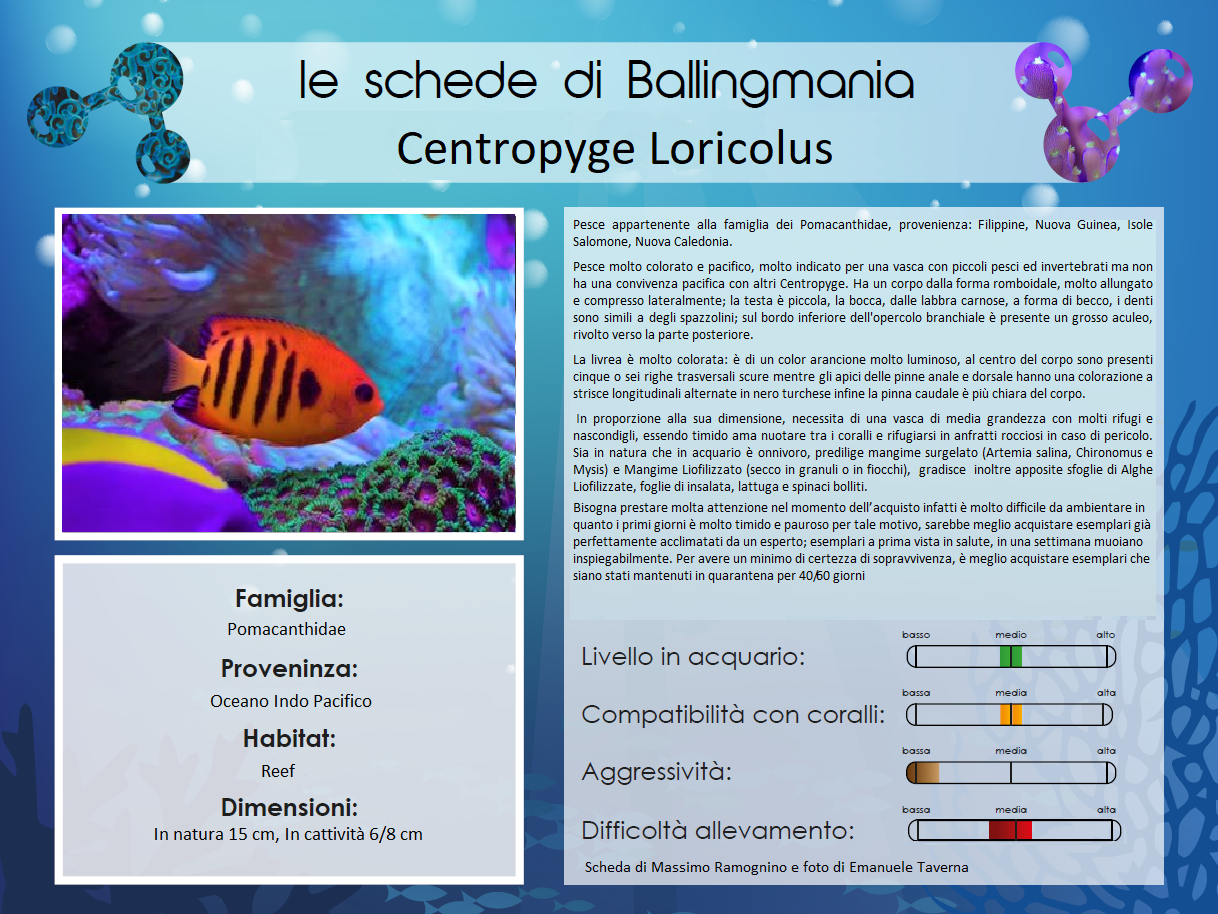
Centropyge loricolus
Currently accepted name: Centropyge loriculus
Centropyge loriculus is a small angelfish (Pomacanthidae) 1 from the tropical Pacific, up to 15 cm long. 2 It is bright orange with black bars on the flanks. 3 4 It lives close to shelter, in clear lagoons and on the outer side of reefs, in harems of 3-7 individuals. 2
At a glance
Data from the scientific sources listed at the bottom.
Depth in the wild
15–60 m
Size
up to 15 cm
maximum total length
Temperature in the wild
23–29.8 °C
Where it lives
Pacific, mainly in tropical waters. 2 Fishes of Australia gives it for the western and central parts of the ocean; in Australia it is found on the northern Great Barrier Reef and on the reefs of the Coral Sea. The species was described from specimens from the Society Islands, in French Polynesia. 4
How to recognise it
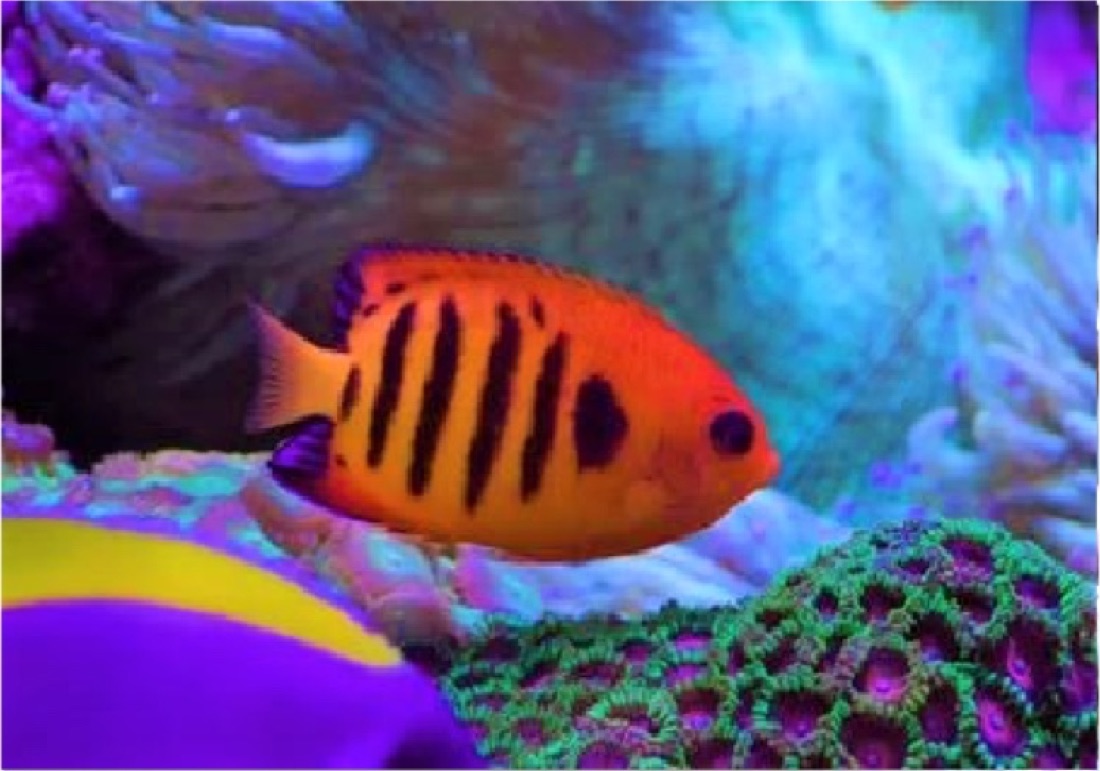
Tap a number on the photo: the key explains what to look for.
- 1Orange body very bright 3 4
- 2Black spot large and elongated, behind the base of the pectoral fin 4
- 3Black bars Reef Life Survey counts five on the body 3 4
- 4Stripes on the dorsal fin purplish blue and black on the rear part, more marked in males 4
- 5Stripes on the anal fin the same pattern as the rear of the dorsal fin 3 4
Life in the wild
In the aquarium
From the experience of the BallingMania community.
A fish belonging to the family Pomacanthidae, origin: the Philippines, New Guinea, the Solomon Islands and New Caledonia.
A very colourful and peaceful fish, very well suited to a tank with small fish and invertebrates, but it does not live peacefully with other Centropyge. It has a rhomboid body, very elongated and laterally compressed; the head is small, the mouth beak-shaped with fleshy lips, and the teeth look like little brushes; on the lower edge of the gill cover there is a large spine pointing towards the rear.
The livery is very colourful: it is a very bright orange; in the middle of the body there are five or six dark vertical lines, while the tips of the anal and dorsal fins have lengthwise stripes alternating in black and turquoise; finally, the caudal fin is paler than the body.
In proportion to its size, it needs a medium-sized tank with plenty of shelters and hiding places; being shy, it loves swimming among the corals and taking refuge in rocky crevices when in danger. Both in the wild and in the aquarium it is omnivorous; it prefers frozen food (brine shrimp, Chironomus and Mysis) and freeze-dried food (dry, in granules or flakes), and it also likes the special sheets of freeze-dried algae, lettuce leaves, lettuce and boiled spinach.
Great care is needed when buying it: in fact it is very difficult to settle in, as in the first days it is very shy and fearful; for this reason it would be better to buy specimens already perfectly acclimatised by an expert; specimens that look healthy at first sight die inexplicably within a week. To have at least some certainty of survival, it is better to buy specimens that have been kept in quarantine for 40-60 days
Species sheet by Massimo Ramognino and photo by Emanuele Taverna
What studies say about keeping it
FishBase reports that the species has been bred in captivity. 2
Did you know?
Sources
- WoRMS Editorial Board (2026). Centropyge loriculus (Günther, 1874). World Register of Marine Species.
- Froese R., Pauly D. (eds.) (2026). Centropyge loriculus, Flame angel. FishBase.
- Reef Life Survey (2026). Centropyge loricula. Reef Life Survey.
- Bray D.J. (2022). Centropyge loriculus. Fishes of Australia, Museums Victoria.
- GBIF Secretariat (2026). Centropyge loriculus, IUCN Red List category. GBIF.
- UNEP-WCMC, Segretariato CITES (2026). Search for Centropyge loriculus in the CITES lists. Species+.
Sources checked on 5 November 2026. Community texts and ratings are kept separate from the scientific data.