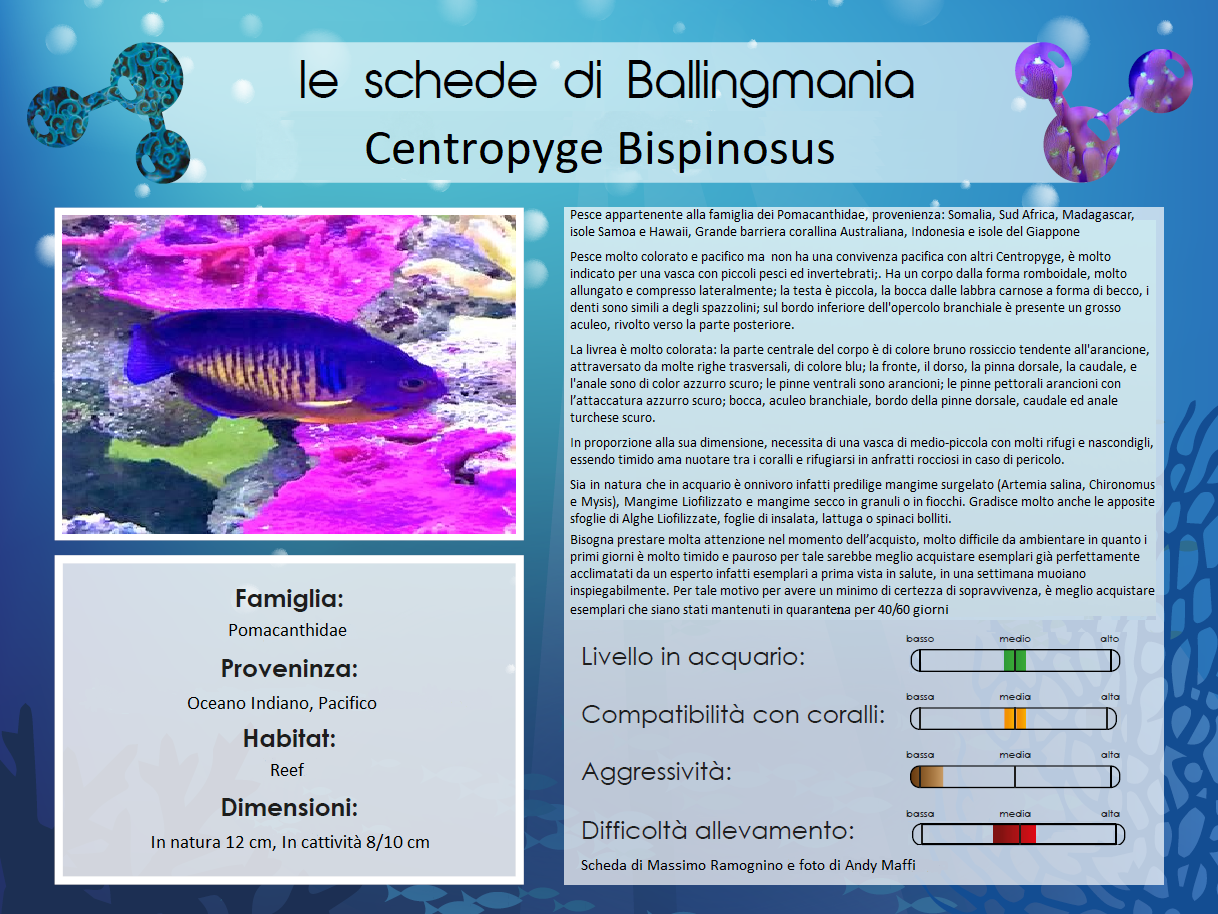
Centropyge bispinosus
Currently accepted name: Centropyge bispinosa
Centropyge bispinosa is a small Indo-Pacific angelfish (Pomacanthidae) 1, just over 11 cm long. 2 It is dark purplish blue with irregular orange bars on the flanks 4 and lives hidden in reef crevices, often in small harems. 2 3
At a glance
Data from the scientific sources listed at the bottom.
Depth in the wild
3–60 m
Size
up to 11.5 cm
maximum total length according to FishBase; Reef Life Survey gives 10 cm
Temperature in the wild
22.3–30.4 °C
Where it lives
From East Africa to the Tuamotu Islands; to the north it reaches the Izu Islands, in Japan, to the south Lord Howe. FishBase notes that it is absent from the Red Sea, Hawaii and the South Pacific. 2 In Australia it is recorded from the Rowley Shoals and Scott Reef to Bass Point, in New South Wales, and also at Christmas Island. 4
How to recognise it
Tap a number on the photo: the key explains what to look for.
Life in the wild
Where it is found
Lagoons and outer reef slopes, where corals grow in abundance. 2 4 In Reef Life Survey counts it was seen between 3 and 60 m and between 22.3 and 30.4 °C; FishBase gives 0-60 m. 3 2 At Lizard Island, on the Great Barrier Reef, it was most abundant on four headlands and the substrate used was dead branching coral covered with algae. 7
What it eats
FishBase lists it as an algae eater. 2
Reproduction
It forms harems of 3-7 individuals. 2 The small angelfish of this group are hermaphrodites and can change from female to male during their lives. 4 In a study with captive broodstock, at 26 °C, the eggs were transparent, spherical and buoyant, with an average diameter of about 0.63 mm; the larvae began hatching after thirteen and a half hours and the mouth opened about 96 hours after hatching. 6
In the aquarium
From the experience of the BallingMania community.
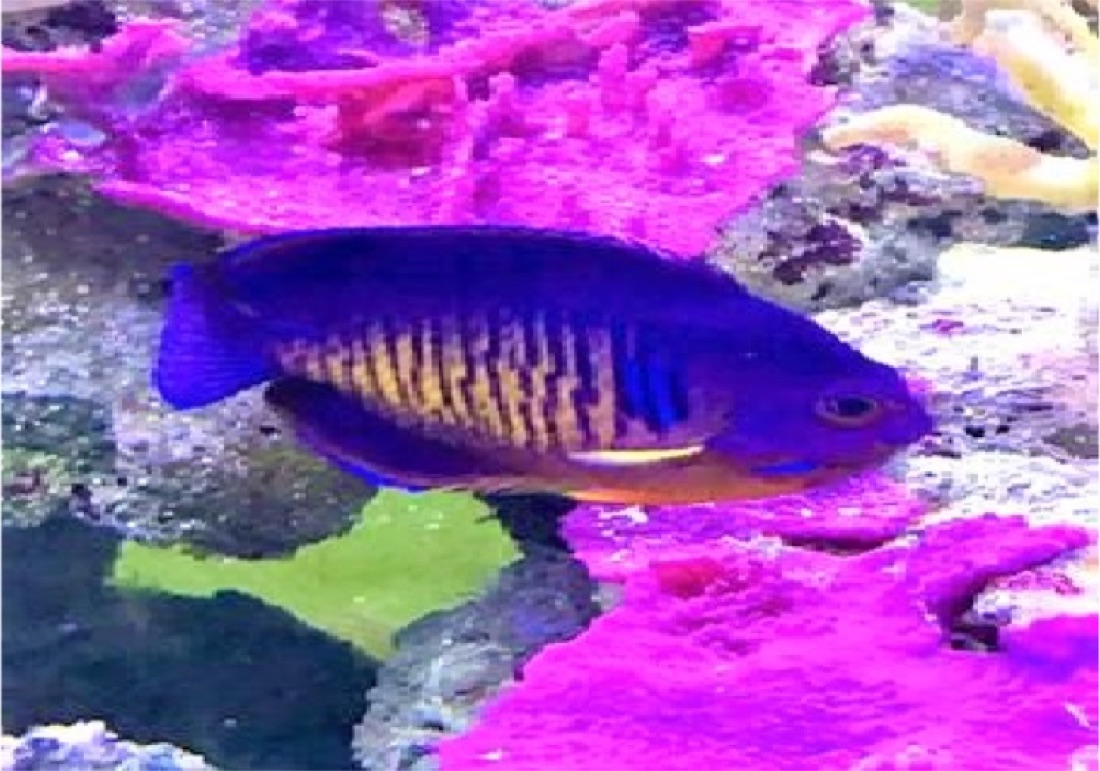
A fish belonging to the family Pomacanthidae, origin: Somalia, South Africa, Madagascar, the Samoa Islands and Hawaii, the Australian Great Barrier Reef, Indonesia and the islands of Japan. A very colourful and peaceful fish, but it does not live peacefully with other Centropyge; it is very well suited to a tank with small fish and invertebrates. It has a rhomboid body, very elongated and laterally compressed; the head is small, the mouth beak-shaped with fleshy lips, and the teeth look like little brushes; on the lower edge of the gill cover there is a large spine pointing towards the rear.
The livery is very colourful: the central part of the body is reddish brown tending to orange, crossed by many blue vertical lines; the forehead, back, dorsal, caudal and anal fins are dark blue; the pelvic fins are orange; the pectoral fins are orange with a dark blue base; the mouth, gill spine and the edges of the dorsal, caudal and anal fins are dark turquoise.
In proportion to its size, it needs a small-to-medium tank with plenty of shelters and hiding places; being shy, it loves swimming among the corals and taking refuge in rocky crevices when in danger.
Both in the wild and in the aquarium it is omnivorous: in fact it prefers frozen food (brine shrimp, Chironomus and Mysis), freeze-dried food and dry food in granules or flakes. It is also very fond of the special sheets of freeze-dried algae, lettuce leaves, lettuce or boiled spinach.
Great care is needed when buying it: it is very difficult to settle in, as in the first days it is very shy and fearful; for this reason it would be better to buy specimens already perfectly acclimatised by an expert; in fact specimens that look healthy at first sight die inexplicably within a week. For this reason, to have at least some certainty of survival, it is better to buy specimens that have been kept in quarantine for 40/60 days
Species sheet by Massimo Ramognino and photo by Andy Maffi
What studies say about keeping it
A study obtained eggs from spontaneous spawnings of captive broodstock and described their early stages of development. 6
Did you know?
Sources
- WoRMS Editorial Board (2026). Centropyge bispinosa (Günther, 1860). World Register of Marine Species.
- Froese R., Pauly D. (eds.) (2026). Centropyge bispinosa, Twospined angelfish. FishBase.
- Reef Life Survey (2026). Centropyge bispinosa. Reef Life Survey.
- Bray D.J. (2026). Centropyge bispinosa. Fishes of Australia, Museums Victoria.
- Lowe J.R., Payet S.D., Harrison H.B. et al. (2021). Regional versus latitudinal variation in the life-history traits and demographic rates of a reef fish, Centropyge bispinosa, in the Coral Sea and Great Barrier Reef Marine Parks, Australia. Journal of Fish Biology.
- Mendonça R.C., Chen J.Y., Zeng C., Tsuzuki M.Y. (2020). Embryonic and early larval development of two marine angelfish, Centropyge bicolor and Centropyge bispinosa. Zygote.
- Eagle J.V., Jones G.P., McCormick M.I. (2001). A multi-scale study of the relationships between habitat use and the distribution and abundance patterns of three coral reef angelfishes (Pomacanthidae). Marine Ecology Progress Series.
- UNEP-WCMC, Segretariato CITES (2026). Search for Centropyge bispinosa in the CITES lists. Species+.
Sources checked on 5 November 2026. Community texts and ratings are kept separate from the scientific data.