Apolemichthys xanthopunctatus
Goldflake angelfish
The goldflake angelfish, known in Italian as pesce angelo in scaglie 5, is a central Pacific angelfish 1 with a yellow spot on every scale and black fins edged with blue. 2 3 It lives on outer slopes and reef walls, where it eats sponges and tunicates. 2 3
At a glance
Data from the scientific sources listed at the bottom.
Depth in the wild
10–65 m
Size
up to 25 cm
maximum total length [2] [3]
Conservation
IUCN Red List: least concern (2009). Red List data taken from FishBase and GBIF. 2 5 It does not appear in the CITES lists checked on Species+. 6 It is exported only now and then for the aquarium trade. 2 3
Where it lives
From the Gilbert Islands to the Line Islands, with records from Kapingamarangi, Nauru, Canton, Howland, Baker and Fanning. 2 3 The Catalog of Fishes adds Micronesia and the northern Cook Islands. 4 Nausicaá also mentions Fiji, Tonga, Samoa and Hawaii, not confirmed by the other sources. 7
How to recognise it
Tap a number on the photo: the key explains what to look for.
Life in the wild
In the aquarium
From the experience of the BallingMania community.
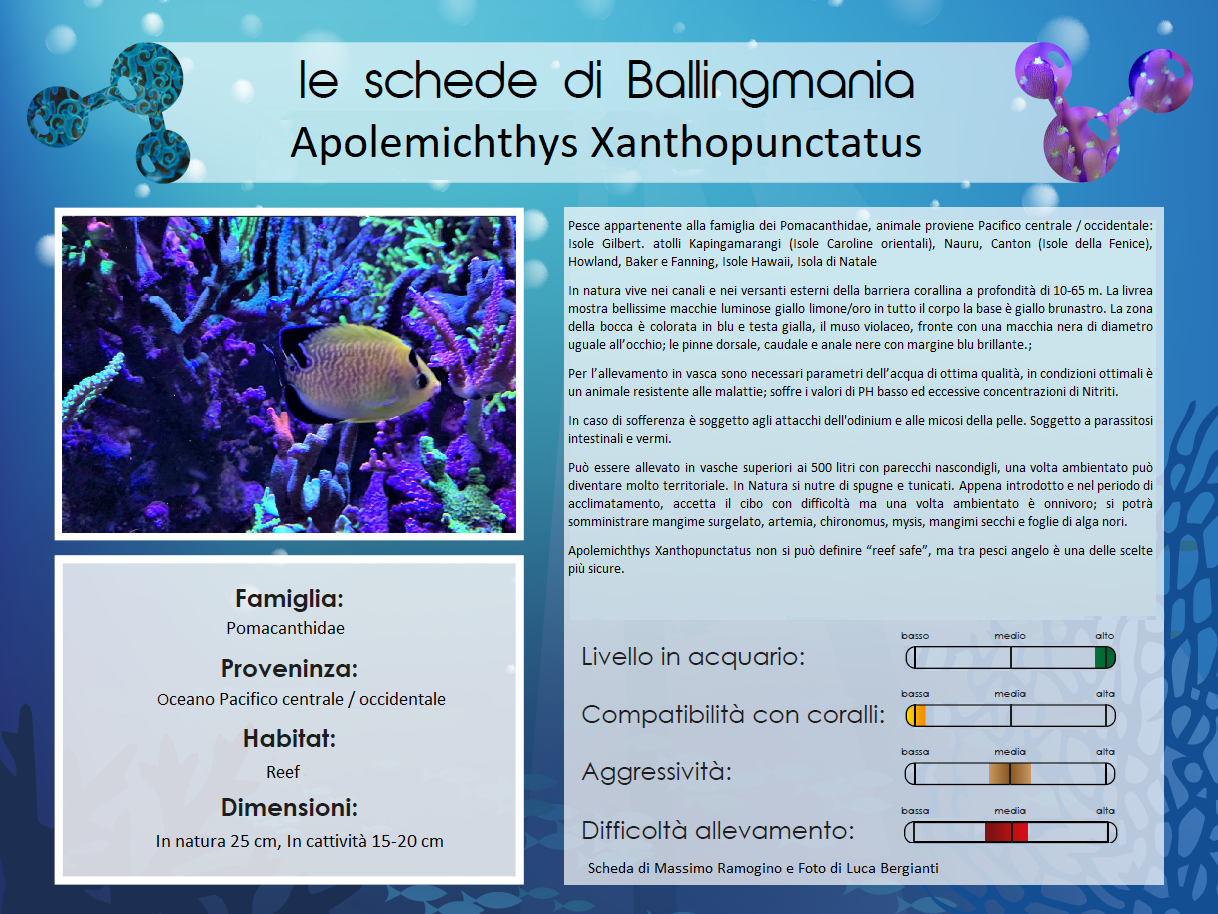
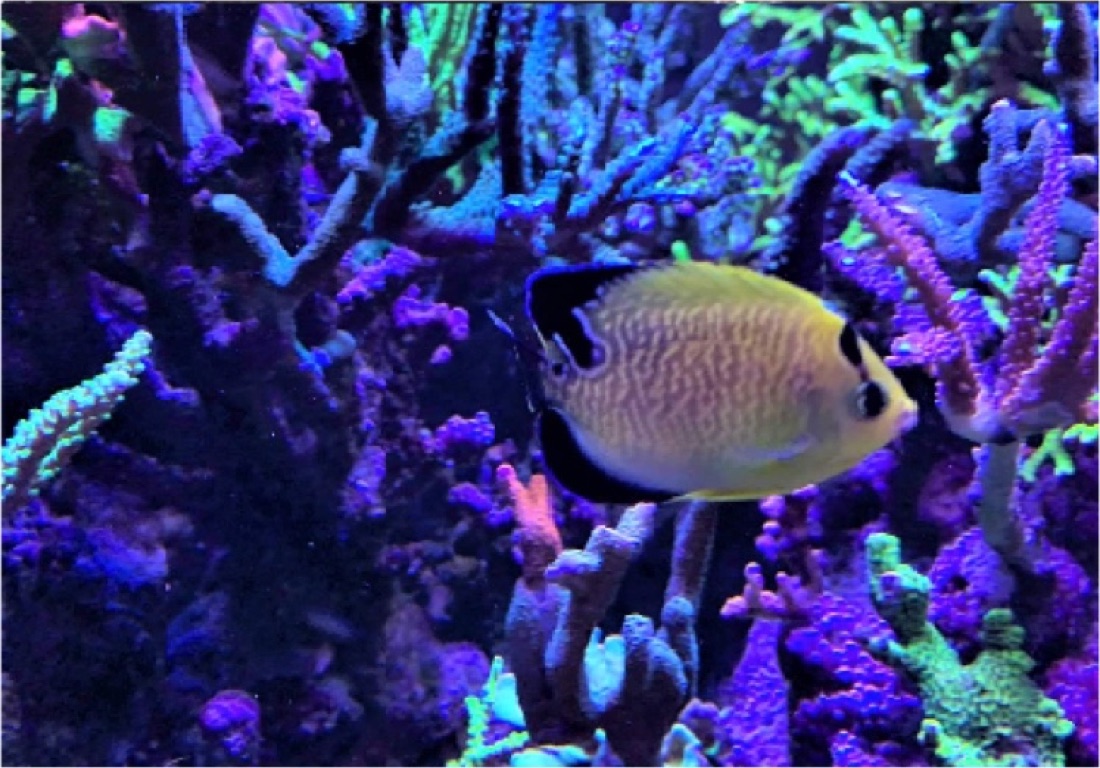
A fish belonging to the family Pomacanthidae, an animal coming from the central/western Pacific: the Gilbert Islands, Kapingamarangi Atoll (eastern Caroline Islands), Nauru, Canton (Phoenix Islands), Howland, Baker and Fanning, the Hawaiian Islands and Christmas Island. In the wild it lives in channels and on the outer slopes of the coral reef at depths of 10-65 m. The livery shows beautiful bright lemon-yellow/gold spots all over the body on a brownish-yellow base. The mouth area is blue and the head yellow, the snout purplish, the forehead with a black spot as wide as the eye; the dorsal, caudal and anal fins are black with a bright blue margin. To keep it in a tank, excellent water quality is needed; in optimal conditions it is an animal resistant to disease; it suffers from low pH and excessive concentrations of nitrite. When stressed it is prone to attacks of Oodinium and to fungal skin infections. Prone to intestinal parasites and worms.
It can be kept in tanks larger than 500 litres with plenty of hiding places; once settled in it can become very territorial. In the wild it feeds on sponges and tunicates. Once introduced and during acclimatisation it accepts food with difficulty, but once settled in it is omnivorous; it can be given frozen food, Artemia, chironomus, mysis, dry foods and sheets of Nori seaweed. Apolemichthys xanthopunctatus cannot be called "reef safe", but among angelfish it is one of the safer choices.
Species sheet by Massimo Ramogino and photo by Luca Bergianti
What studies say about keeping it
The Nausicaá public aquarium displays it, but does not describe how it keeps it. 7 No rearing studies on this species were found.
Did you know?
Sources
- WoRMS Editorial Board (2026). Apolemichthys xanthopunctatus Burgess, 1973. World Register of Marine Species.
- Froese R., Pauly D. (eds.) (2026). Apolemichthys xanthopunctatus, Goldspotted angelfish. FishBase.
- Pyle R., in Carpenter K.E., Niem V.H. (eds.) (2001). Pomacanthidae. The living marine resources of the Western Central Pacific, vol. 5. FAO.
- (2026). Apolemichthys xanthopunctatus, in Eschmeyer's Catalog of Fishes. California Academy of Sciences.
- GBIF Secretariat (2026). Apolemichthys xanthopunctatus, common names and IUCN Red List category. GBIF.
- UNEP-WCMC (2026). Search for Apolemichthys xanthopunctatus in the CITES lists. Species+.
- (2026). Goldspotted angelfish. Nausicaá, Centre National de la Mer.
Sources checked on 5 November 2026. Community texts and ratings are kept separate from the scientific data.