
Amphiprion ocellaris
Ocellaris clownfish
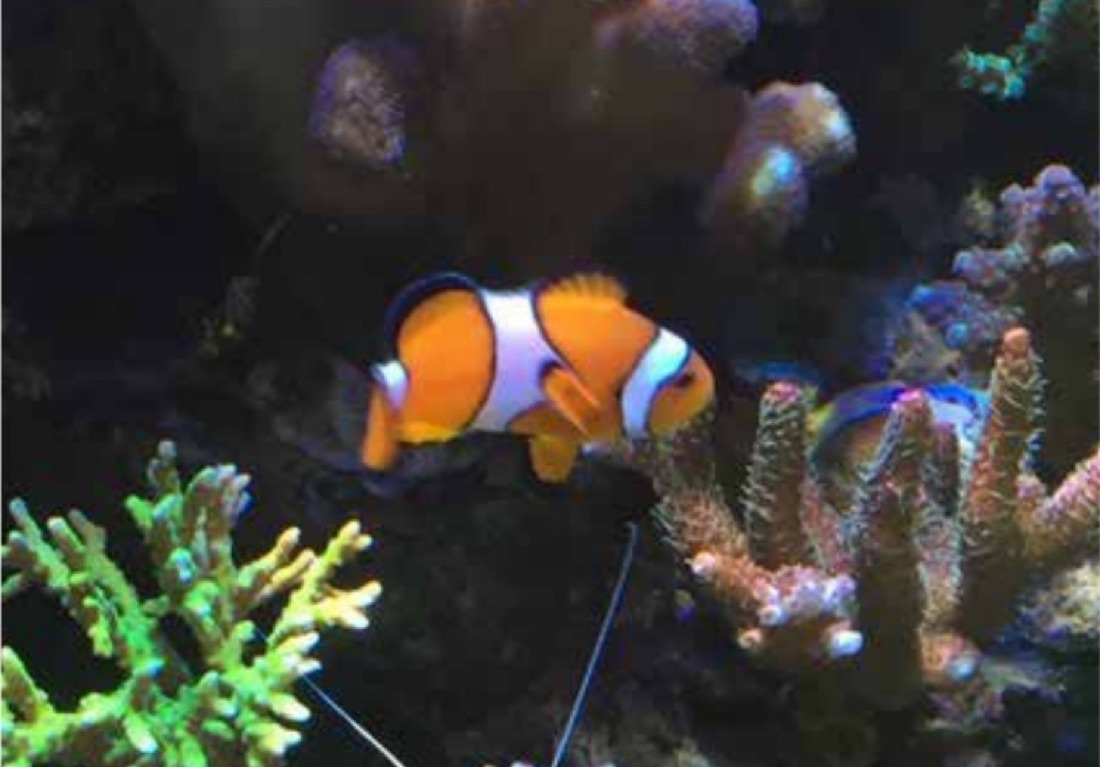
A small reef fish, orange with three white bars, that in the wild lives among the tentacles of large sea anemones. 1 2 4 It is born male, can become female and forms stable pairs. 2 3 It is one of the most popular marine fish in the aquarium hobby and is bred in captivity. 2
At a glance
Data from the scientific sources listed at the bottom.
Depth in the wild
1–15 m
Size
up to 11 cm
maximum total length (males or unsexed specimens)
Conservation
IUCN Red List: least concern (2021). Red List data taken from FishBase and GBIF. 2 7 It does not appear in the CITES lists checked on Species+. 8 In Malaysia one study reports concern about local decline due to collection for the aquarium trade and habitat degradation. 5
Where it lives
Western Indo-Pacific: from the eastern Indian Ocean, including the Andaman and Nicobar Islands, to Thailand, Malaysia and north-western Australia, then Singapore, Indonesia and the Philippines, up to Taiwan and the Ryukyu Islands. 2
How to recognise it
Tap a number on the photo: the key explains what to look for.
Life in the wild
What it eats
Omnivore. In 60 specimens collected at Pulau Tioman (Malaysia) the stomachs mainly contained barnacle larvae, tunicates, crustaceans and gastropods, as well as copepods and algae; many stomachs, however, were empty or nearly empty. The estimated trophic level is 2.98. 5 From time to time it leaves the anemone to feed on plankton in the water column. 6
Behaviour
It lives in groups on one anemone: a monogamous breeding pair, with the larger and dominant female, and non-breeding juveniles ranked by size. 3 If the female dies, the male changes sex and the largest non-breeder becomes the new male. 5 It is active during the day, especially in the morning, and almost still at night. 6
Reproduction
A hermaphrodite that is born male and can become female; sex change has been recorded at around 4.4 cm and, from the analysis of the gonads, may not be reversible. 2 5 The eggs stick to the substrate and the male guards and fans them. 2 At Pulau Tioman the number of eggs per female ranged from a few dozen to about 1,500. 5
In the aquarium
From the experience of the BallingMania community.
A fish suitable for reef and community tanks. It often lives in symbiosis with many kinds of anemone and sometimes even with the polyps of some LPS and soft corals.
In the wild this charming fish feeds on small crustaceans, plankton and amphipods. To help the Amphiprion ocellaris settle in quickly, frozen food (Artemia, Cyclops and Mysis) is recommended; after this phase the fish can be fed flake and/or granular dry food, which it accepts willingly and eagerly.
Breeding is possible in captivity. Spawning mostly takes place near the host anemone or the symbiotic coral and continues for many years. In this phase the female becomes extremely aggressive towards all the tank inhabitants. The larvae must be removed from the tank and fed zooplankton, otherwise they will not survive.
photo by: Ciro Murino
What studies say about keeping it
Data from laboratory studies, not advice for a home aquarium. In a scientific breeding facility the pairs were kept at 26-28 °C, salinity 30-35 g/L and pH 8-8.5, without an anemone. A new pair took from 6 months to 2 years to spawn for the first time, then laid 100-500 eggs every 12-15 days, hatching after about 10 days at 26 °C. The larvae were fed rotifers and then Artemia nauplii; among juveniles, aggression can cause up to 90% mortality. 3 Another study found that juveniles grow better with a natural host anemone than with non-natural hosts or without contact with anemones, and concluded that welfare is highest with the natural host. 6
Did you know?
Sources
- Froese R., Pauly D. (eds.), via WoRMS (2026). Amphiprion ocellaris Cuvier, 1830. World Register of Marine Species.
- Froese R., Pauly D. (eds.) (2026). Amphiprion ocellaris, Clown anemonefish. FishBase.
- Roux N., Logeux V., Trouillard N., Pillot R., Magré K., Salis P., Lecchini D., Besseau L., Laudet V., Romans P. (2021). A star is born again: Methods for larval rearing of an emerging model organism, the False clownfish Amphiprion ocellaris. Journal of Experimental Zoology Part B.
- Salis P., Roux N., Soulat O., Lecchini D., Laudet V., Frédérich B. (2018). Ontogenetic and phylogenetic simplification during white stripe evolution in clownfishes. BMC Biology.
- Khoo M.L., Das S.K., Ghaffar M.A. (2018). Growth pattern, diet and reproductive biology of the clownfish Amphiprion ocellaris in waters of Pulau Tioman, Malaysia. Egyptian Journal of Aquatic Research.
- Nguyen H.-T.T., Tran A.-N.T., Ha L.T.L., Ngo D.N., Dang B.T., Geffen A.J. (2019). Host choice and fitness of anemonefish Amphiprion ocellaris living with host anemones in captive conditions. Journal of Fish Biology.
- GBIF Secretariat (2026). Amphiprion ocellaris, IUCN Red List category. GBIF.
- UNEP-WCMC (2026). Search for Amphiprion ocellaris in the CITES lists. Species+.
Sources checked on 4 November 2026. Community texts and ratings are kept separate from the scientific data.