
Balistoides conspicillum
Clown triggerfish
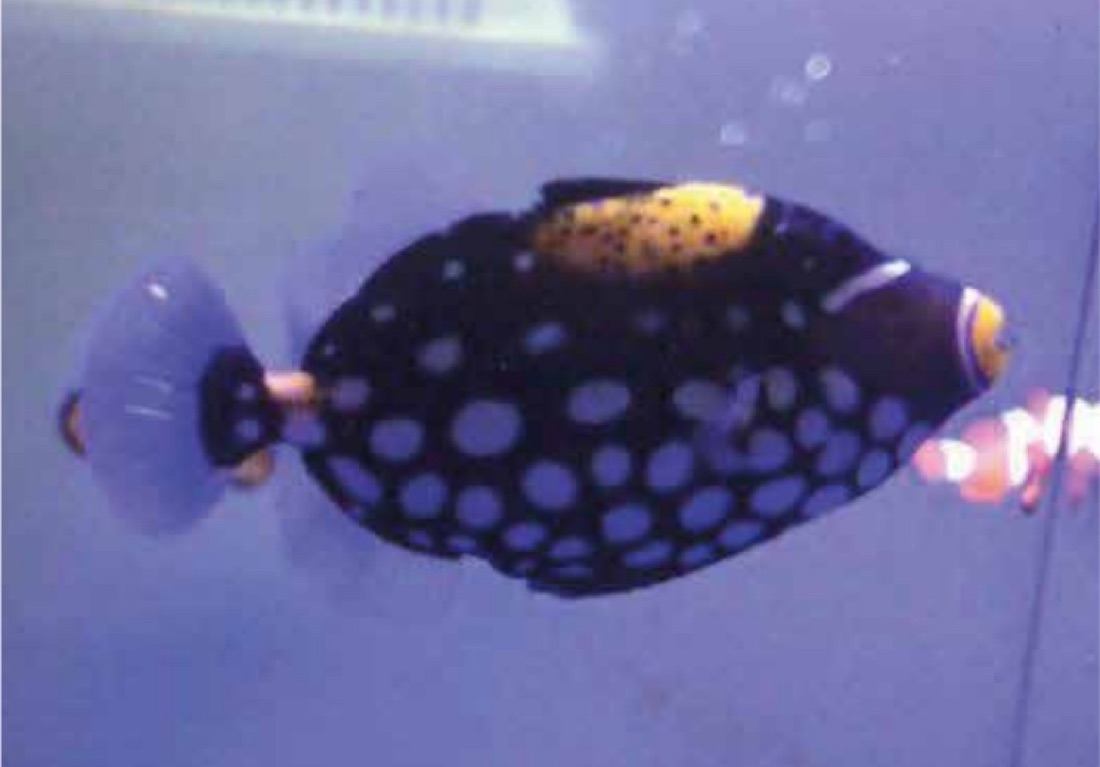
The clown triggerfish, known in Italian as pesce balestra pagliaccio 5, belongs to the triggerfish family (Balistidae). 1 It is black with large white spots on the lower half of the body, a yellow network on the back and a yellowish orange mouth. 2 3 It lives on the outer side of Indo-Pacific reefs, usually alone, and in many areas it is uncommon or rare. 2
At a glance
Data from the scientific sources listed at the bottom.
Depth in the wild
1–75 m
Size
up to 50 cm
maximum total length; FAO gives 30 cm
Temperature in the wild
19–31.5 °C
Where it lives
Tropical Indo-Pacific: from East Africa through Indonesia and northern Australia to Samoa; to the north it reaches southern Japan, to the south New Caledonia. 2 3
How to recognise it
Tap a number on the photo: the key explains what to look for.
- 1Large white spots round, on the lower half of the body; here the lights make them look blue 2 3 4
- 2Yellow network on the back black spots on a yellow background 2 3
- 3Yellowish orange mouth the lips and the area around the mouth 2 3
- 4Pale band on the snout white or yellowish, below the eye 3 4
- 5Pale band on the tail broad and vertical, whitish 2 3
Life in the wild
Where it is found
Clear water, from coastal to outer reefs, especially near steep walls. 2 3 The temperature given is the one measured in the sea in Reef Life Survey counts. 4 Baited cameras on the edge of the Great Barrier Reef shelf filmed it between 54 and 105 m, beyond the previously reported limit of 75 m. 9
Reproduction
FishBase reports distinct pairs and spawning in areas of coral rubble and sand on outer reefs. 2 Toronto Zoo, on the other hand, describes harems of one male and two to five females, a nest dug by the female in the sand, and eggs that the male guards and fans for about eight days, until they hatch. 8
In the aquarium
From the experience of the BallingMania community.
Belonging to the family Balistidae, it is commonly known as the “clown triggerfish” because of its very colourful livery: black with large white spots, with a yellow or orange mouth, back and caudal peduncle.
It reaches a considerable size, 50 cm in the wild; although it grows much less in the aquarium, to keep it properly an aquarium at least 150 cm long with a capacity of at least 600/700 litres is recommended. It is a sturdy fish, very resistant to disease like all triggerfish; nevertheless the settling-in phase is particularly tricky and can last several days, which is why it is advisable to buy healthy specimens that are not weakened from the start. Once the settling-in hurdle is overcome it is a lively, hardy and very greedy fish, suitable for living with almost all reef fish of other kinds and even with some other types of triggerfish, as long as they are a different colour.
Above all it prefers frozen food: Artemia, chironomus and mysis, shrimp or mussels, but it also accepts freeze-dried food and dry food in large granules. Although it is a particularly disease-resistant fish, it is not recommended for complete beginners because of the difficult settling-in.
photo by: Salvatore Riccardo
What studies say about keeping it
Data from a zoo's species sheet, not advice for a home aquarium. Toronto Zoo writes that it needs a lot of space with plenty of hiding places, that the fish is very territorial and that it can become aggressive towards smaller fish, to the point of biting or killing them. 8
Did you know?
Sources
- Froese R., Pauly D. (eds.), via WoRMS (2026). Balistoides conspicillum (Bloch & Schneider, 1801). World Register of Marine Species.
- Froese R., Pauly D. (eds.) (2026). Balistoides conspicillum, Clown triggerfish. FishBase.
- Matsuura K., in Carpenter K.E., Niem V.H. (eds.) (2001). Balistidae. The living marine resources of the Western Central Pacific, vol. 6. FAO.
- Reef Life Survey (2026). Balistoides conspicillum, Clown Triggerfish. Reef Life Survey.
- GBIF Secretariat (2026). Balistoides conspicillum, nomi comuni. GBIF.
- GBIF Secretariat (2026). Balistoides conspicillum, IUCN Red List category. GBIF.
- UNEP-WCMC (2026). Search for Balistoides conspicillum in the CITES lists. Species+.
- Toronto Zoo (2026). Clown triggerfish. Toronto Zoo.
- Sih T.L., Cappo M., Kingsford M. (2017). Deep-reef fish assemblages of the Great Barrier Reef shelf-break (Australia). Scientific Reports.
Sources checked on 5 November 2026. Community texts and ratings are kept separate from the scientific data.