At a glance
Data from the scientific sources listed at the bottom.
Depth in the wild
0–20 m
Conservation
IUCN Red List: endangered (2023). CITES: Appendix II. The listed criterion is A3ce. 2 The CITES listing currently in force dates back to 18 January 1990; in the European Union the species is in Annex B. 3
The coral
Group: SPS
Growth form: branching, with vertical and horizontal branches
Zooxanthellae: yes
Growth: It has both lateral and vertical growth axes. In the centre of the branches the internal canals are concentrated in a columnar zone: the authors consider it a transitional form towards the more complex system of Acropora. 10
Where it lives
Western Indo-Pacific, roughly from 30° N to 27° S. 2 Records include Saudi Arabia, Oman, Djibouti, Mauritius, Chagos, Indonesia, the Philippines, Japan, Australia, New Caledonia, Fiji and Tonga. 1 3
How to recognise it
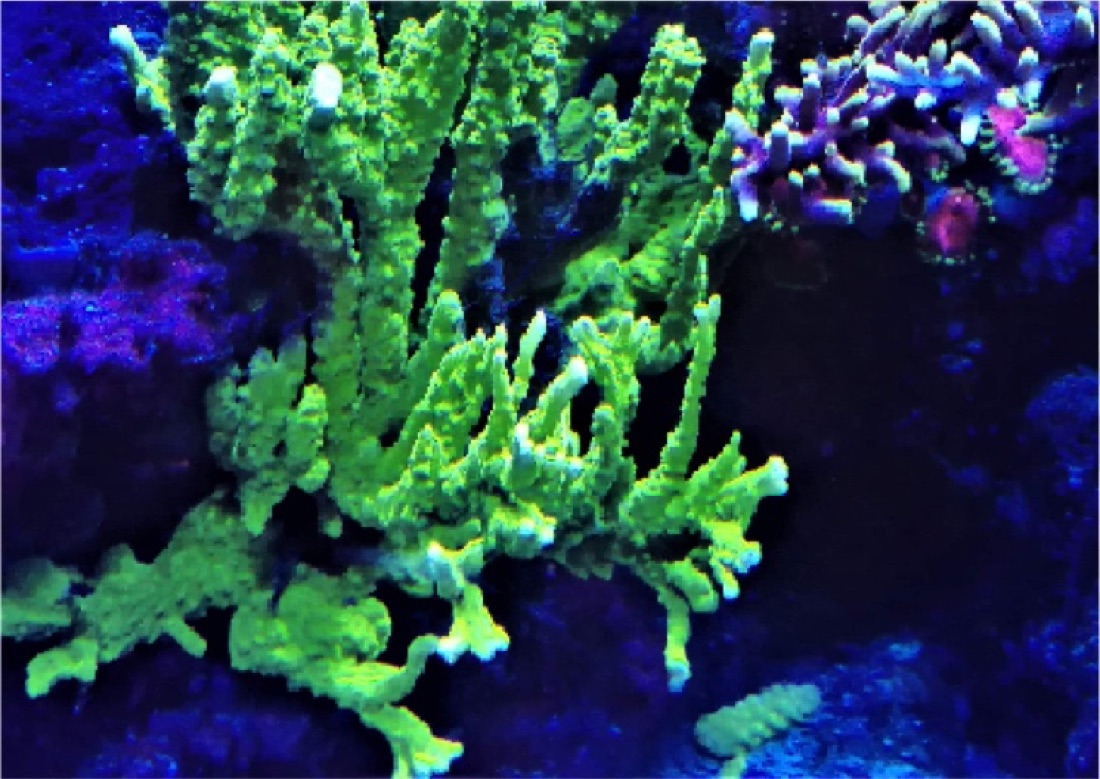
Tap a number on the photo: the key explains what to look for.
Life in the wild
In the aquarium
From the experience of the BallingMania community.
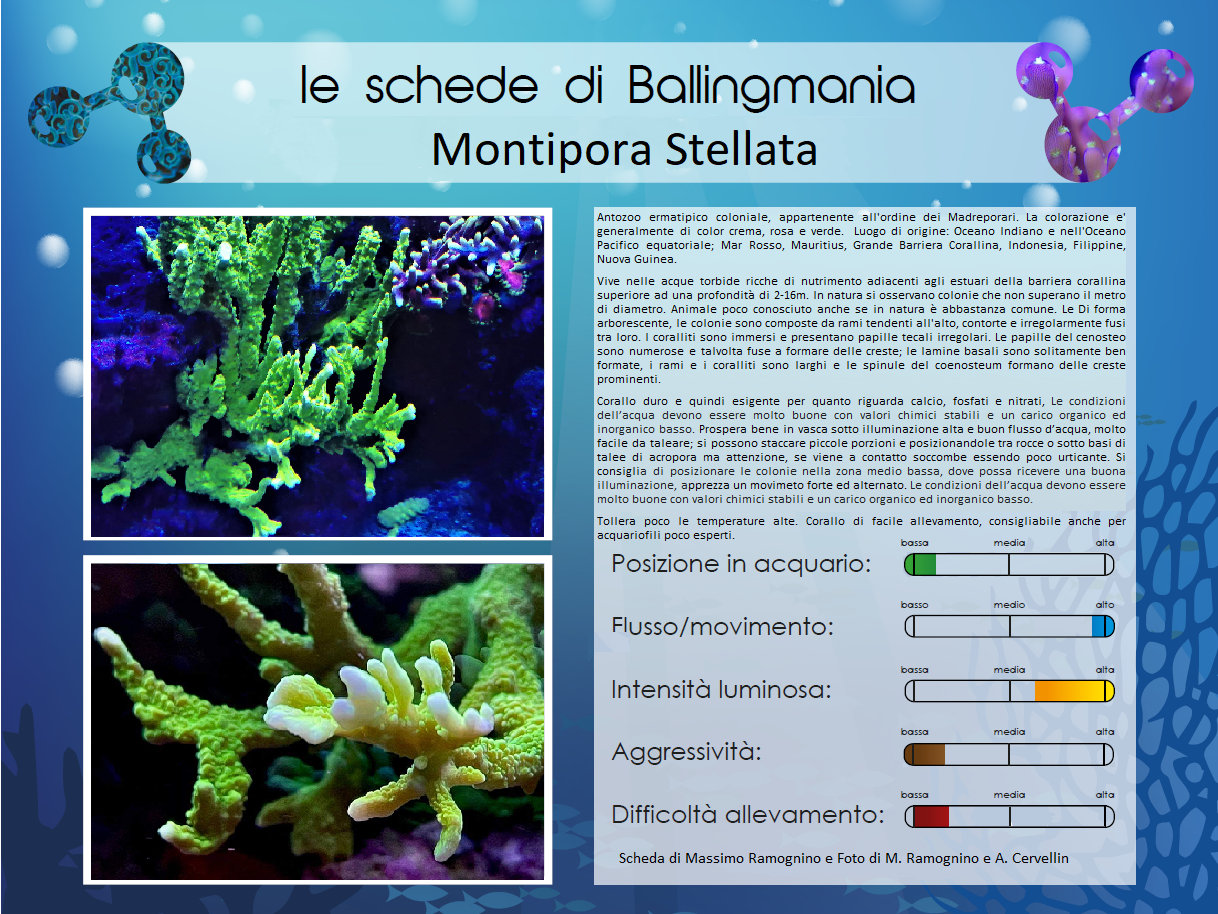
A colonial hermatypic anthozoan belonging to the order of stony corals (Madreporaria). Its colour is generally cream, pink and green. Place of origin: the Indian Ocean and the equatorial Pacific Ocean; the Red Sea, Mauritius, the Great Barrier Reef, Indonesia, the Philippines, New Guinea.
It lives in the turbid, nutrient-rich waters next to the estuaries of the upper coral reef at a depth of 2-16 m. In the wild colonies do not exceed a metre in diameter. A little-known animal, even though it is fairly common in the wild. Arborescent in shape, the colonies are made up of upward-tending branches, twisted and irregularly fused together. The corallites are immersed and have irregular thecal papillae. The papillae of the coenosteum are numerous and sometimes fused to form ridges; the basal plates are usually well formed, the branches and corallites are wide, and the spinules of the coenosteum form prominent ridges.
A hard coral and therefore demanding as regards calcium, phosphate and nitrate. Water conditions must be very good, with stable chemical values and a low organic and inorganic load. It thrives in the tank under high lighting and good water flow, and is very easy to frag; small portions can be broken off and placed among the rocks or under the bases of Acropora frags, but be careful: if it comes into contact with other corals it succumbs, being only slightly stinging. It is advisable to place the colonies in the middle-to-lower area, where they can receive good lighting; it appreciates strong, alternating water movement. Water conditions must be very good, with stable chemical values and a low organic and inorganic load.
It does not tolerate high temperatures well. An easy coral to keep, advisable even for not very experienced aquarists.
Species sheet by Massimo Ramognino and photo by M. Ramognino and A. Cervellin
Did you know?
Sources
- Hoeksema B.W., Cairns S., Samimi-Namin K. (2026). Montipora stellata Bernard, 1897. World List of Scleractinia, via WoRMS.
- Palomares M.L.D., Pauly D. (eds.) (2026). Montipora stellata. SeaLifeBase.
- UNEP-WCMC (2026). Montipora stellata, CITES listings and distribution. Species+.
- GBIF Secretariat (2026). Montipora stellata on the IUCN Red List (Nuñez Lendo, 2024), data from GBIF. GBIF.
- Madin J. et al. (eds.) (2026). Montipora stellata. Coral Trait Database.
- Penland L., Kloulechad J., Idip D., van Woesik R. (2004). Coral spawning in the western Pacific Ocean is related to solar insolation: evidence of multiple spawning events in Palau. Coral Reefs, reference in the Coral Trait Database.
- LaJeunesse T.C., Loh W.K.W., van Woesik R. et al. (2003). Low symbiont diversity in southern Great Barrier Reef corals relative to those of the Caribbean. Limnology and Oceanography, reference in the Coral Trait Database.
- Smith R.T., Pinzón J.H., LaJeunesse T.C. (2009). Symbiodinium (Dinophyta) diversity and stability in aquarium corals. Journal of Phycology.
- Carpenter K.E., Abrar M., Aeby G. et al. (2008). One-third of reef-building corals face elevated extinction risk from climate change and local impacts. Science, reference in the Coral Trait Database.
- Li Y., Liao X., Wang X. et al. (2023). Polyp-canal reconstruction reveals evolution toward complexity in corals. Research.
- Fong J., Tang P.P.Y., Deignan L.K. et al. (2023). Chemically mediated interactions with macroalgae negatively affect coral health but induce limited changes in coral microbiomes. Microorganisms.
Sources checked on 5 November 2026. Community texts and ratings are kept separate from the scientific data.