At a glance
Data from the scientific sources listed at the bottom.
Depth in the wild
1–30 m
Size
up to 100 cm
common colony diameter of P. daedalea, which can be exceeded [3]
Conservation
IUCN Red List: not evaluated. CITES: Appendix II. The Red List assesses individual species, not the genus: P. daedalea and P. lamellina are listed as LC, with an assessment dated 27 October 2023. 3 4 Appendix II covers all Scleractinia since 18 January 1990, excluding fossils; in the European Union the genus is in Annex B. 2
Where it lives
Open-access sources give the distribution by species. Species+ lists P. daedalea, among others, in Egypt, Israel, Saudi Arabia, Sudan, Oman and Qatar; in Tanzania, Mozambique, South Africa and Madagascar; in India, Sri Lanka and the Maldives; in Thailand, Indonesia, the Philippines, China and Japan; in Australia, New Caledonia, Fiji and Tonga, as far as the Cook Islands and French Polynesia. 2
How to recognise it
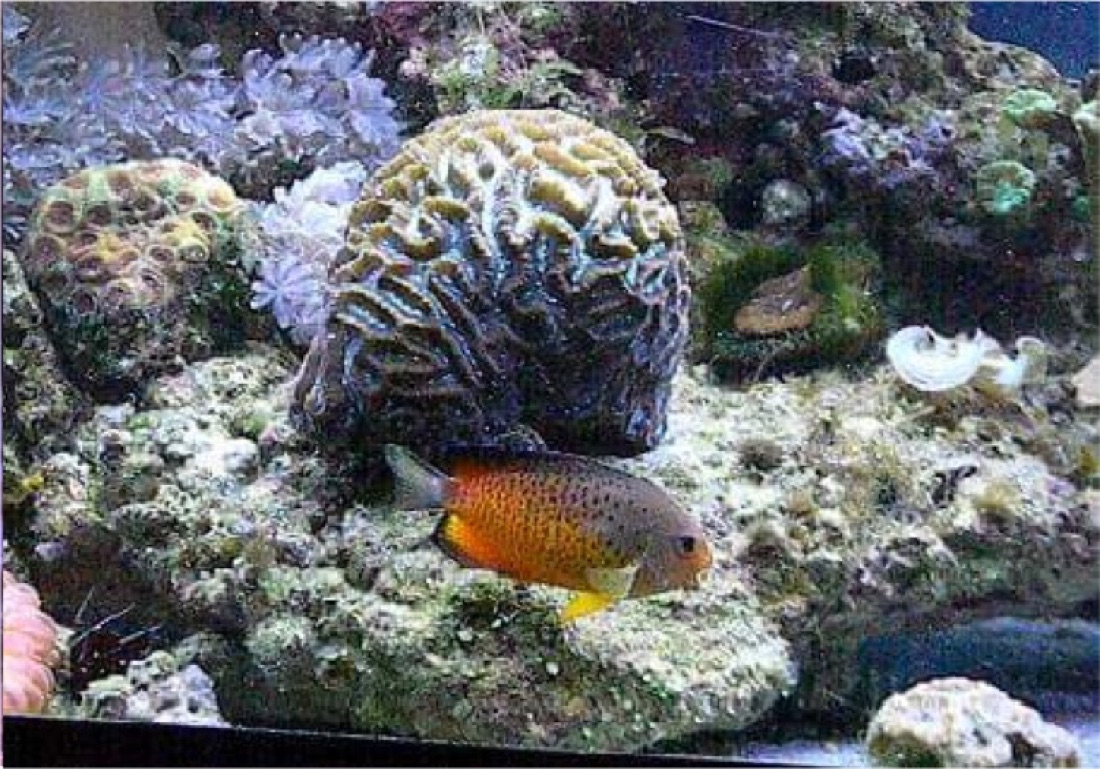
Tap a number on the photo: the key explains what to look for.
Life in the wild
Where it is found
P. daedalea lives in most reef environments, especially on back-reef margins, submerged rock, rocky shores, outer channels and lagoons. 3 The global estimate for P. sinensis is 0-30 m; the other species examined usually reach 15-30 m. 5 Babcock's study (1991) followed P. sinensis on sheltered flats at a depth of 2 m. 5
Reproduction
P. lamellina is a hermaphrodite and releases its gametes from the mouth. 4 The genus is among the best documented: an Indo-Pacific database reports 509 observations for 9 species. 6 In Zanzibar, colonies of P. daedalea released gametes in December 2024 and January 2025, about 80 minutes after sunset. 7 In the Gulf of Thailand 104 colonies were preparing to release or releasing gametes between about 4 and 7 days after the full moon. 8 P. sinensis reaches maturity at about 6.5 years. 5
In the aquarium
From the experience of the BallingMania community.
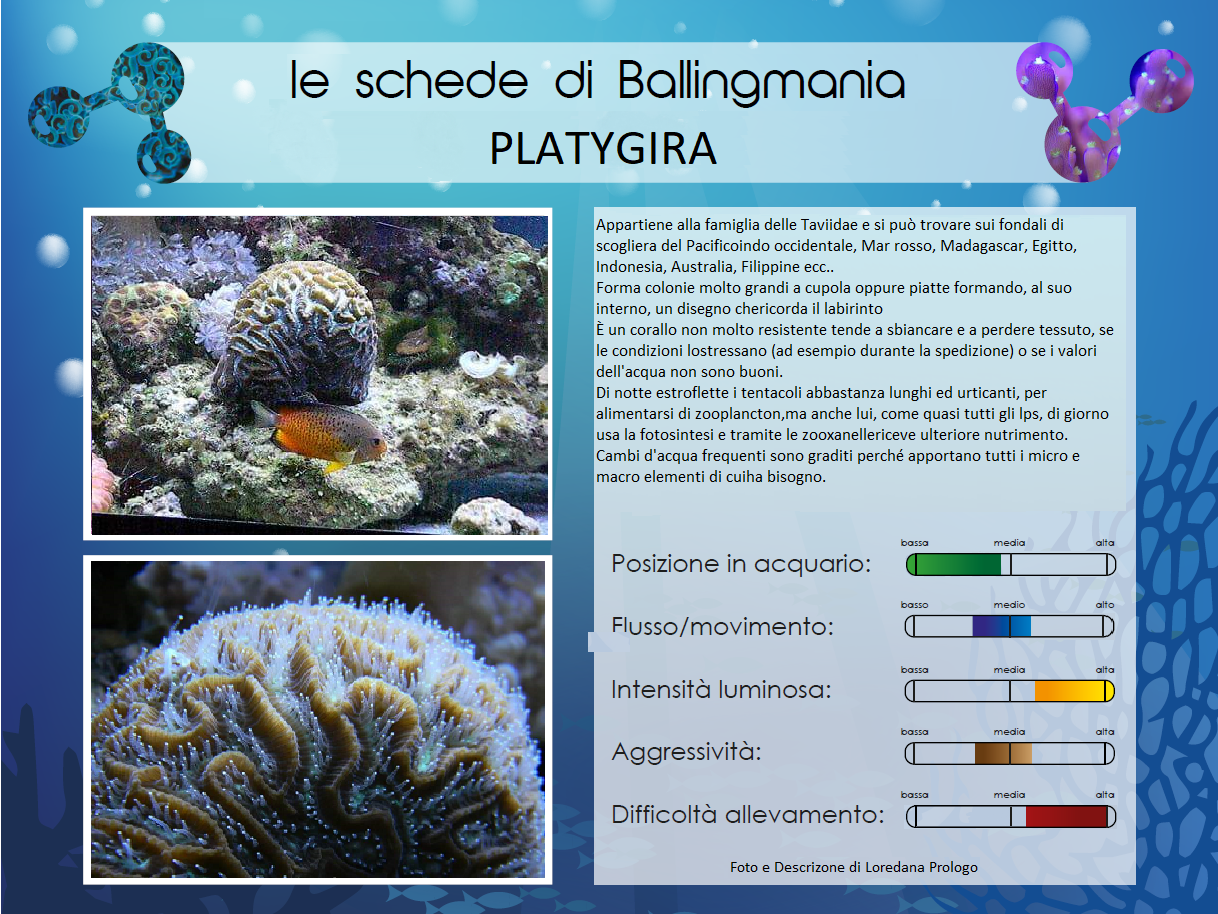
It belongs to the family Faviidae and can be found on the reef bottoms of the western Indo-Pacific, the Red Sea, Madagascar, Egypt, Indonesia, Australia, the Philippines, etc.
It forms very large dome-shaped or flat colonies, creating within them a pattern that looks like a maze. It is not a very hardy coral: it tends to bleach and lose tissue if conditions stress it (for example during shipping) or if the water values are not good.
At night it extends its fairly long, stinging tentacles to feed on zooplankton, but it too, like almost all LPS, uses photosynthesis by day and receives further nourishment through its zooxanthellae. Frequent water changes are welcome because they supply all the micro and macro elements it needs.
Photo and description by Loredana Prologo
What studies say about keeping it
Study results, not advice for the tank. In a 12-week comparison, half of the small P. sinensis colonies died in the aquarium, against 12.5% in the sea: the authors consider it less suited than the other corals tested to being grown outside the sea. 11 In a 3-month trial on P. daedalea fragments, neither food nor the presence of fish significantly improved growth. 12
Did you know?
Sources
- Hoeksema B.W., Cairns S., Samimi-Namin K. (2026). Platygyra Ehrenberg, 1834. World Register of Marine Species.
- UNEP-WCMC (2026). Platygyra daedalea, distribution and CITES listing. Species+.
- SeaLifeBase (2026). Platygyra daedalea, summary record. SeaLifeBase.
- SeaLifeBase (2026). Platygyra lamellina, summary record. SeaLifeBase.
- Coral Trait Database (2026). Platygyra sinensis in the Coral Trait Database: depth from Carpenter et al. (2008), zooxanthellae from Cairns (1999), demography from Babcock (1991). Coral Trait Database.
- Baird A.H. et al. (2021). An Indo-Pacific coral spawning database. Scientific Data.
- Lillis A., Jiddawi N. (2026). Documenting coral spawning in East Africa: first in situ observations from Zanzibar for three reef-building species. PeerJ.
- Mehrotra R. et al. (2026). Coral spawning patterns in the Gulf of Thailand reveal synchronised annual daytime spawning. PLoS ONE.
- Conti-Jerpe I.E. et al. (2020). Trophic strategy and bleaching resistance in reef-building corals. Science Advances.
- Kirk N.L., Howells E.J., Abrego D., Burt J.A., Meyer E. (2018). Genomic and transcriptomic signals of thermal tolerance in heat-tolerant corals (Platygyra daedalea) of the Arabian/Persian Gulf. Molecular Ecology.
- Loo P.L., Li A., Tan K.S. (2020). Interactions between coral propagules in aquarium and field conditions. Scientific Reports.
- Neil R.C. et al. (2025). Improving Coral Grow-Out Through an Integrated Aquaculture Approach. Aquaculture Nutrition.
Sources checked on 5 November 2026. Community texts and ratings are kept separate from the scientific data.