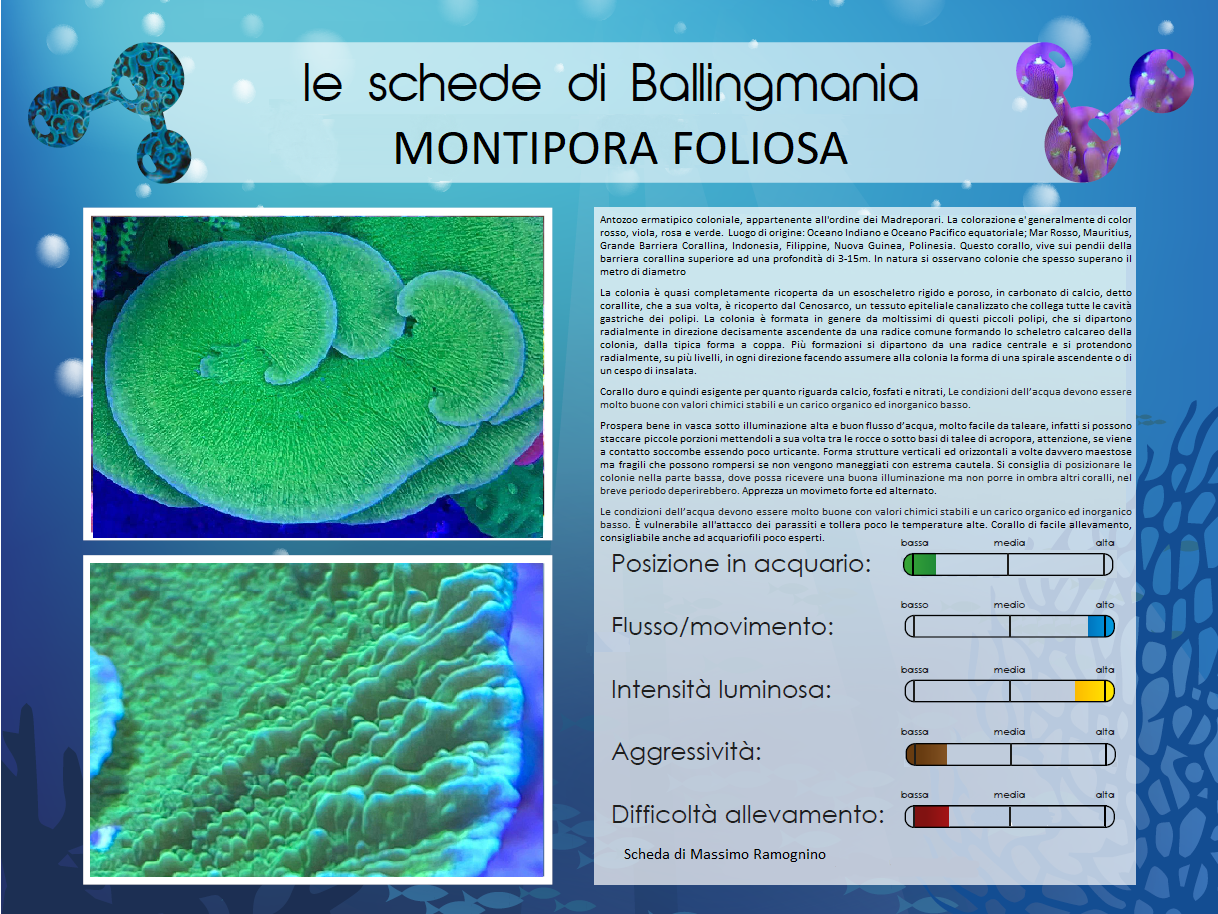
Montipora foliosa
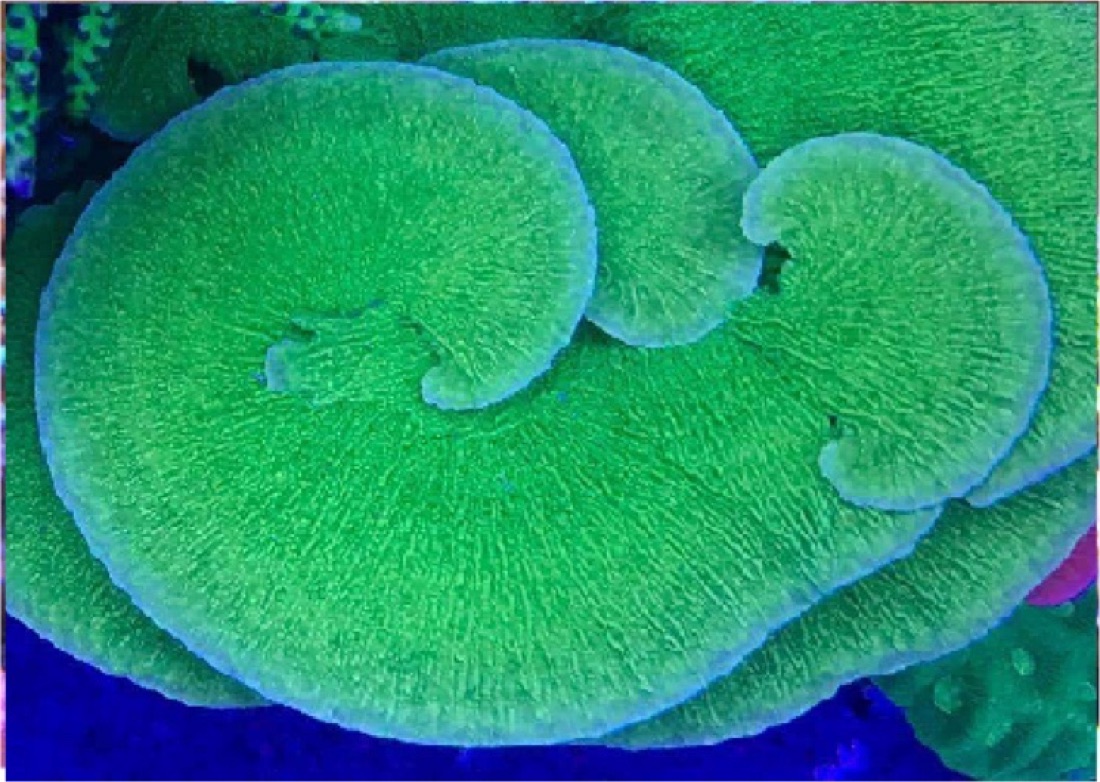
A hard coral that forms thin plates, sometimes arranged in tiers or spirals, with clearly visible ridges on the surface. 2 It lives mainly on the upper, sheltered part of reef slopes, from the Red Sea and East Africa to the central Pacific. 2 3 It is classified as threatened globally. 4
At a glance
Data from the scientific sources listed at the bottom.
Depth in the wild
0–20 m
Conservation
IUCN Red List: endangered (2023). CITES: Appendix II. The listed criterion is A3ce. 2 The CITES listing currently in force dates back to 18 January 1990; in the European Union the species is in Annex B. 3
The coral
Group: SPS
Growth form: laminar, in tiers or spirals
Zooxanthellae: yes
Growth: It grows sideways, from the centre towards the edge, splitting the growth axis in two at every branching. 10 In experimental culture the diameter increased by 1.4-1.9 cm a month. 11
Where it lives
Widespread in the tropical and subtropical Indo-Pacific, roughly between 31° N and 32° S. 2 Records include Egypt, Israel and Djibouti, East Africa, Madagascar, the Mascarenes, the Seychelles, the Maldives, India and Sri Lanka, Indonesia, the Philippines, Australia, Japan, French Polynesia and the United States Minor Outlying Islands. 1 3
How to recognise it
Tap a number on the photo: the key explains what to look for.
Life in the wild
In the aquarium
From the experience of the BallingMania community.
A colonial hermatypic anthozoan belonging to the order of stony corals (Madreporaria). Its colour is generally red, purple, pink and green. Place of origin: the Indian Ocean and the equatorial Pacific Ocean; the Red Sea, Mauritius, the Great Barrier Reef, Indonesia, the Philippines, New Guinea, Polynesia. This coral lives on the upper slopes of the coral reef at a depth of 3-15 m. In the wild colonies are seen that often exceed a metre in diameter. The colony is almost completely covered by a rigid, porous exoskeleton of calcium carbonate, called the corallite, which in turn is covered by the coenosarc, a channelled epithelial tissue that connects all the gastric cavities of the polyps. The colony is generally made up of a great many of these small polyps, which spread out radially in a clearly upward direction from a common root, forming the calcareous skeleton of the colony, with its typical cup shape. Several formations start from a central root and stretch out radially, on several levels, in every direction, giving the colony the shape of an upward spiral or a head of lettuce.
A hard coral and therefore demanding as regards calcium, phosphate and nitrate. Water conditions must be very good, with stable chemical values and a low organic and inorganic load.
It thrives in the tank under high lighting and good water flow, and is very easy to frag: in fact small portions can be broken off and placed in turn among the rocks or under the bases of Acropora frags. Be careful: if it comes into contact with other corals it succumbs, being only slightly stinging. It forms vertical and horizontal structures that are sometimes truly majestic but fragile, and can break if they are not handled with extreme care. It is advisable to place the colonies in the lower part, where they can receive good lighting but do not shade other corals, which would decline in a short time. It appreciates strong, alternating water movement.
Water conditions must be very good, with stable chemical values and a low organic and inorganic load. It is vulnerable to attack by pests and does not tolerate high temperatures well. An easy coral to keep,
Species sheet by Massimo Ramognino
What studies say about keeping it
Research data, not advice for a home aquarium. In the laboratory, colonies collected in the Xisha Islands were kept in a reef tank at 26 °C and specific gravity 1.025, with a protein skimmer, chiller, circulation pumps and calcium reactor. 12 In a study on fragments grown under controlled conditions, the four groups showed rapid growth in diameter; the authors propose using it for reef restoration. 11
Did you know?
Sources
- Hoeksema B.W., Cairns S., Samimi-Namin K. (2026). Montipora foliosa (Pallas, 1766). World List of Scleractinia, via WoRMS.
- Palomares M.L.D., Pauly D. (eds.) (2026). Montipora foliosa, Cabbage coral. SeaLifeBase.
- UNEP-WCMC (2026). Montipora foliosa, CITES listings and distribution. Species+.
- GBIF Secretariat (2026). Montipora foliosa on the IUCN Red List (Crabbe and Nuñez Lendo, 2024), data from GBIF. GBIF.
- Madin J. et al. (eds.) (2026). Montipora foliosa. Coral Trait Database.
- Dai C.F., Soong T.K., Fan T.Y. (1992). Sexual reproduction of corals in northern and southern Taiwan. Proceedings of the 7th International Coral Reef Symposium, reference in the Coral Trait Database.
- LaJeunesse T.C., Loh W.K.W., van Woesik R. et al. (2003). Low symbiont diversity in southern Great Barrier Reef corals relative to those of the Caribbean. Limnology and Oceanography, reference in the Coral Trait Database.
- Bridge T.C.L., Fabricius K.E., Bongaerts P. et al. (2011). Diversity of Scleractinia and Octocorallia in the mesophotic zone of the Great Barrier Reef, Australia. Coral Reefs, reference in the Coral Trait Database.
- Kühlmann D.H.H. (1983). Composition and ecology of deep-water coral associations. Helgoländer Meeresuntersuchungen, reference in the Coral Trait Database.
- Li Y., Liao X., Bi K. et al. (2021). Micro-CT reconstruction reveals the colony pattern regulations of four dominant reef-building corals. Ecology and Evolution.
- Wang E., Li H., Chen G., Yao X., Cai F. (2012). Research on isolated artificial feeding of Montipora foliosa and environmental regulation of physical and chemical factors. Journal of Hainan Normal University (Natural Science).
- Liu Y., Liao X., Han T. et al. (2021). Full-length transcriptome sequencing of the scleractinian coral Montipora foliosa reveals the gene expression profile of coral-zooxanthellae holobiont. Biology.
Sources checked on 5 November 2026. Community texts and ratings are kept separate from the scientific data.