
At a glance
Data from the scientific sources listed at the bottom.
Depth in the wild
0–5 m
Conservation
IUCN Red List: endangered (2023). CITES: Appendix II. The listed criterion is A3ce, as reported by WoRMS and SeaLifeBase. 1 3 4 For international trade, the listing currently in force dates back to 18 January 1990; in the European Union it is in Annex B. 2 It has been studied for reef restoration. 9
The coral
Group: SPS
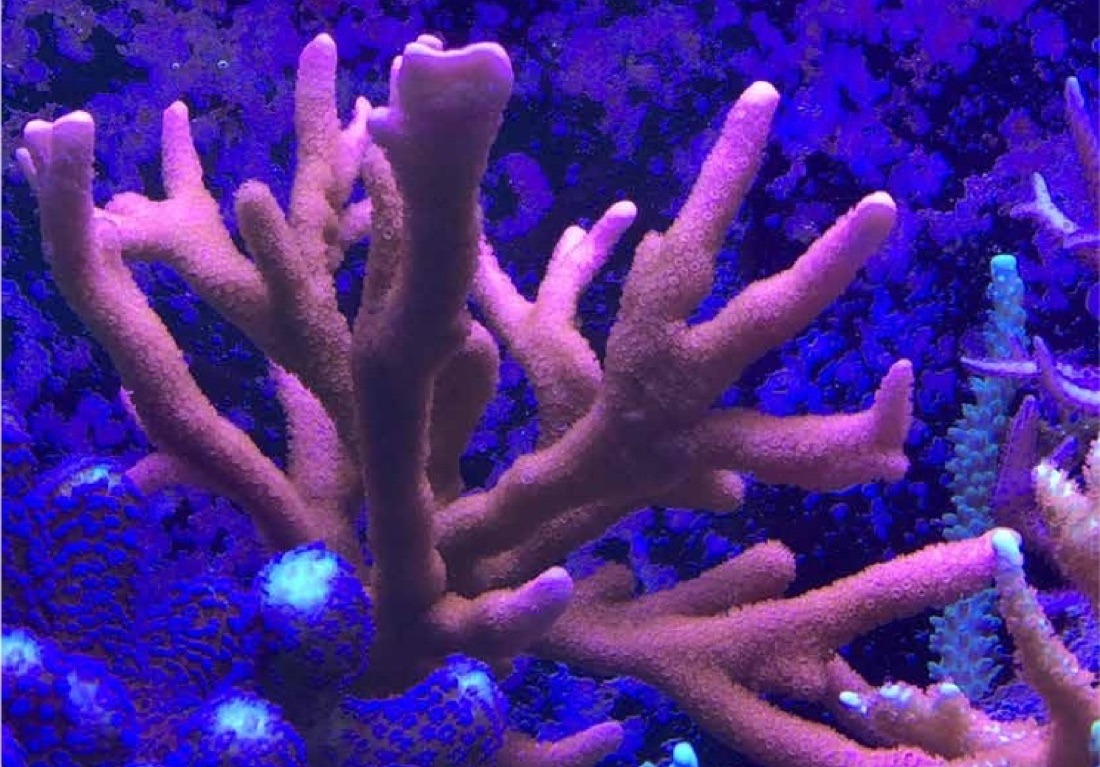
Growth form: finger-like or bushy branching, with upright branches that fuse together; in the tank it can also grow encrusting
Zooxanthellae: yes
Growth: At Magnetic Island the branches lengthen by up to 30.5 mm a year 6, with monthly averages of about 1.8-3.1 mm in a sheltered bay. 7 At Bolinao, in the Philippines, they grew an average of 57.8 mm a year in a nursery and 138.5 mm in transplanted branches. 7 9 At Okinawa, in tanks, calcification fell by about 37% going from 28 to 32 °C. 13
Where it lives
Western Indo-Pacific. Recorded in Kenya, Madagascar, Mauritius and South Africa, in India and the Cocos Islands, then from Thailand and Malaysia to Indonesia, the Philippines, Japan and Australia, as far as Fiji, Tonga and the Marshall Islands. The type locality is Fiji. 1 2 4
How to recognise it
Tap a number on the photo: the key explains what to look for.
Life in the wild
Where it is found
Very shallow water: 0-5 m according to a 2008 dataset 7 8, and the colonies sampled by the studies collected in the Coral Trait Database are all within 4 m. 7 It lives in lagoons and on reef flats and can be the dominant species on muddy flats. 1 4 SeaLifeBase gives a maximum of 33 m, which is a limit value. 4 It forms rounded mounds more than 40 cm across. 1
Reproduction
A hermaphrodite. 4 7 11 On the Great Barrier Reef it has a yearly cycle that ends with a brief spawning: eggs and sperm meet in the water. 6 A later study along the Queensland coast, however, found spawning both in spring and in autumn, with larger eggs than the related species M. tortuosa. 5 Mature oocytes measure on average 337 micrometres at Orpheus Island and 383 at Okinawa. 7 10 12 Newly settled juveniles have a skeleton of about 0.6 mm. 12
In the aquarium
From the experience of the BallingMania community.
An easy-to-manage SPS hard coral, available in a huge variety of colours; the most common are pink/orange, light blue and purple.
A hardy coral with a fast growth rate once well settled in; it has a branching structure that grows up from below in search of light, and it appreciates strong water movement, which will make the branches thicker and more sinuous.
Extended polyps and white growth tips are signs of good health; like all SPS it needs a stable system, pollutants close to zero and well-balanced calcium, alkalinity and magnesium.
photo by: Paolo Corbellini
What studies say about keeping it
Research data, not advice for a home aquarium. At the ICBM in Wilhelmshaven (University of Oldenburg) it is kept in long-term culture in recirculating tanks with artificial seawater, Balling method dosing and light of 100-130 micromoles of photons per square metre per second, at 26 ± 1 °C and salinity 34.5. There the mother colonies grow encrusting on PVC plates, from which fragments with a hollow tip are taken. 15 At the University of Giessen it is grown in the Ocean2100 facility and used for heat studies, with 26 °C as the control temperature. 16 In Bremen, 1-2 cm fragments were glued to calcium carbonate plugs and kept at 25 °C and about 100 micromoles of photons per square metre per second before the trials. 14
Did you know?
Sources
- Hoeksema B.W., Cairns S., Samimi-Namin K. (2026). Montipora digitata (Dana, 1846). World List of Scleractinia, via WoRMS.
- UNEP-WCMC (2026). Montipora digitata, CITES listings and distribution. Species+.
- GBIF Secretariat (2026). Montipora digitata on the IUCN Red List (Nuñez Lendo), data from GBIF. GBIF.
- Palomares M.L.D., Pauly D. (eds.) (2026). Montipora digitata. SeaLifeBase.
- Stobart B. (1994). Delimiting coral species using alternative techniques: Montipora digitata (Dana, 1846), a case study. James Cook University, PhD thesis.
- Heyward A.J., Collins J.D. (1985). Growth and sexual reproduction in the scleractinian coral Montipora digitata (Dana). Marine and Freshwater Research.
- Madin J. et al. (eds.) (2026). Montipora digitata. Coral Trait Database.
- Carpenter K.E., Abrar M., Aeby G. et al. (2008). One-third of reef-building corals face elevated extinction risk from climate change and local impacts. Science.
- Shaish L., Levy G., Katzir G., Rinkevich B. (2010). Employing a highly fragmented, weedy coral species in reef restoration. Ecological Engineering, reference in the Coral Trait Database.
- Hirose M., Kinzie R., Hidaka M. (2001). Timing and process of entry of zooxanthellae into oocytes of hermatypic corals. Coral Reefs, reference in the Coral Trait Database.
- Baird A.H., Pratchett M.S., Gibson D.J., Koziumi N., Marquis C.P. (2001). Variable palatability of coral eggs to a planktivorous fish. Marine and Freshwater Research, reference in the Coral Trait Database.
- Babcock R.C., Baird A.H., Piromvaragorn S., Thomson D.P., Willis B.L. (2003). Identification of scleractinian coral recruits from Indo-Pacific reefs. Zoological Studies.
- Manullang C., Millyaningrum I.H., Iguchi A. et al. (2020). Responses of branching reef corals Acropora digitifera and Montipora digitata to elevated temperature and pCO2. PeerJ.
- Mezger S.D., Littke S., Ostendarp M., de Breuyn M., Wild C. (2025). Differential responses of hard coral Montipora digitata and soft coral Xenia umbellata to nutrient stoichiometry under heat stress. PeerJ.
- Di Mauro V., Kamyab E., Kellermann M.Y. et al. (2023). Ecotoxicological Effects of Four Commonly Used Organic Solvents on the Scleractinian Coral Montipora digitata. Toxics.
- Ferrara E.F., Roik A., Wöhrmann-Zipf F., Ziegler M. (2025). Ex Situ Thermal Preconditioning Modulates Coral Physiology and Enhances Heat Tolerance: A Multispecies Perspective for Active Restoration. Environmental Science & Technology.
Sources checked on 5 November 2026. Community texts and ratings are kept separate from the scientific data.