At a glance
Data from the scientific sources listed at the bottom.
Conservation
IUCN Red List: not evaluated. A search for the name Pinnigorgia in Species+, the CITES listings database, gives no results. 7
The coral
Growth form: branching soft coral: short, thin branches growing from the sides of, or all around, thick main branches, in a feather or bottlebrush shape 2
Zooxanthellae: yes
Where it lives
Central Indo-Pacific and the Great Barrier Reef. 2 The genus is known in particular from the Philippines, Sabah, Indonesia and Palau. 3 Colonies identified as Pinnigorgia sp. have also been collected off Taiwan. 6
Life in the wild
In the aquarium
From the experience of the BallingMania community.
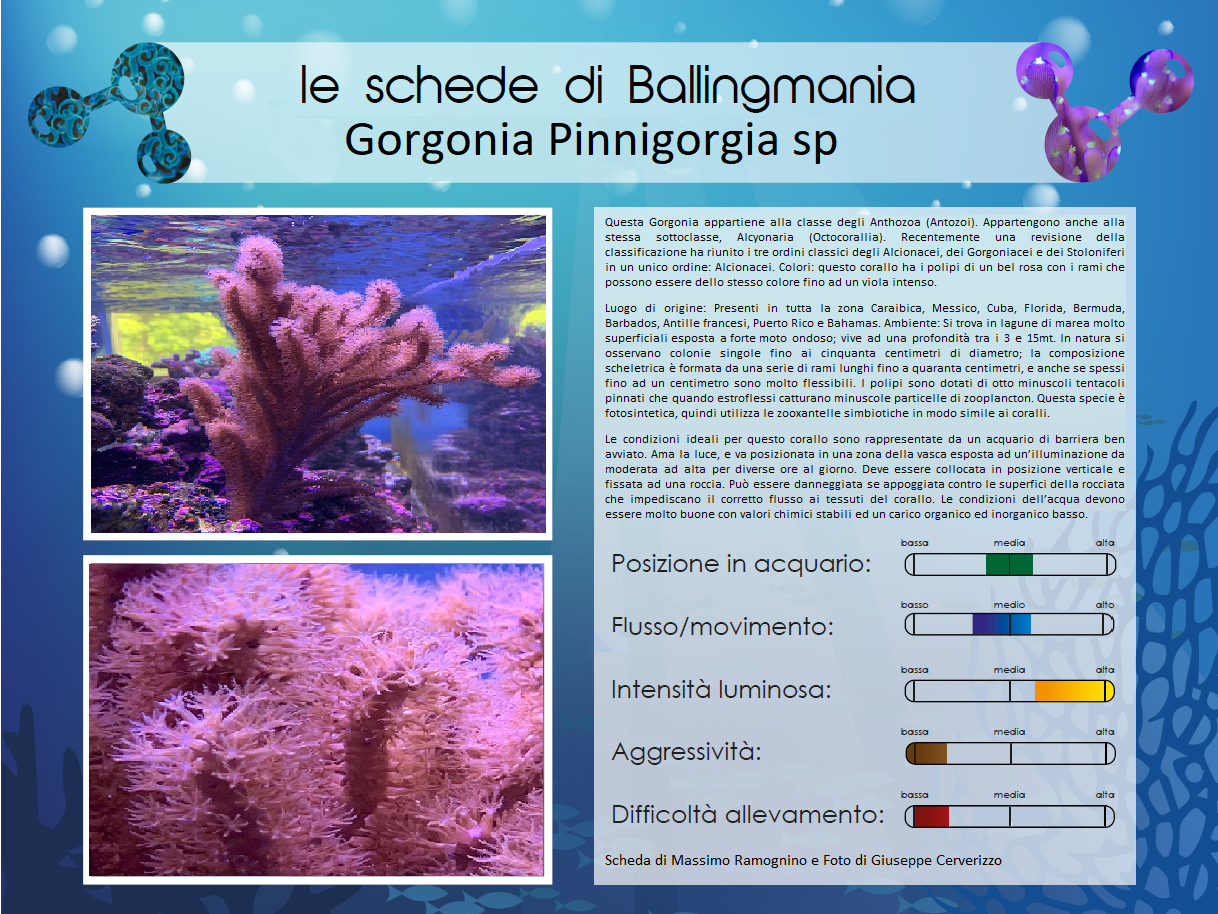
This gorgonian belongs to the class Anthozoa (anthozoans). They also belong to the same subclass, Alcyonaria (Octocorallia).
Recently a revision of the classification merged the three classic orders of Alcyonacea, Gorgonacea and Stolonifera into a single order: Alcyonacea. Colours: this coral has beautiful pink polyps, with branches that can be the same colour or a deep purple.
Place of origin: found throughout the Caribbean area, Mexico, Cuba, Florida, Bermuda, Barbados, the French Antilles, Puerto Rico and the Bahamas. Habitat: it is found in very shallow tidal lagoons exposed to strong wave action; it lives at a depth of 3 to 15 m. In the wild single colonies up to fifty centimetres in diameter are seen; the skeletal structure is made up of a series of branches up to forty centimetres long which, although up to a centimetre thick, are very flexible. The polyps have eight tiny pinnate tentacles which, when extended, catch tiny particles of zooplankton. This species is photosynthetic, so it uses symbiotic zooxanthellae in a similar way to corals.
The ideal conditions for this coral are a well-established reef aquarium. It loves light and should be placed in an area of the tank exposed to moderate to high lighting for several hours a day. It must be placed upright and fixed to a rock. It can be damaged if it rests against rockwork surfaces that prevent proper flow to the coral's tissues. Water conditions must be very good, with stable chemical values and a low organic and inorganic load.
Species sheet by Massimo Ramognino and photo by Giuseppe Cerverizzo
What studies say about keeping it
Research data on P. flava, not advice for a home aquarium. In the laboratory, fragments of about 2 cm taken from colonies kept for more than a year in a 420-litre aquarium were followed for 45 days. Adding organic carbon alone did not change oxygen, symbiont density or growth, while gradual warming from 26 to 32 °C reduced photosynthesis and symbionts. 4 In another study, plastic nanofibres at 0.1 and 1 mg/L caused oxidative stress in the cells. 5
Did you know?
Sources
- McFadden C.S., Cordeiro R., Samimi-Namin K., Hoeksema B.W., Williams G., van Ofwegen L.P. (2026). Pinnigorgia Grasshoff & Alderslade, 1997. World List of Octocorallia, via WoRMS.
- Naturalis Biodiversity Center (2026). Genus Pinnigorgia. Reef Corals of the Indo-Malayan Seas.
- Williams G.C. (2018). Illustrated Key and Synopses of Shallow-water Gorgonians and Pennatulaceans of the Central Philippines, Part 2, section on Pinnigorgia flava. Proceedings of the California Academy of Sciences, testo riprodotto da Plazi.
- Zelli E., Simancas-Giraldo S.M., Xiang N. et al. (2023). Individual and combined effect of organic eutrophication (DOC) and ocean warming on the ecophysiology of the Octocoral Pinnigorgia flava. PeerJ.
- Isa V., Seveso D., Concari E. et al. (2025). Evidence of oxidative stress in the soft coral Pinnigorgia flava (Nutting, 1910) exposed to secondary plastic nanofibers and related leachates. Environmental Pollution.
- Chang Y.-C., Kuo L.-M., Hwang T.-L. et al. (2016). Pinnisterols A-C, New 9,11-Secosterols from a Gorgonian Pinnigorgia sp.. Marine Drugs.
- UNEP-WCMC (2026). Search for the name Pinnigorgia in the CITES lists. Species+.
Sources checked on 5 November 2026. Community texts and ratings are kept separate from the scientific data.