At a glance
Data from the scientific sources listed at the bottom.
Depth in the wild
1–30 m
Conservation
IUCN Red List: not evaluated. CITES: Appendix II. The Red List assesses individual species, not the genus: G. columna is listed as LC, with an assessment dated 24 October 2023. 3 Appendix II covers all Scleractinia since 18 January 1990, excluding fossils; in the European Union the genus is in Annex B. 2 At One Tree Reef, on the Great Barrier Reef, after the 2024 heatwave, bleaching and black band disease had killed 75% of 112 monitored colonies by October. 11
The coral
Group: LPS
Growth form: columnar in G. columna; the long polyps often hide the skeleton 3 5
Zooxanthellae: yes
Where it lives
Open-access sources give the distribution by species. Species+ lists G. lobata, among others, in Saudi Arabia, Djibouti and Oman; in Somalia, Mozambique, South Africa, Madagascar, the Seychelles and Mauritius; in India, the Maldives, Myanmar and Thailand; in Indonesia, the Philippines, Vietnam, Taiwan and Japan; in Australia, Papua New Guinea, Fiji, Tonga, Samoa and the Marshall Islands. 2 G. columna is described as native to the western Pacific and the eastern and western Indian Ocean. 7
How to recognise it
Tap a number on the photo: the key explains what to look for.
Life in the wild
Where it is found
The global estimate for G. lobata ranges from 0.5 to 30 m; those for the other species examined generally start at 1-5 m and end between 15 and 30 m. 4 G. columna lives mainly on intertidal reefs, where it often forms large stands in muddy, nutrient-rich water. 7 It is found both in shallow and in deeper water. 3
What it eats
It hosts zooxanthellae, which are particularly dense in the tentacles of G. lobata. 12 Studies disagree on how much food it takes from outside: G. columna is described as a heterotrophic coral 7, while an isotope analysis places Goniopora among the genera most dependent on their symbiotic algae. 6
In the aquarium
From the experience of the BallingMania community.
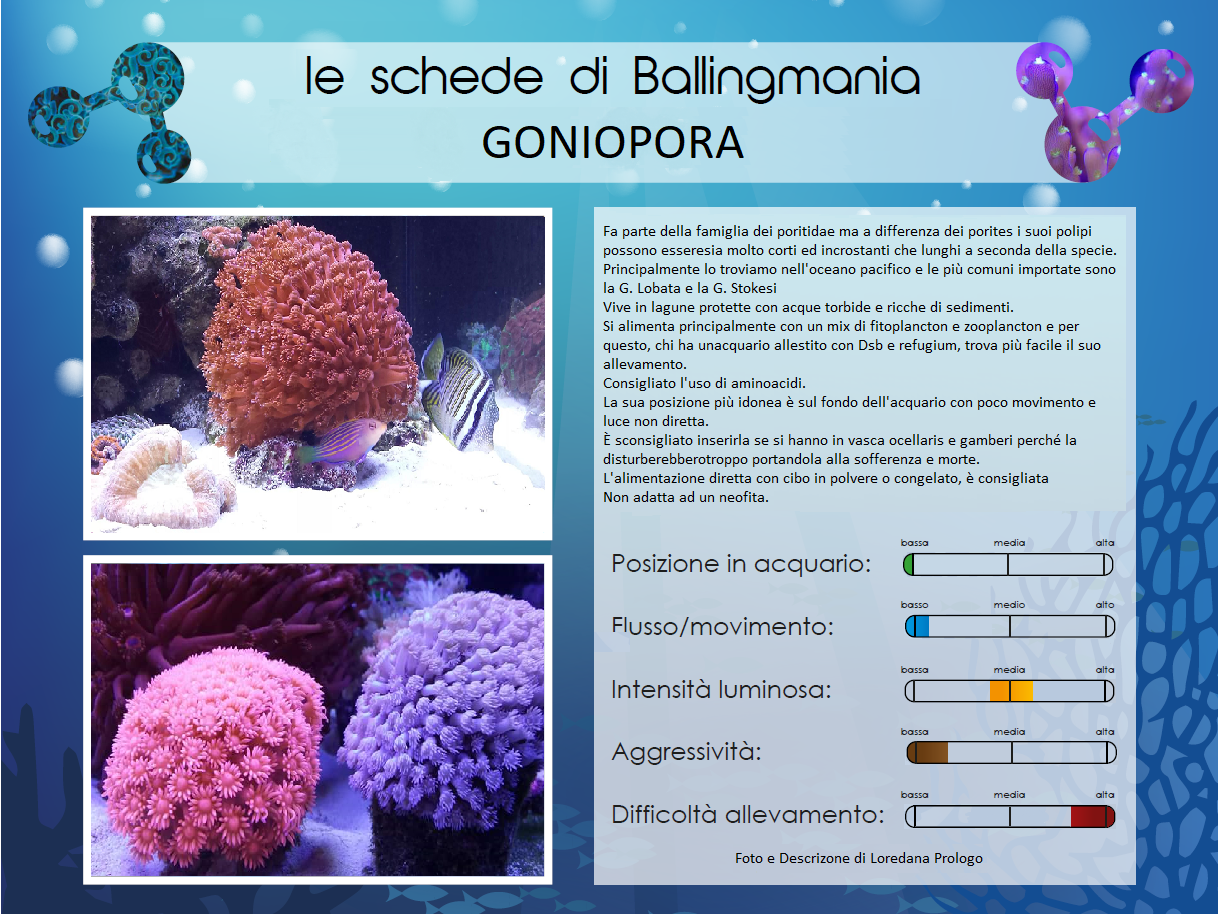
It belongs to the family Poritidae but, unlike Porites, its polyps can be either very short and encrusting or long, depending on the species. It is found mainly in the Pacific Ocean, and the most commonly imported are G. lobata and G. stokesi. It lives in sheltered lagoons with turbid, sediment-rich water.
It feeds mainly on a mix of phytoplankton and zooplankton, and for this reason those with an aquarium set up with a DSB and a refugium find it easier to keep.
The use of amino acids is recommended.
Its most suitable position is on the bottom of the aquarium with little water movement and indirect light.
It is not advisable to add it if you have ocellaris clownfish and shrimp in the tank, because they would disturb it too much, leading it to decline and die.
Direct feeding with powdered or frozen food is recommended. Not suitable for a beginner.
Photo and description by Loredana Prologo
What studies say about keeping it
Results of studies on G. columna raised in Taiwan, not doses to use in a tank. With an artificial feed rich in animal protein, given at 5% and 10% of body weight, the number of polyps increased by about 40 and 47, more than with microalgae or yeast. 7 The best growth was at 25 °C and salinity 30-35 psu, in trials at 20, 25 and 30 °C; the species survived between 25 and 40 psu. 8 Blue (440-470 nm) and violet (400-430 nm) light for at least 6 hours a day favoured growth and survival, and the polyps fully extended after 30 minutes. 9
Did you know?
Sources
- Hoeksema B.W., Cairns S., Samimi-Namin K. (2026). Goniopora de Blainville, 1830. World Register of Marine Species.
- UNEP-WCMC (2026). Goniopora lobata, distribution and CITES listing. Species+.
- SeaLifeBase (2026). Goniopora columna, summary record. SeaLifeBase.
- Coral Trait Database (2026). Goniopora lobata in the Coral Trait Database: depth from Carpenter et al. (2008), reproduction from Heyward (1985) and from Babcock and Heyward (1986). Coral Trait Database.
- Kitano Y.F. et al. (2014). A phylogeny of the family Poritidae (Cnidaria, Scleractinia) based on molecular and morphological analyses. PLoS ONE.
- Conti-Jerpe I.E. et al. (2020). Trophic strategy and bleaching resistance in reef-building corals. Science Advances.
- Ding D.S., Sun W.T., Pan C.H. (2021). Feeding of a Scleractinian Coral, Goniopora columna, on Microalgae, Yeast, and Artificial Feed in Captivity. Animals.
- Ding D.S. et al. (2022). Effects of Temperature and Salinity on Growth, Metabolism and Digestive Enzymes Synthesis of Goniopora columna. Biology.
- Cheng C.M. et al. (2022). Effects of LED Light Illumination on the Growth, Digestive Enzymes, and Photoacclimation of Goniopora columna in Captivity. Animals.
- Gunthorpe L., Cameron A.M. (1990). Toxic exudate from the hard coral Goniopora tenuidens. Toxicon.
- Byrne M. et al. (2025). Marine heatwave-driven mortality of bleached colonies of the massive coral Goniopora is exacerbated by a black band disease epizootic. Proceedings of the Royal Society B.
- Levy O., Dubinsky Z., Achituv Y. (2003). Photobehavior of stony corals: responses to light spectra and intensity. Journal of Experimental Biology.
Sources checked on 5 November 2026. Community texts and ratings are kept separate from the scientific data.