At a glance
Data from the scientific sources listed at the bottom.
Depth in the wild
1–25 m
Size
up to 21 cm
maximum skeleton diameter in the specimens examined by Hoeksema (0.5-21 cm)
Conservation
IUCN Red List: least concern (2022). CITES: Appendix II. Red List data taken from SeaLifeBase and GBIF. 4 5 Older lists gave it as Vulnerable. 15 16 The CITES listing covers all Scleractinia since 18 January 1990, excluding fossils. 3 In southern Sulawesi collection targets small polyps and has reduced abundance at exploited sites: one study proposes a minimum size limit of 5 cm. 7 Indonesian populations are genetically different from one another, something to take into account when setting quotas. 8
Where it lives
According to Hoeksema's revision it lives in the central Indo-Pacific: west as far as the Malay Peninsula, Indonesia and north-western Australia, east as far as the Ryukyu line, Palau, the Solomon Islands, Vanuatu and New Caledonia. 2 WoRMS and Species+ also give Mozambique 1 3, and in the Maldives it has been photographed at Laamu. 9
The coral
Growth form: solitary and free-living: a circular or slightly oval disc, flat to slightly arched 1 2
Zooxanthellae: yes
Growth: At Spermonde average growth is 5.76 mm a year, measured on 30 polyps 6 13, and it slows as size increases. The maximum biomass yield is at 12 cm, at about 20 years of age. 6
How to recognise it
Tap a number on the photo: the key explains what to look for.
Life in the wild
Where it is found
The 1-25 m range comes from the group assessment by Carpenter et al. 13 14 It has been photographed on a slope at 15 m at Kudingareng Keke 2, with a median depth of 11 m in the Spermonde Archipelago 6 13 and at 30 m in the Maldives. 9 At Spermonde the abundance of large polyps varies from site to site together with the cover of coral rubble. 6
Reproduction
Sexually produced larvae settle on the reef and form stalks, the anthocauli, which bud further polyps: in this way a single larva gives rise to a group. 6 As an adult the polyp detaches, leaving a scar under the skeleton. 2 At Spermonde neither larval settlement nor budding shows any seasonality. 6 According to Knittweis and Wolff reproductive maturity comes at around 10 years. 7 The larvae, about 0.5 mm long, swim horizontally at about 1.6 mm per second. 10
In the aquarium
From the experience of the BallingMania community.
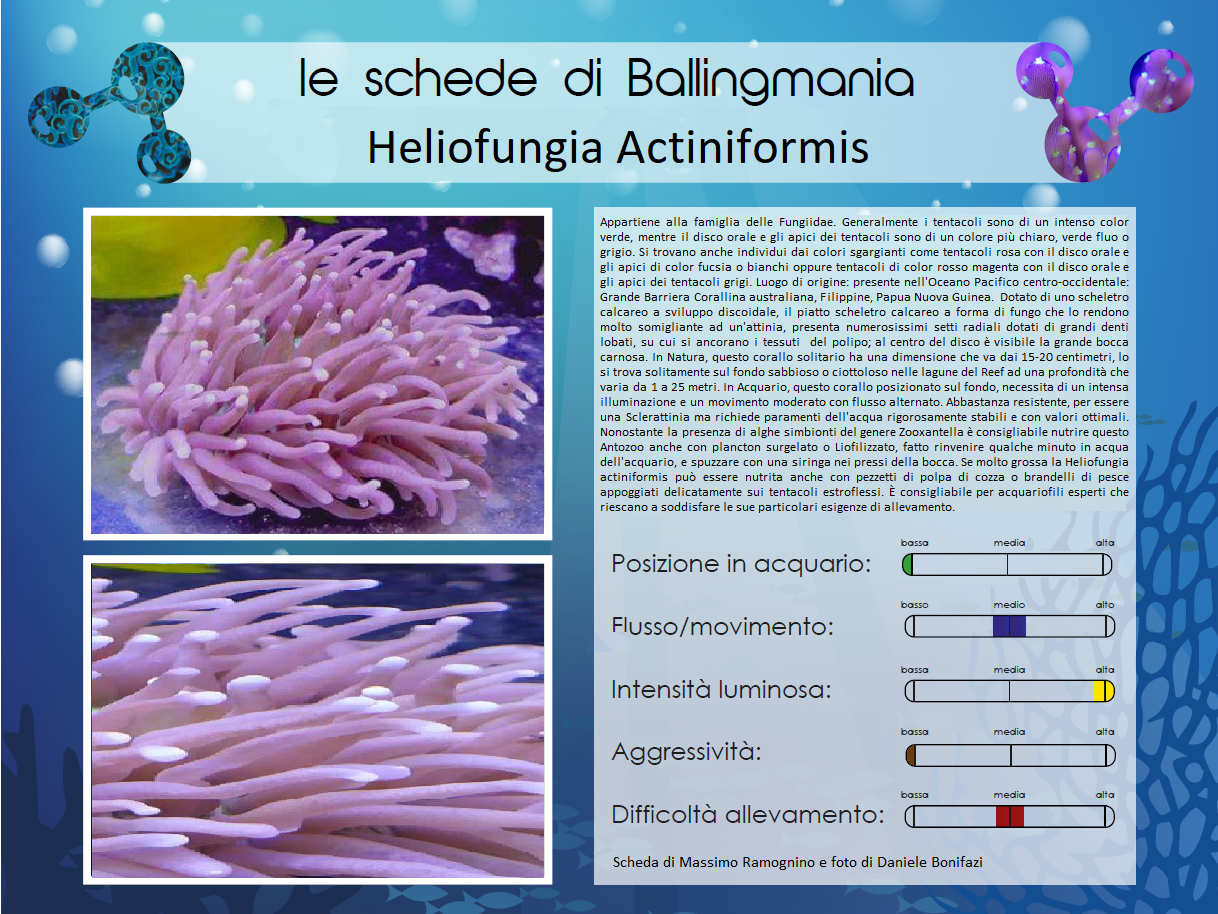
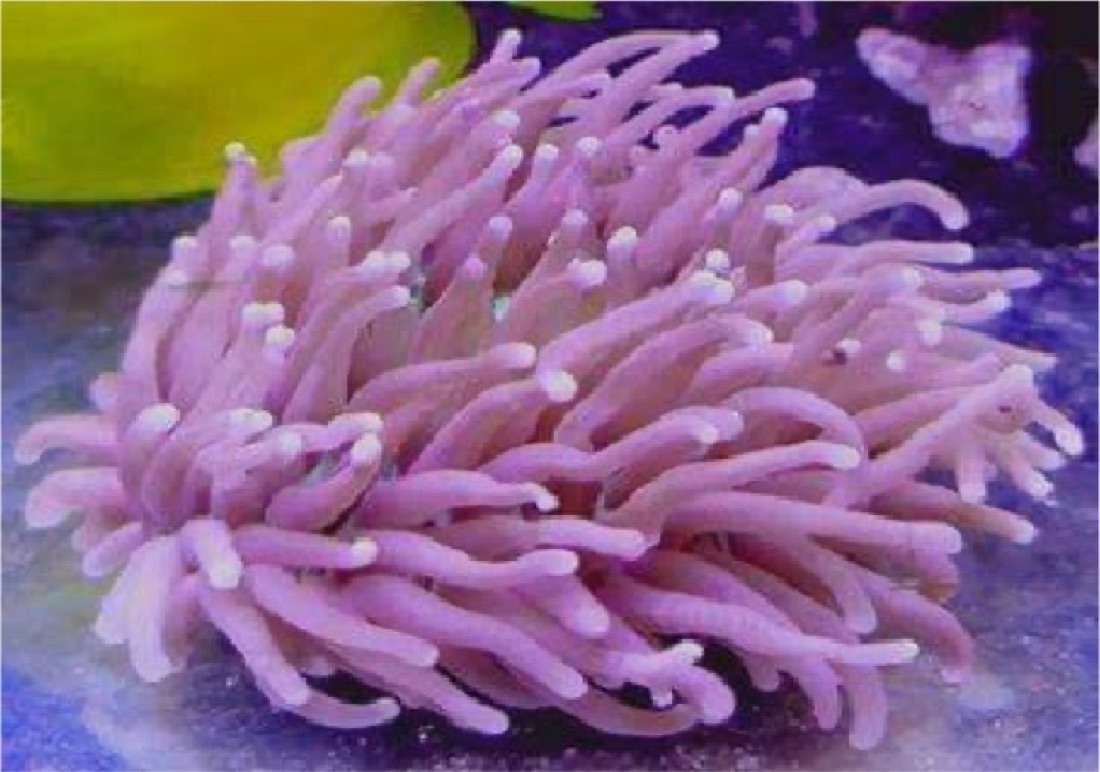
It belongs to the family Fungiidae. Generally the tentacles are a deep green, while the oral disc and the tips of the tentacles are paler, fluorescent green or grey. There are also individuals with bright colours, such as pink tentacles with a fuchsia or white oral disc and tips, or magenta-red tentacles with a grey oral disc and tentacle tips. Place of origin: found in the central-western Pacific Ocean: the Australian Great Barrier Reef, the Philippines, Papua New Guinea. It has a disc-shaped calcareous skeleton, a flat mushroom-shaped calcareous skeleton that makes it look very much like a sea anemone, with very numerous radial septa bearing large lobed teeth, to which the tissues of the polyp are anchored; in the centre of the disc the large fleshy mouth can be seen. In the wild this solitary coral measures from 15 to 20 centimetres and is usually found on the sandy or pebbly bottom of reef lagoons at depths ranging from 1 to 25 metres. In the aquarium this coral, placed on the bottom, needs intense lighting and moderate water movement with alternating flow. Fairly hardy for a stony coral, but it needs strictly stable water parameters with optimal values. Despite the presence of symbiotic algae of the genus Zooxanthella, it is advisable to feed this anthozoan also with frozen or freeze-dried plankton, soaked for a few minutes in aquarium water and squirted with a syringe near the mouth. If very large, Heliofungia actiniformis can also be fed small pieces of mussel flesh or bits of fish placed gently on the extended tentacles. It is advisable for experienced aquarists who can meet its particular care requirements.
Species sheet by Massimo Ramognino and photo by Daniele Bonifazi
What studies say about keeping it
It is among the corals recorded in the aquariums of the Species360 network. 16
Did you know?
Sources
- Hoeksema B.W., Cairns S., Samimi-Namin K. (2026). Heliofungia actiniformis (Quoy & Gaimard, 1833). World Register of Marine Species.
- Hoeksema B.W. (1989). Taxonomy, phylogeny and biogeography of mushroom corals (Scleractinia: Fungiidae). Zoologische Verhandelingen 254, Naturalis.
- UNEP-WCMC (2026). Heliofungia actiniformis, CITES record. Species+.
- SeaLifeBase (2026). Heliofungia actiniformis, IUCN status and bleaching. SeaLifeBase.
- GBIF Secretariat (2026). Heliofungia actiniformis, IUCN Red List category. GBIF.
- Knittweis L., Jompa J., Richter C., Wolff M. (2009). Population dynamics of the mushroom coral Heliofungia actiniformis in the Spermonde Archipelago, South Sulawesi, Indonesia. Coral Reefs.
- Knittweis L., Wolff M. (2010). Live coral trade impacts on the mushroom coral Heliofungia actiniformis in Indonesia: Potential future management approaches. Biological Conservation.
- Knittweis L., Kraemer W.E., Timm J., Kochzius M. (2009). Genetic structure of Heliofungia actiniformis populations in the Indo-Malay Archipelago: implications for live coral trade management efforts. Conservation Genetics.
- Amjad F. et al. (2024). An underwater imagery identification guide for shallow, mesophotic and deep-sea benthos in Maldives. Biodiversity Data Journal.
- Hata T., Madin J.S., Cumbo V.R., Denny M., Figueiredo J. et al. (2017). Coral larvae are poor swimmers and require fine-scale reef structure to settle. Scientific Reports.
- Dobson N.C., Johnson M.L., De Grave S. (2016). Insights into the morphology of symbiotic shrimp eyes (Crustacea, Decapoda, Palaemonidae). PeerJ.
- Horká I., De Grave S., Fransen C.H., Petrusek A., Ďuriš Z. (2016). Multiple host switching events shape the evolution of symbiotic palaemonid shrimps. Scientific Reports.
- Coral Trait Database (2026). Heliofungia actiniformis, Coral Trait Database data. Coral Trait Database.
- Carpenter K.E. et al. (2008). One-third of reef-building corals face elevated extinction risk from climate change and local impacts (record in the Coral Trait Database). Science.
- Lee J.N. et al. (2022). Scleractinian coral diversity of the Mersing Islands, Peninsular Malaysia. ZooKeys.
- da Silva R., Conde D.A. (2019). Data on the conservation potential of fish and coral populations in aquariums. Data in Brief.
- LaJeunesse T.C. et al. (2004). Closely related Symbiodinium spp. differ in relative dominance in coral reef host communities (record in the Coral Trait Database). Marine Ecology Progress Series.
Sources checked on 5 November 2026. Community texts and ratings are kept separate from the scientific data.