
Acropora valida
A hard coral of the genus Acropora, described by Dana in 1846 from a specimen from Fiji. 1 2 It usually forms compact colonies with a defined outline (corymbose), with branches 5-10 cm long. 2 It is very widespread: from the Red Sea to the Pacific, from shallow water down to about 30 m. 2 3 7
At a glance
Data from the scientific sources listed at the bottom.
Depth in the wild
0–30 m
Conservation
IUCN Red List: endangered (2023). CITES: Appendix II. The listed criterion is A3ce. 3 The CITES listing currently in force dates back to 18 January 1990; in the European Union it is in Annex B. 4
The coral
Group: SPS
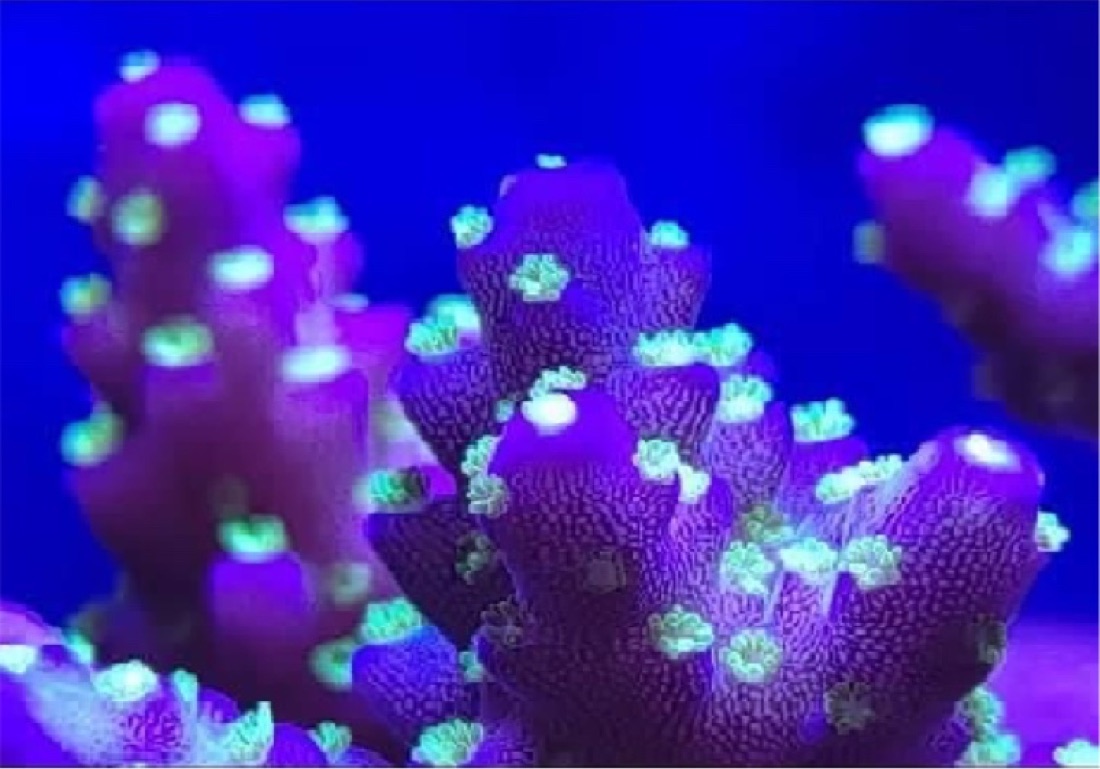
Growth form: corymbose with a defined outline, with branches 50-100 mm long and 10-20 mm thick; some colonies are table-shaped 2
Zooxanthellae: yes
Growth: At Johnston Atoll, with water at 26 °C on average, an average of 45 mm a year was measured over 24 replicates. 5 8
Where it lives
WoRMS records it from, among other places, the Red Sea, East Africa, the Seychelles, Chagos, the Maldives, India, Australia, Fiji, the Marshall Islands and American Samoa. 1 The Queensland reference collection holds specimens from the Red Sea, the Persian Gulf, Oman, Kenya, South Africa, South-East Asia, Australia, Japan, Hawaii, Tahiti and Pitcairn, as far as Colombia. 2 Species+ confirms, among others, Madagascar, Egypt, Sudan and Colombia. 4
How to recognise it
Tap a number on the photo: the key explains what to look for.
Life in the wild
In the aquarium
From the experience of the BallingMania community.
It belongs to the family Acroporidae; its colour is generally ochre, purple, pink and green; the colour varies a lot with the amount of symbiotic algae of the zooxanthellae type present. The Tricolor variety, with very bright colours, is much appreciated: the corallite is ochre and purple with deep blue tips, while the polyps are fluorescent green.
Place of origin: the Red Sea, the Indian Ocean, the Pacific Ocean.
This coral lives on the upper slopes of the coral reef at a depth of 1-15 m. In the wild colonies are seen that often exceed 50 metres in diameter. The colony is generally made up of a great many small polyps. The tentacles are both very stinging and very sticky, useful for catching the zooplankton on which it feeds. All the corallites, fused together, form the calcareous skeleton of the colony, with its typical compact, regular, hemispherical bush shape, with "branch" formations that start from a central root and stretch out radially in every direction.
In the aquarium this coral grows very slowly, which is why it is advisable to place it in the middle-to-upper part, in a position where it can receive good lighting. It appreciates strong, alternating water movement.
Water conditions must be very good, with stable chemical values and a low organic and inorganic load. It is vulnerable to attack by pests and does not tolerate high temperatures well. An easy coral to keep, advisable even for not very
Species sheet by Massimo Ramognino and photo by llario lorio
What studies say about keeping it
In a trial of ten corals in a land-based recirculating system, at 26, 28, 30 and 32 °C for two months, this species was the only one to perform best at 26 °C. 11 The flatworm Amakusaplana acroporae, which feeds on coral, attacks this species in aquariums, and infestations can lead to the rapid and complete death of the colony; it has also been found in the wild on colonies at Lizard Island. 10
Did you know?
Sources
- Hoeksema B.W., Cairns S., Samimi-Namin K. (2026). Acropora valida (Dana, 1846). World List of Scleractinia, via WoRMS.
- Wallace C.C., Done B.J., Muir P.R. (2012). Revision and catalogue of worldwide staghorn corals Acropora and Isopora (Scleractinia: Acroporidae) in the Museum of Tropical Queensland. Memoirs of the Queensland Museum - Nature.
- Palomares M.L.D., Pauly D. (eds.) (2026). Acropora valida. SeaLifeBase.
- UNEP-WCMC (2026). Acropora valida, CITES listings and distribution. Species+.
- Madin J. et al. (eds.) (2026). Acropora valida. Coral Trait Database.
- Muir P., Wallace C., Bridge T.C.L., Bongaerts P. (2015). Diverse Staghorn Coral Fauna on the Mesophotic Reefs of North-East Australia. PLOS ONE.
- Bouchon C. (1981). Quantitative Study of the Scleractinian Coral Communities of a Fringing Reef of Reunion Island (Indian Ocean). Marine Ecology Progress Series, reference in the Coral Trait Database.
- Jokiel P.L., Tyler W.A. (1992). Distribution of stony corals in Johnston Atoll lagoon. Proceedings of the 7th International Coral Reef Symposium, reference in the Coral Trait Database.
- Langley C., Doropoulos C., dela Cruz D., Harrison P.L. (2025). Scaling up coral spawn collection: Impacts of method and timing on Acropora valida larval quality. PLOS One.
- Rawlinson K.A., Stella J.S. (2012). Discovery of the Corallivorous Polyclad Flatworm, Amakusaplana acroporae, on the Great Barrier Reef, Australia - the First Report from the Wild. PLoS ONE.
- Loo P.L., Tan K.S., Lee Y., Kikuzawa Y.P., Yeo J.H.S., Toh T.C. (2021). Optimal temperature regimes for land-based mariculture of tropical corals. Aquaculture Research.
- Cairns S.D. (1999). Species richness of recent Scleractinia. Atoll Research Bulletin, reference in the Coral Trait Database.
Sources checked on 5 November 2026. Community texts and ratings are kept separate from the scientific data.
