
Acropora tenuis
A hard coral of the genus Acropora at the centre of a recent revision: for a long time its name lumped together several similar species. 2 3 In the strict sense it is now known only from Fiji and Tonga. 2 Much data published as 'A. tenuis' comes from other places and therefore concerns this group of related species, not necessarily the true species. 2 4 10
At a glance
Data from the scientific sources listed at the bottom.
Depth in the wild
3–20 m
Conservation
IUCN Red List: endangered (2023). CITES: Appendix II. The listed criterion is A3ce, as reported by WoRMS and SeaLifeBase. 1 6 7 For international trade, the listing currently in force dates back to 18 January 1990; in the European Union it is in Annex B. 5 The revision of the group warns that these species have much smaller ranges and populations than was thought. 3 The related species A. kenti, on the other hand, has a separate assessment, for now Data Deficient. 15
The coral
Group: SPS
Growth form: corymbose or table-shaped, very variable; in Tonga also thick bottlebrush
Zooxanthellae: yes
Where it lives
In the strict sense, only Fiji and Tonga, in the South Pacific; similar specimens from other regions are probably other species, including A. kenti (Great Barrier Reef, Papua New Guinea, Coral Sea, Lord Howe), A. bifaria (Java), A. macrostoma (Mauritius) and A. assicana (South Africa). 2 4 In the broad sense, earlier or not yet updated databases give the name from East Africa and the Red Sea as far as Samoa and the Cook Islands. 1 5 7
Life in the wild
Where it is found
The depth figure applies in the broad sense: 3-20 m in SeaLifeBase, 8-20 m in a 2008 dataset 11 14 and down to 26 m in another study. 11 13 Again in the broad sense, the name is associated with upper reef slopes and shallow reef flats. 1 7 In the strict sense, the specimens most similar to Dana's original come from a reef flat on the south coast of Viti Levu, in Fiji. 2
What it eats
It hosts symbiotic algae (zooxanthellae). In the laboratory, larvae of A. tenuis in the broad sense collected at Okinawa were exposed to cultured symbionts: after 24 hours about 30% of the larvae had taken up Symbiodinium microadriaticum, and 6% and 3% two other types. 9
Reproduction
A hermaphrodite that releases eggs and sperm into the sea. 7 11 12 This figure comes from the Great Barrier Reef, where the correct name today would be A. kenti. 4 12 At Okinawa, in a population of the A. tenuis group, spawning took place at around 8 pm: in 2018 six days after the full moon, in 2019 the day after. 8
In the aquarium
From the experience of the BallingMania community.
Acropora tenuis belongs to the order of the Acroporidae (SPS); it is found in the Indian Ocean, the Pacific and the Red Sea and is among the species at risk of extinction described in the “IUCN Red List”.
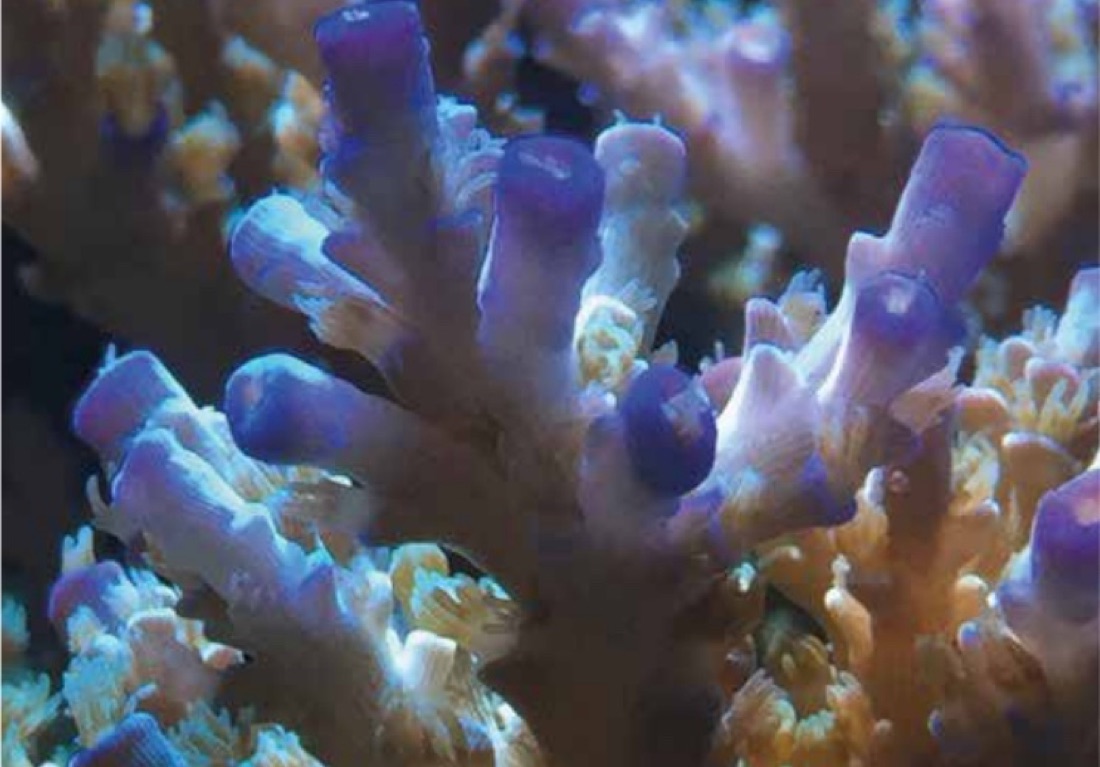
This magnificent coral is found at about 8/20 metres deep on coral reefs, and its colour varies in the following shades: yellow/cream, emerald green or light blue/blue, all with tips that are markedly coloured compared with the corallite. An aquarist wishing to keep this marvellous Acropora must have a medium-to-high level of knowledge in keeping small-polyp stony corals.
photo by: Ciro Murino
What studies say about keeping it
Data from research aquaculture, referring to the A. tenuis group from Okinawa, and not advice for a home aquarium. At the Yaeyama Station, colonies collected in the wild were kept for about a year in tanks with flowing seawater and spawned in the tanks the following season. 8 In corals of the group raised in aquaculture, colour stayed stable for 7 days at 27.5 and 30 °C, while at 32 °C they began to pale. 10
Did you know?
Sources
- Hoeksema B.W., Cairns S., Samimi-Namin K. (2026). Acropora tenuis (Dana, 1846). World List of Scleractinia, via WoRMS.
- Bridge T.C.L., Cowman P.F., Quattrini A.M. et al. (2024). A tenuis relationship: traditional taxonomy obscures systematics and biogeography of the 'Acropora tenuis' species complex, section on Acropora tenuis. Zoological Journal of the Linnean Society, testo riprodotto da Plazi.
- Bridge T.C.L., Cowman P.F., Quattrini A.M. et al. (2024). A tenuis relationship: traditional taxonomy obscures systematics and biogeography of the 'Acropora tenuis' species complex, riassunto. Zoological Journal of the Linnean Society, portale James Cook University.
- Bridge T.C.L., Cowman P.F., Quattrini A.M. et al. (2024). A tenuis relationship: traditional taxonomy obscures systematics and biogeography of the 'Acropora tenuis' species complex, section on Acropora kenti. Zoological Journal of the Linnean Society, testo riprodotto da Plazi.
- UNEP-WCMC (2026). Acropora tenuis, CITES listings and distribution. Species+.
- GBIF Secretariat (2026). Acropora tenuis on the IUCN Red List (Richards and Nuñez Lendo), data from GBIF. GBIF.
- Palomares M.L.D., Pauly D. (eds.) (2026). Acropora tenuis. SeaLifeBase.
- Yoshioka Y., Suzuki G., Fujikura Y. et al. (2025). Time-Series RNA-Seq of Acropora tenuis Reveals Molecular Waves Leading to Synchronous Mass Spawning of Scleractinian Corals. Molecular Ecology.
- Yoshioka Y., Yamashita H., Suzuki G., Shinzato C. (2022). Larval transcriptomic responses of a stony coral, Acropora tenuis, during initial contact with the native symbiont, Symbiodinium microadriaticum. Scientific Reports.
- Gushi M., Ishibashi H., Takayama K., Yamashiro H., Takeuchi I. (2025). Interactive effects of high seawater temperature and the PS II herbicide Irgarol 1051 on photosynthetic efficiency of one species of the Acropora tenuis [sensu lato] complex. Marine Pollution Bulletin.
- Madin J. et al. (eds.) (2026). Acropora tenuis. Coral Trait Database.
- Babcock R.C., Bull G.D., Harrison P.L. et al. (1986). Synchronous spawnings of 105 scleractinian coral species on the Great Barrier Reef. Marine Biology, reference in the Coral Trait Database.
- Muir P.R., Wallace C.C., Done T., Aguirre J.D. (2015). Limited scope for latitudinal extension of reef corals. Science.
- Carpenter K.E., Abrar M., Aeby G. et al. (2008). One-third of reef-building corals face elevated extinction risk from climate change and local impacts. Science.
- GBIF Secretariat (2026). Acropora kenti, IUCN Red List category. GBIF.
Sources checked on 5 November 2026. Community texts and ratings are kept separate from the scientific data.