
At a glance
Data from the scientific sources listed at the bottom.
Depth in the wild
2–25 m
Conservation
IUCN Red List: vulnerable (2023). CITES: Appendix II. The listed criterion is A3ce. 3 An older list, reported in the Coral Trait Database, gave it as Least Concern. 4 The CITES listing currently in force dates back to 18 January 1990; in the European Union it is in Annex B. 2
The coral
Group: SPS
Growth form: branching, with thin branches that spread at a wide angle and form low tangles; protruding corallites of 0.7-1 mm 7
Zooxanthellae: yes
Where it lives
From the Seychelles and Madagascar to the Marshall Islands and Fiji; Species+ also lists it for the Cocos (Keeling) Islands, Indonesia, Malaysia, the Philippines, Vietnam, Japan, Australia, Papua New Guinea, the Solomon Islands, Vanuatu and New Caledonia. 1 2 A study on ranges places it between about 34° E and 174° W and between 30° N and 29° S. 4 6
How to recognise it
Tap a number on the photo: the key explains what to look for.
Life in the wild
Where it is found
Shallow, usually turbid reefs and deeper soft bottoms; it is also found on the upper part of exposed slopes. 3 The 2-25 m range comes from a 2008 dataset. 3 4 5 For the genus as a whole, the fragile branches point to environments with little turbulence, and the deeper bottoms can be rich in silt. 8
In the aquarium
From the experience of the BallingMania community.
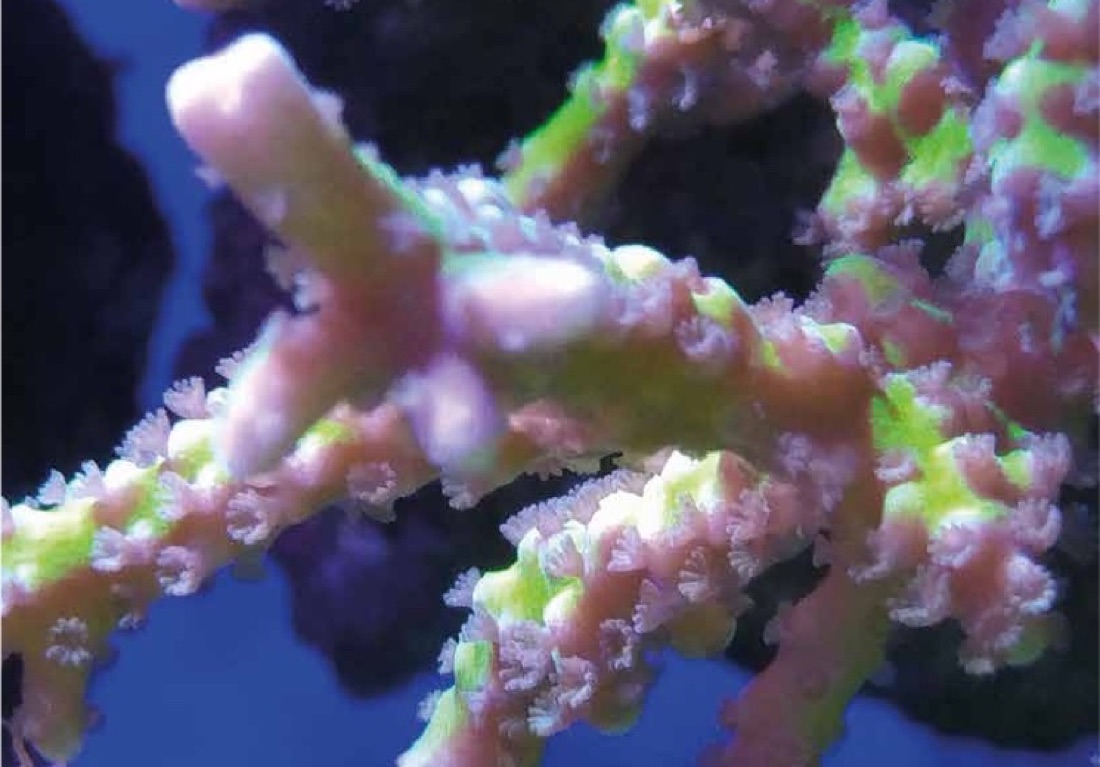
Anacropora forbesi lives in the Indian and Pacific Oceans and differs from Acropora in the absence of axial corallites at the tips of its branches. It is found mainly in muddy water at a depth of about 8/10 metres.
This coral is made up of branches less than ten centimetres long that form small colonies.
Its colour ranges from light green to dark green, depending on the amount of light where it is growing.
photo by: Ciro Murino
Did you know?
Sources
- Hoeksema B.W., Cairns S., Samimi-Namin K. (2026). Anacropora forbesi Ridley, 1884. World List of Scleractinia, via WoRMS.
- UNEP-WCMC (2026). Anacropora forbesi, CITES listings and distribution. Species+.
- Palomares M.L.D., Pauly D. (eds.) (2026). Anacropora forbesi, False flower coral. SeaLifeBase.
- Madin J. et al. (eds.) (2026). Anacropora forbesi. Coral Trait Database.
- Carpenter K.E., Abrar M., Aeby G. et al. (2008). One-third of reef-building corals face elevated extinction risk from climate change and local impacts. Science, reference in the Coral Trait Database.
- Hughes T.P., Connolly S.R., Keith S.A. (2013). Geographic ranges of reef corals (Cnidaria: Anthozoa: Scleractinia) in the Indo-Pacific. Ecology, reference in the Coral Trait Database.
- Pillai C.S.G. (1973). A review of the genus Anacropora Ridley (Scleractinia, Acroporidae) with the description of a new species. Journal of the Marine Biological Association of India.
- Naturalis Biodiversity Center (2026). Genus Anacropora, Reef Corals of the Indo-Malayan Seas. Naturalis Biodiversity Center.
- Cairns S.D. (1999). Species richness of recent Scleractinia. Atoll Research Bulletin, reference in the Coral Trait Database.
Sources checked on 5 November 2026. Community texts and ratings are kept separate from the scientific data.