
Acropora jaquelinae
Currently accepted name: Acropora jacquelineae
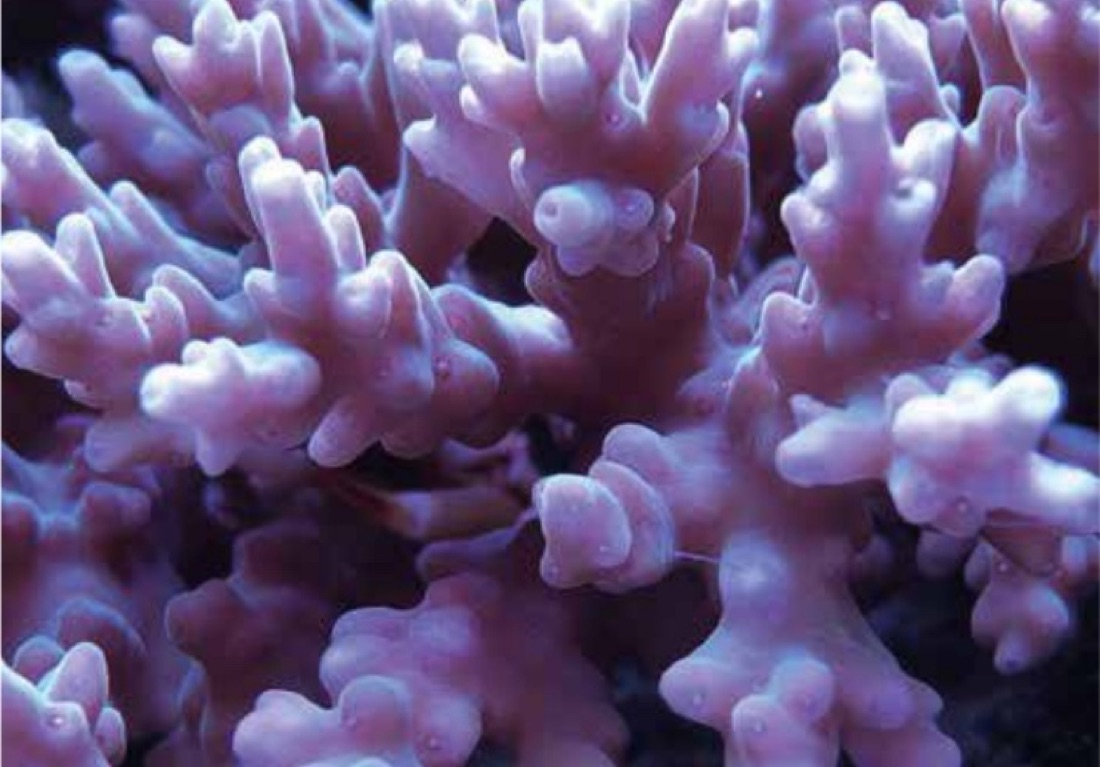
The correct name is Acropora jacquelineae: the spelling 'jaquelinae' does not exist on WoRMS. 1 It is a coral with flat plates, their surface densely covered with thin corallites that give them an almost mossy look. 4 It has a small range, centred on the Coral Triangle, and lives on slopes and walls between 10 and 35 m. 4 5
At a glance
Data from the scientific sources listed at the bottom.
Depth in the wild
10–35 m
Size
up to 25 cm
usual colony diameter; it can reach about 1 m
Conservation
IUCN Red List: vulnerable (2023). CITES: Appendix II. The listed criterion is A3ce. 7 The CITES listing in force dates from 18 January 1990; in the European Union it is in Annex B. 2 The category is also confirmed by GBIF and WoRMS. 1 8 In the United States it is classified as Threatened under the Endangered Species Act: the 2024 review did not change its status. 5 NOAA estimates about 31 million colonies and considers it highly sensitive to ocean warming, based, however, on data for the genus rather than the species. 4
Where it lives
Coral Triangle: Indonesia, Malaysia, the Philippines, New Guinea and the Solomon Islands, as far as the central Pacific. 5 Museum specimens come from Flores, Sulawesi, Halmahera, Papua New Guinea, the Solomon Islands and Pohnpei. 3 Species+ adds New Caledonia, Tonga and American Samoa. 2 Its presence in American Samoa is uncertain: specimens attributed to this species could be A. aculeus. 4
The coral
Group: SPS
Growth form: plate-like, with an undefined outline and short cylindrical branches
Zooxanthellae: yes
Life in the wild
What it eats
It hosts symbiotic algae (zooxanthellae). 1 I found no studies on the symbiont types of this species.
In the aquarium
From the experience of the BallingMania community.
An Acropora with tabular growth and a branching appearance. This Acropora belongs to the “deep water” family (deep-water corals).
Being a deep-water coral, it prefers direct but gentle light; excellent results are achieved with T5 fluorescent tubes. Its position in the aquarium should in fact be towards the bottom, in the lower part of the rockwork. It wants a continuous but not direct current.
Keeping it is difficult because it is a fairly delicate animal that needs stable values (Ca, Mg and KH) and perfect water free of pollutants, so it is not recommended for beginners.
photo by: Alessandro Tomaselli
Did you know?
Sources
- Hoeksema B.W., Cairns S., Samimi-Namin K. (2026). Acropora jacquelineae Wallace, 1994. World List of Scleractinia, via WoRMS.
- UNEP-WCMC (2026). Acropora jacquelineae, CITES listings and distribution. Species+.
- Wallace C.C., Done B.J., Muir P.R. (2012). Acropora jacquelineae Wallace, 1994, in: Revision and catalogue of worldwide staghorn corals Acropora and Isopora (Scleractinia: Acroporidae) in the Museum of Tropical Queensland. Memoirs of the Queensland Museum - Nature.
- National Marine Fisheries Service, NOAA (2014). Final listing determinations on proposal to list 66 reef-building coral species and to reclassify elkhorn and staghorn corals (79 FR 53852). Federal Register.
- NOAA Fisheries (2026). Acropora jacquelineae coral. NOAA.
- Madin J. et al. (eds.) (2026). Acropora jacquelineae: data from Carpenter 2008, Muir 2015. Coral Trait Database.
- Palomares M.L.D., Pauly D. (eds.) (2026). Acropora jacquelineae. SeaLifeBase.
- GBIF Secretariat (2026). Acropora jacquelineae, IUCN Red List category. GBIF.
- Wallace C.C., Wolstenholme J. (1998). Revision of the coral genus Acropora (Scleractinia: Astrocoeniina: Acroporidae) in Indonesia. Zoological Journal of the Linnean Society.
Sources checked on 5 November 2026. Community texts and ratings are kept separate from the scientific data.