Acropora loisettae
Currently accepted name: Acropora loisetteae
A hard coral of the genus Acropora, tree-shaped with thin branches, described in 1994 from material from Scott Reef, in Western Australia. 1 5 The correct scientific name is spelled loisetteae. 1 It lives between the eastern Indian Ocean and the central Indo-Pacific, and some museum specimens come from further east. 5 8
At a glance
Data from the scientific sources listed at the bottom.
Depth in the wild
1–30 m
Conservation
IUCN Red List: endangered (2023). CITES: Appendix II. The listed criterion is A3ce. 3 An older list, reported in the Coral Trait Database, gave it as vulnerable. 4 The CITES listing currently in force dates back to 18 January 1990; in the European Union it is in Annex B. 2
The coral
Group: SPS
Growth form: tree-like (arborescent) colony without a defined outline; cylindrical branches more than 10 cm long and 2.5-4.9 mm wide 5
Zooxanthellae: yes
Where it lives
The type locality is Scott Reef, in Western Australia; the Museum of Tropical Queensland also holds specimens from Thailand, Malaysia (Sabah), Indonesia (Sulawesi and Papua), Papua New Guinea and the Marshall Islands. 5 Species+ lists it for Australia, Indonesia, Malaysia and New Caledonia. 2 A study on coral ranges places it between about 20° N and 29° S and between 94° and 135° E, so less far east than the museum specimens suggest. 4 8
How to recognise it
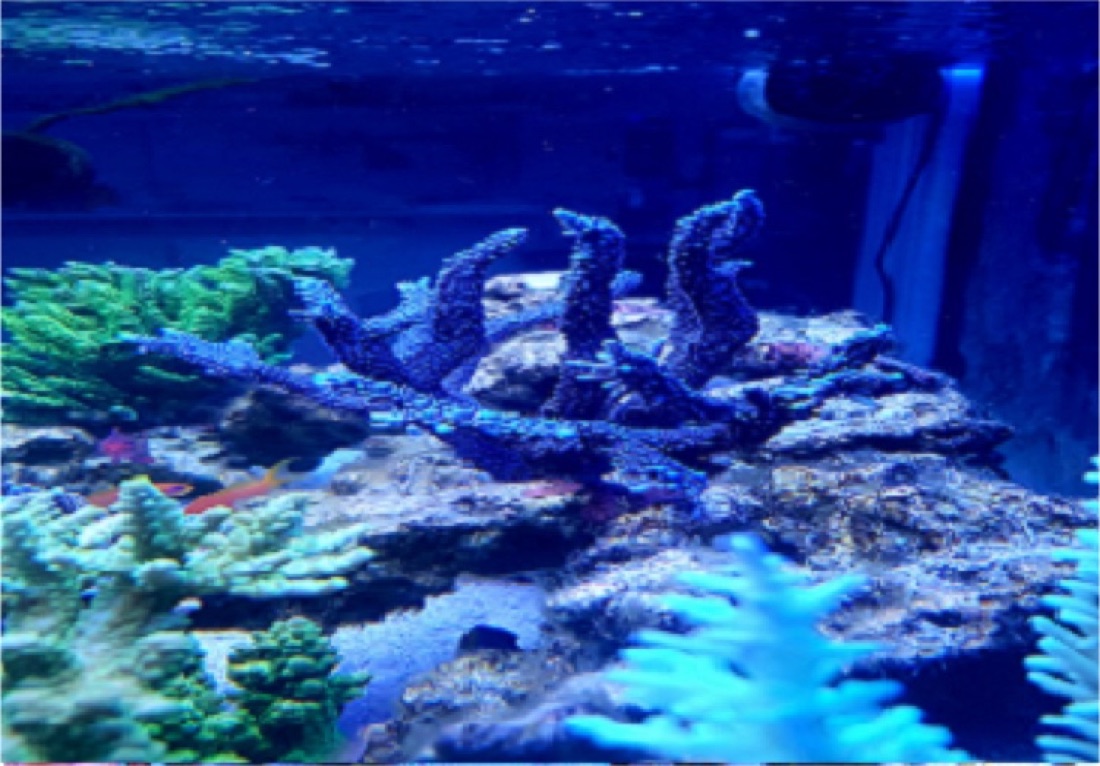
Tap a number on the photo: the key explains what to look for.
Life in the wild
In the aquarium
From the experience of the BallingMania community.
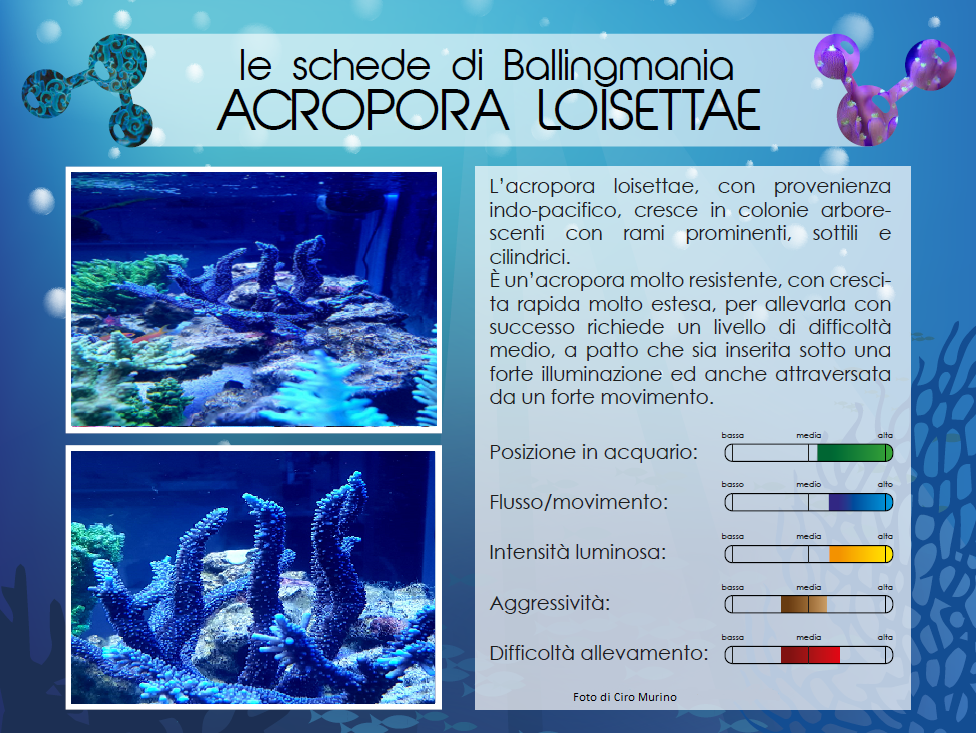
Acropora loisettae, from the Indo-Pacific, grows in arborescent colonies with prominent, thin, cylindrical branches.
It is a very hardy Acropora, with rapid and very extensive growth; keeping it successfully requires a medium level of difficulty, as long as it is placed under strong lighting and also exposed to strong water movement.
Photo by Ciro Murino
Did you know?
Sources
- Hoeksema B.W., Cairns S., Samimi-Namin K. (2026). Acropora loisetteae Wallace, 1994. World List of Scleractinia, via WoRMS.
- UNEP-WCMC (2026). Acropora loisetteae, CITES listings and distribution. Species+.
- Palomares M.L.D., Pauly D. (eds.) (2026). Acropora loisetteae. SeaLifeBase.
- Madin J. et al. (eds.) (2026). Acropora loisetteae. Coral Trait Database.
- Wallace C.C., Done B.J., Muir P.R. (2012). Revision and catalogue of worldwide staghorn corals Acropora and Isopora (Scleractinia: Acroporidae) in the Museum of Tropical Queensland. Memoirs of the Queensland Museum - Nature, record on Plazi.
- Carpenter K.E., Abrar M., Aeby G. et al. (2008). One-third of reef-building corals face elevated extinction risk from climate change and local impacts. Science, reference in the Coral Trait Database.
- Muir P.R., Wallace C.C., Done T., Aguirre J.D. (2015). Limited scope for latitudinal extension of reef corals. Science, reference in the Coral Trait Database.
- Hughes T.P., Connolly S.R., Keith S.A. (2013). Geographic ranges of reef corals (Cnidaria: Anthozoa: Scleractinia) in the Indo-Pacific. Ecology, reference in the Coral Trait Database.
- Cairns S.D. (1999). Species richness of recent Scleractinia. Atoll Research Bulletin, reference in the Coral Trait Database.
Sources checked on 5 November 2026. Community texts and ratings are kept separate from the scientific data.