
Acropora hyacinthus
A table-forming hard coral of the genus Acropora, described in 1846 from a specimen from Fiji. 1 2 For decades the name lumped together many similar species: a 2025 genetic revision recognised 16 species in the group and restricted the true A. hyacinthus to the South and South-West Pacific. 2 Much of the data published before that revision therefore concerns the group, not necessarily this species. 2
At a glance
Data from the scientific sources listed at the bottom.
Depth in the wild
0–20 m
Size
up to 300 cm
maximum colony diameter, in the broad sense [9] [12]
Conservation
IUCN Red List: endangered (2023). CITES: Appendix II. The listed criterion is A3ce. 1 The CITES listing currently in force dates back to 18 January 1990; in the European Union it is in Annex B. 3 The IUCN assessment predates the 2025 revision, according to which the species in the group have much smaller ranges than was thought. 2
Where it lives
In the strict sense, from the Cook Islands (Rarotonga) west through Tonga, Fiji, New Caledonia and the Coral Sea, to the Great Barrier Reef, the Solitary Islands and Lord Howe, in eastern Australia. 2 According to the same revision it does not live in the Indian Ocean or the Red Sea. 2 Databases not yet updated give the name over a much wider area, from East Africa and the Red Sea to Polynesia. 1 3
The coral
Group: SPS
Growth form: table or plate-shaped; in the species in the strict sense the end branches have different lengths and grow in several directions
Zooxanthellae: yes
Growth: About 94-105 mm a year at Enewetak, at a depth of 6 m: a figure in the broad sense, outside the restricted range. 2 9 10
Life in the wild
Where it is found
The depth figure applies in the broad sense: 5-20 m in a 2008 dataset, 9 11 while the WoRMS notes describe it as most common below 3-4 m, especially on wave-swept crests, and also on upper slopes and outer reef flats. 1 Extreme values reported are 35 m in clear water and lagoons 1 and 52 m in SeaLifeBase. 4
What it eats
It hosts symbiotic algae (zooxanthellae). 9
Behaviour
It can keep its long tentacles extended even by day. 1
Reproduction
A hermaphrodite that releases eggs and sperm into the sea. 4 8 On the central Great Barrier Reef (Trunk Reef), within the restricted range, it spawned 8 to 11 days after the full moon, between 9.35 pm and 10.15 pm. 5 At One Tree Island 35-47% of the larvae of the corals studied, including this species, began attaching to settlement tiles 2-3 days after spawning. 8 In the Maldives, outside the restricted range, colonies going by this name spawned in March and April. 2 7
In the aquarium
From the experience of the BallingMania community.
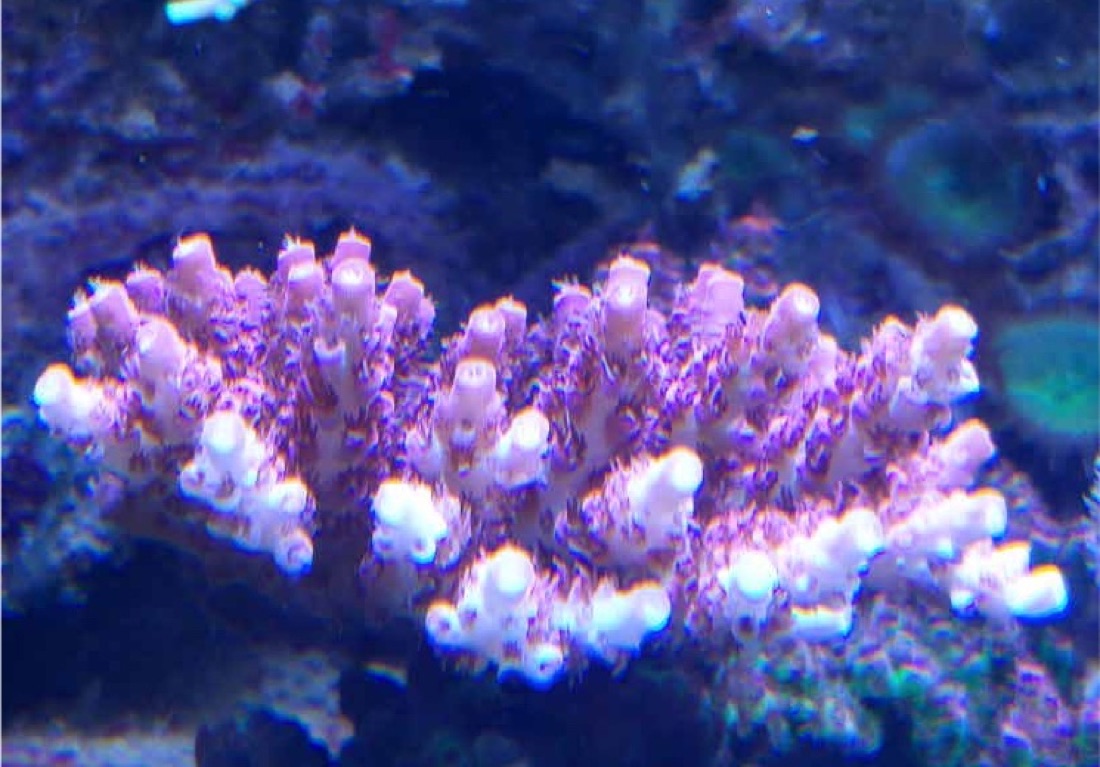
Acropora hyacinthus, from the Indo-Pacific, has a tabular growth form, and reproduction can take place either by fragmentation or asexually.
In the wild this Acropora species is found on the upper part of the reef, which is why, to be kept, it needs strong lighting and intense water movement; it is of medium difficulty to keep.
photo by: Vincenzo Milazzo
What studies say about keeping it
Data from a research study, not advice for a home aquarium. In a 780-litre closed system, 14 colonies from Singapore (outside the restricted range) were kept with seasonal temperature cycles, light from about 378 to 498 µmol/m²/s and simulated moonlight. Ten arrived already carrying eggs and spawned in 2015; four completed a full cycle in the tank and spawned in April 2016, with a delay relative to the moon that the authors attribute perhaps to residual light. 6
Did you know?
Sources
- Hoeksema B.W., Cairns S., Samimi-Namin K. (2026). Acropora hyacinthus (Dana, 1846). World List of Scleractinia, via WoRMS.
- Rassmussen S.H., Cowman P.F., Baird A.H. et al. (2025). The tables have turned: taxonomy, systematics and biogeography of the Acropora hyacinthus (Scleractinia: Acroporidae) complex. Invertebrate Systematics.
- UNEP-WCMC (2026). Acropora hyacinthus, CITES listings and distribution. Species+.
- Palomares M.L.D., Pauly D. (eds.) (2026). Acropora hyacinthus. SeaLifeBase.
- Chan W.Y., Peplow L.M., van Oppen M.J.H. (2019). Interspecific gamete compatibility and hybrid larval fitness in reef-building corals: Implications for coral reef restoration. Scientific Reports.
- Craggs J., Guest J.R., Davis M., Simmons J., Dashti E., Sweet M. (2017). Inducing broadcast coral spawning ex situ: Closed system mesocosm design and husbandry protocol. Ecology and Evolution.
- Monfared M.A.A., Sheridan K., Dixon S.P., Gledhill M., Le Berre T. (2023). Coral spawning patterns of Acropora across two Maldivian reef ecosystems. PeerJ.
- Harrison P.L. (2006). Settlement competency periods and dispersal potential of scleractinian reef coral larvae. Proceedings of the 10th International Coral Reef Symposium, Southern Cross University portal.
- Madin J. et al. (eds.) (2026). Acropora hyacinthus. Coral Trait Database.
- Stimson J. (1985). The Effect of Shading by the Table Coral Acropora hyacinthus on Understory Corals. Ecology, reference in the Coral Trait Database.
- Carpenter K.E., Abrar M., Aeby G. et al. (2008). One-Third of Reef-Building Corals Face Elevated Extinction Risk from Climate Change and Local Impacts. Science, reference in the Coral Trait Database.
- Wallace C.C., Wolstenholme J. (1998). Revision of the coral genus Acropora (Scleractinia: Astrocoeniina: Acroporidae) in Indonesia. Zoological Journal of the Linnean Society, reference in the Coral Trait Database.
Sources checked on 5 November 2026. Community texts and ratings are kept separate from the scientific data.