At a glance
Data from the scientific sources listed at the bottom.
Depth in the wild
3–20 m
Size
up to 200 cm
maximum colony diameter
Conservation
IUCN Red List: endangered (2023). CITES: Appendix II. The listed criterion is A3ce. 3 The CITES listing currently in force dates back to 18 January 1990; in the European Union it is in Annex B. 2
Where it lives
According to the range dataset of Hughes et al. it runs from about 25° E to about 138° W and from about 31° N to 34° S, covering almost 90 million km². 4 8 WoRMS gives it in the Red Sea, Kenya, Mauritius, South Africa, the western Indo-Pacific and Fiji. 1 Species+ lists 32 countries and territories, including Egypt, Mozambique, the Maldives, Thailand, Indonesia, Japan, Australia and French Polynesia. 2
How to recognise it
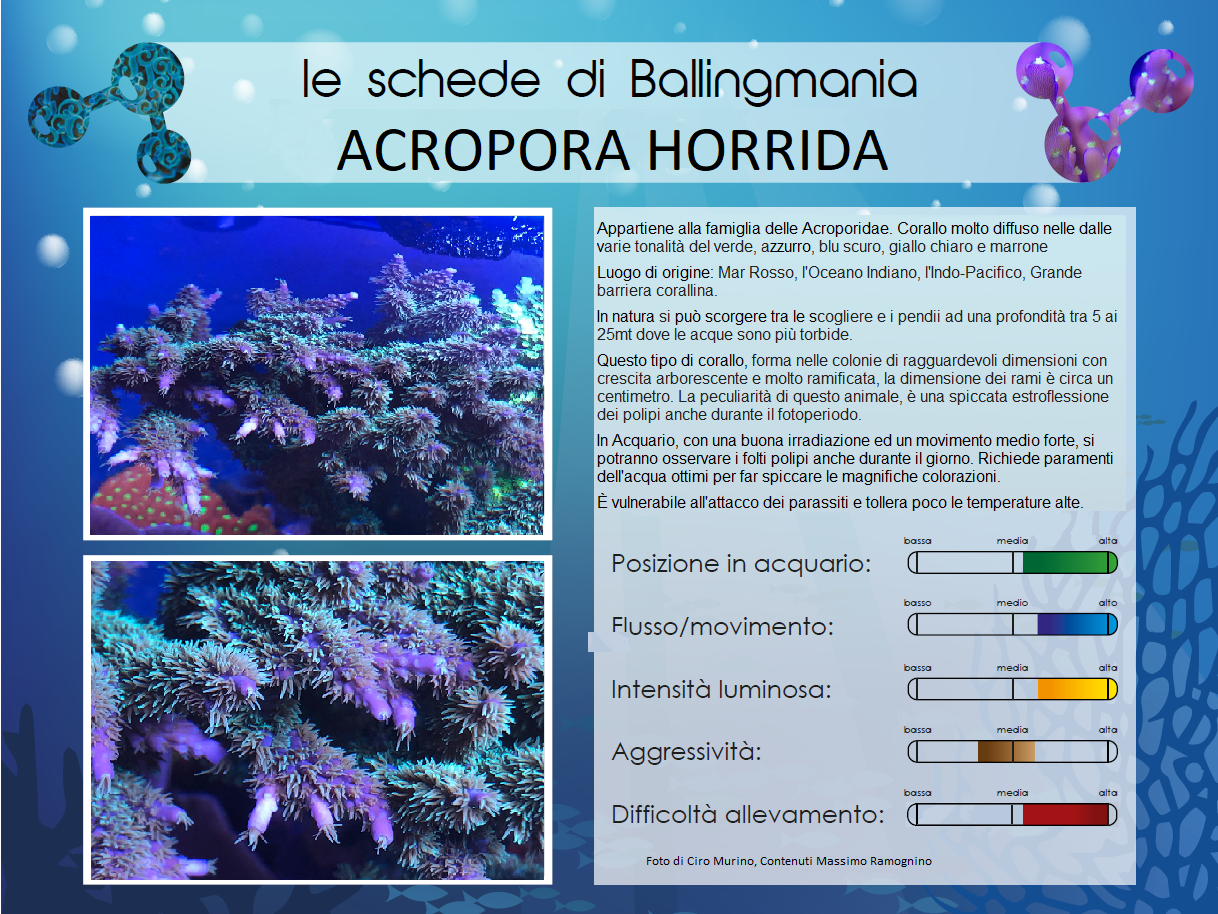
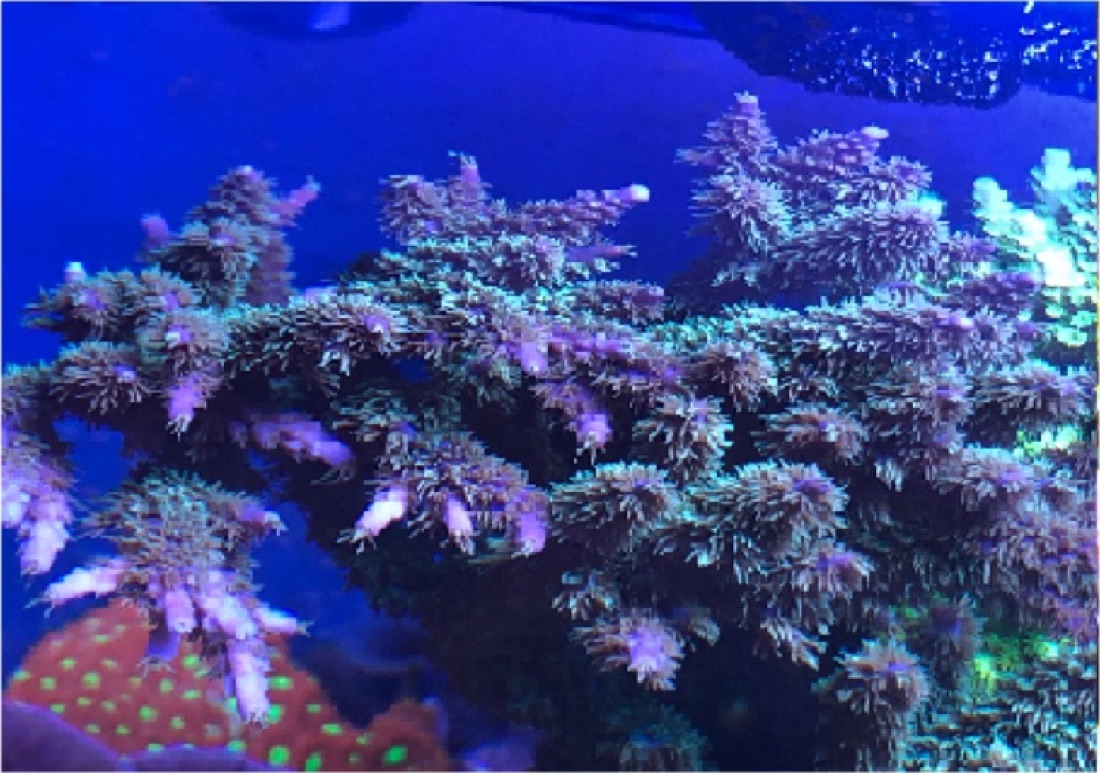
Tap a number on the photo: the key explains what to look for.
Life in the wild
In the aquarium
From the experience of the BallingMania community.
It belongs to the family Acroporidae. A very widespread coral in various shades of green, light blue, dark blue, pale yellow and brown. Place of origin: the Red Sea, the Indian Ocean, the Indo-Pacific, the Great Barrier Reef.
In the wild it can be spotted among the reefs and slopes at a depth of 5 to 25 m, where the water is more turbid.
This type of coral forms colonies of considerable size, with arborescent and highly branched growth; the branches are about a centimetre thick. What is special about this animal is the marked extension of its polyps even during the photoperiod.
In the aquarium, with good lighting and medium-strong water movement, its dense polyps can be seen even during the day. It needs excellent water parameters to bring out its magnificent colours.
It is vulnerable to attack by pests and does not tolerate high temperatures well.
Photo by Ciro Murino, text by Massimo Ramognino
Did you know?
Sources
- Hoeksema B.W., Cairns S., Samimi-Namin K. (2026). Acropora horrida (Dana, 1846). World List of Scleractinia, via WoRMS.
- UNEP-WCMC (2026). Acropora horrida, CITES listings and distribution. Species+.
- Palomares M.L.D., Pauly D. (eds.) (2026). Acropora horrida, Blue staghorn. SeaLifeBase.
- Madin J. et al. (eds.) (2026). Acropora horrida. Coral Trait Database.
- Muir P., Wallace C., Bridge T.C.L., Bongaerts P. (2015). Diverse Staghorn Coral Fauna on the Mesophotic Reefs of North-East Australia. PLoS ONE.
- Muir P.R., Wallace C.C., Done T., Aguirre J.D. (2015). Limited scope for latitudinal extension of reef corals. Science, reference in the Coral Trait Database.
- Wallace C.C., Wolstenholme J. (1998). Revision of the coral genus Acropora (Scleractinia: Astrocoeniina: Acroporidae) in Indonesia. Zoological Journal of the Linnean Society, reference in the Coral Trait Database.
- Hughes T.P., Connolly S.R., Keith S.A. (2013). Geographic ranges of reef corals (Cnidaria: Anthozoa: Scleractinia) in the Indo-Pacific. Ecology, reference in the Coral Trait Database.
- Wallace C.C., Done B.J., Muir P.R. (2012). Revision and catalogue of worldwide staghorn corals Acropora and Isopora (Scleractinia: Acroporidae) in the Museum of Tropical Queensland. Memoirs of the Queensland Museum, reference in the Coral Trait Database.
- Richards Z.T., Miller D.J., Wallace C.C. (2013). Molecular phylogenetics of geographically restricted Acropora species: Implications for threatened species conservation. Molecular Phylogenetics and Evolution.
- Babcock R.C., Wills B.L., Simpson C.J. (1994). Mass spawning of corals on a high latitude coral reef. Coral Reefs, reference in the Coral Trait Database.
- LaJeunesse T.C., Pettay D.T., Sampayo E.M. et al. (2010). Long-standing environmental conditions, geographic isolation and host-symbiont specificity influence the relative ecological dominance and genetic diversification of coral endosymbionts in the genus Symbiodinium. Journal of Biogeography, reference in the Coral Trait Database.
Sources checked on 5 November 2026. Community texts and ratings are kept separate from the scientific data.