At a glance
Data from the scientific sources listed at the bottom.
Depth in the wild
3–40 m
Size
up to 50 cm
maximum colony diameter
Conservation
IUCN Red List: vulnerable (2023). CITES: Appendix II. The listed criterion is A3ce. 3 The CITES listing currently in force dates back to 18 January 1990; in the European Union it is in Annex B. 2
Where it lives
According to the range dataset of Hughes et al. it runs from about 37° E to about 133° W and from about 30° N to 32° S, covering about 71 million km². 4 6 WoRMS gives it, among other places, in the Red Sea, East Africa, the Seychelles, Réunion, Chagos, the Maldives, Australia and American Samoa. 1 Species+ lists 33 countries and territories, including Egypt, Tanzania, India, Indonesia, Japan and French Polynesia. 2
How to recognise it
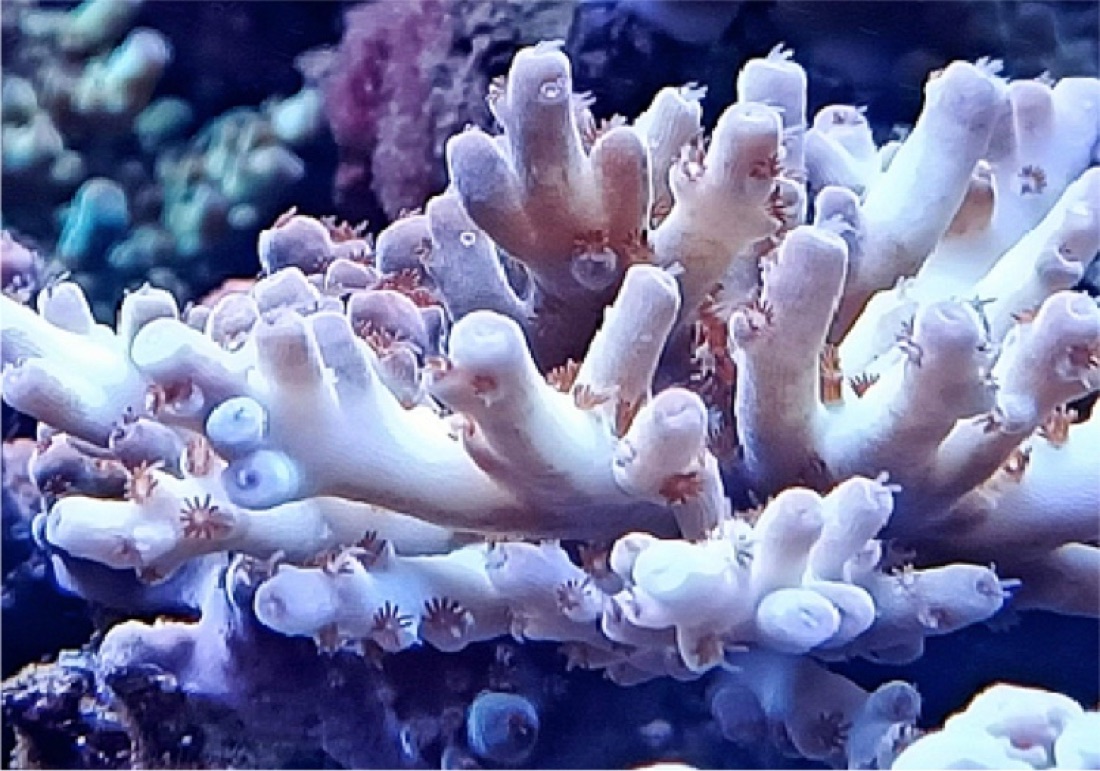
Tap a number on the photo: the key explains what to look for.
Life in the wild
Where it is found
The usual range is 3-40 m, on permanently submerged walls and steep slopes, sometimes in shaded spots. 3 On the Great Barrier Reef and in the Coral Sea it is common in shallow water and also present below 30 m, with samples down to 50 m. 5 A small, atypically shaped sample from 73 m was assigned to the species only provisionally. 5
In the aquarium
From the experience of the BallingMania community.
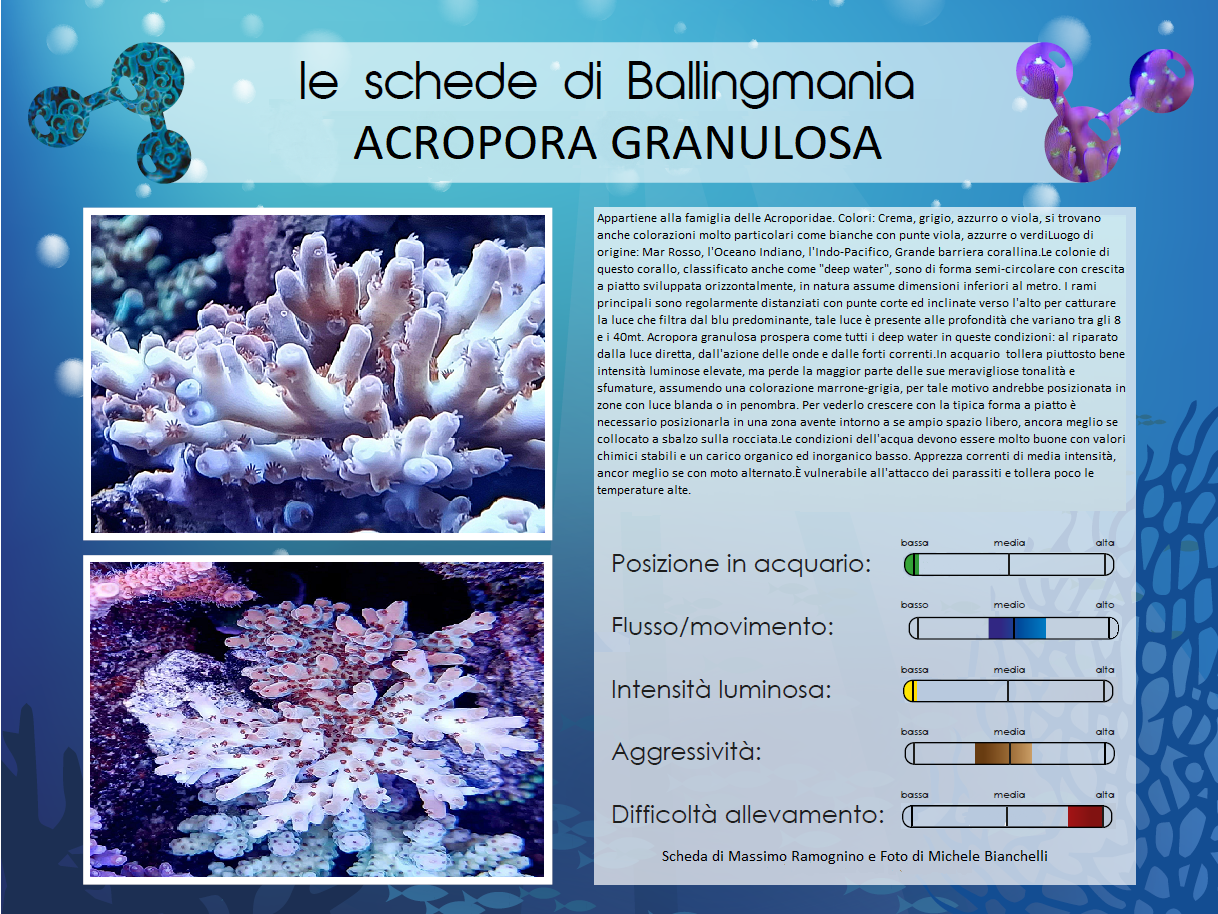
It belongs to the family Acroporidae. Colours: cream, grey, light blue or purple; there are also very unusual colourings, such as white with purple, light blue or green tips. Place of origin: the Red Sea, the Indian Ocean, the Indo-Pacific, the Great Barrier Reef. The colonies of this coral, also classed as "deep water", are semicircular, with plate-like growth spreading horizontally; in the wild it stays under a metre across. The main branches are evenly spaced, with short tips angled upwards to catch the light filtering through the predominant blue, a light present at depths between 8 and 40 m. Like all deep-water corals, Acropora granulosa thrives in these conditions: sheltered from direct light, wave action and strong currents. In the aquarium it tolerates high light intensity fairly well, but loses most of its marvellous shades and hues, taking on a greyish-brown colour, which is why it should be placed in areas with soft light or in partial shade. To see it grow with its typical plate shape, it must be placed in an area with plenty of free space around it, even better if it overhangs from the rockwork. Water conditions must be very good, with stable chemical values and a low organic and inorganic load. It appreciates medium-strength currents, even better if alternating. It is vulnerable to attack by pests and does not tolerate high temperatures well.
Species sheet by Massimo Ramognino and photo by Michele Bianchelli
What studies say about keeping it
In a study on corals from private and public aquariums, A. granulosa hosted symbiotic algae of types C21, C94 and C94a. 4 12 In general, the authors found that corals kept for years in tanks, even with periodic fragmentation, keep stable associations with their algae. 12
Did you know?
Sources
- Hoeksema B.W., Cairns S., Samimi-Namin K. (2026). Acropora granulosa (Milne Edwards, 1860). World List of Scleractinia, via WoRMS.
- UNEP-WCMC (2026). Acropora granulosa, CITES listings and distribution. Species+.
- Palomares M.L.D., Pauly D. (eds.) (2026). Acropora granulosa, Tubular table coral. SeaLifeBase.
- Madin J. et al. (eds.) (2026). Acropora granulosa. Coral Trait Database.
- Muir P., Wallace C., Bridge T.C.L., Bongaerts P. (2015). Diverse Staghorn Coral Fauna on the Mesophotic Reefs of North-East Australia. PLoS ONE.
- Hughes T.P., Connolly S.R., Keith S.A. (2013). Geographic ranges of reef corals (Cnidaria: Anthozoa: Scleractinia) in the Indo-Pacific. Ecology, reference in the Coral Trait Database.
- Wallace C.C., Done B.J., Muir P.R. (2012). Revision and catalogue of worldwide staghorn corals Acropora and Isopora (Scleractinia: Acroporidae) in the Museum of Tropical Queensland. Memoirs of the Queensland Museum, reference in the Coral Trait Database.
- Wallace C.C. (1985). Reproduction, recruitment and fragmentation in nine sympatric species of the coral genus Acropora. Marine Biology, reference in the Coral Trait Database.
- Wallace C.C., Wolstenholme J. (1998). Revision of the coral genus Acropora (Scleractinia: Astrocoeniina: Acroporidae) in Indonesia. Zoological Journal of the Linnean Society, reference in the Coral Trait Database.
- Sola E., Silva I.M. da, Glassom D. (2015). An annotated and illustrated checklist of species of the coral genus Acropora (Cnidaria: Scleractinia) from Vamizi Island, Mozambique. African Invertebrates, record on Plazi.
- Kotb M.M.A. (2001). Growth rates of three reef-building coral species in the northern Red Sea, Egypt. Egyptian Journal of Aquatic Biology and Fisheries, reference in the Coral Trait Database.
- Smith R.T., Pinzón J.H., LaJeunesse T.C. (2009). Symbiodinium (Dinophyta) diversity and stability in aquarium corals. Journal of Phycology.
Sources checked on 5 November 2026. Community texts and ratings are kept separate from the scientific data.