
Starfish in the Reef Aquarium
Beautiful and colourful, but few species really survive in the tank
Starfish (class Asteroidea) belong to the large group of echinoderms (phylum Echinodermata), which also includes species such as urchins and sea cucumbers, crinoids, brittle stars and so on.
They stand out for their body divided into 5 parts, very similar to one another and arranged concentrically around the individual's central axis, called arms; they have a flat body and a mouth facing downwards. Rare species can have more arms, up to as many as fifty (Labidiaster annulatus).
A starfish's body, top and underside
- 1Arms usually 5, around the central axis
- 2Central disc the body is flat
- 3Madreporite pale, near the centre of the disc
- 4Plates in neat rows on the arms
- 5Mouth always facing downwards
- 6Ambulacral groove holds the tube feet, from mouth to tip
Five almost identical parts around a disc: the mouth is underneath, the madreporite on top.
Why so many do not survive
Having adapted to the extreme conditions of the coral reef, this magnificent echinoderm could also adjust to the conditions replicated in our reef aquariums, but in fact in most cases it does not; only a very few species survive in our tanks.
An inexperienced aquarist, drawn in by the bright colours, will buy this animal without any awareness or the slightest knowledge of the unhappy consequences.
An unsuitable specimen is doomed to a slow decline, ending in inevitable death by starvation, since the starfish, unable to find enough food, will start to consume its own tissues.
It should be noted that the internal necrosis of the tissues becomes visible when surface lesions appear; this worsens to a point of no return when pieces of tissue start to come away from the arms, until the animal rots completely and dies.
These factors should make us aquarists aware of our duty to be informed, to read up and to learn as much as possible about the vital needs of the species we introduce into our tanks.
The specimens best suited to keeping in reef tanks can be all the species that feed on microalgae, detritus and tiny invertebrates. In a well-established aquarium, with algae and benthic fauna, starfish could survive for a long time.
Another aspect to consider is changes in water chemistry. It is no coincidence that water treatment proves crucial in deciding whether a starfish is suitable for a particular reef aquarium.
To improve coral growth, the nutrient content (nitrates and phosphates), even if at reduced levels, undergoes continual changes; these measures significantly affect the growth of algae and benthic fauna, to the point that the conditions for finding food sources could be lost.
From the small Asterina to the blue star, to the same scale
- 1Linckia laevigata the blue star; grows little in aquariums
- 2Protoreaster lincki predatory: fish-only tank
- 3Genus Nardoa usually smaller than the blue star
- 4Archaster typicus lives and burrows in sandy bottoms
- 5Linckia multifora feeds like the blue star
- 6Genus Fromia small, but hard to feed
- 7Genus Asterina tiny: needs very little food
The bigger the star, the more food it must find in the tank: size matters as much as colour.
Archaster typicus
It is found in shallow water in the Indo-Pacific region and grows to about 15 cm in diameter.
It lives on sandy bottoms, spending most of its time burrowing in the sand in search of food (organic detritus, decomposing plant material and small invertebrates).
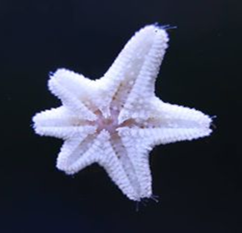
The overall colour is grey or brown, variously marked with darker and lighter patches. The underside is pale. The body is slightly inflated and there is a whitish madreporite near the centre of the disc. The small armour plates covering the upper surface of the arms are lined up in neat parallel rows.
This kind of starfish is particularly suitable for aquariums run with the DSB (Deep Sand Bed) method or with substrates deeper than 2 centimetres, where these stars help keep the surface stirred, preventing solid clumps from forming through lack of movement. In this case it needs no extra feeding, but it is best kept in well-matured tanks with a fairly large sandy area, so that it can find enough food; being detritivores, they feed on anything edible they come across.
This species reproduces sexually, through gonochoric reproduction with external fertilisation, and asexually, through regeneration and cloning.
The sand-sifting star reproduces through pseudocopulation, which means the starfish show mating-like behaviour that does not involve sexual union; its embryos develop into planktonic larvae and then turn into young starfish.
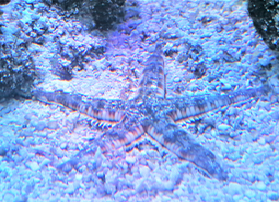
The blue starfish (Linckia laevigata)
It is very widespread throughout the Indo-Pacific and is among the species most easily kept in an aquarium. Its arms are round in cross-section and it reaches 30 cm, while in the marine aquarium its growth is very limited. The whole body is blue, but the intensity of the colour varies depending on the depth at which they live; sometimes a grey or beige tone is also seen.
In the hobby this starfish is considered an algae-eating star, but this assumption is wrong, because it feeds on organic detritus, decomposing animals and microscopic invertebrates, which they take in with the help of a sticky, cilia-lined pathway; for the most part they accept no supplementary food, and they are a perfect example of "self-sufficiency". They must be able to find enough food resources and can waste away because of competition from their own kind, because in that case food would become scarce.
Strong skimming and sparse feeding also create conditions in which little organic detritus builds up, making it hard for dense populations of microscopic invertebrates to form. This takes away the starfish's food base. To make sure, to some extent, that enough food is available, this starfish should be introduced only into aquariums with live rock and a thriving micro-fauna and flora.
It should be noted that this star is very sensitive to transport, and care is needed right from the moment of purchase, at the shop's tank.
Nor should you choose specimens that are too large, but preferably small ones, because a large animal has a considerably higher food requirement. Careful acclimatisation is of fundamental importance for these starfish. Another starfish belonging to this genus is the species L. multifora, light brown or yellowish in colour, which reaches 15 cm and not only feeds like L. laevigata but is equally sensitive to transport. It can be susceptible to various parasites, among others the snail Thyca crystallina, and they are also easily exposed to bacterial infections.
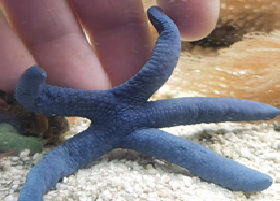
The genus Nardoa
This genus of starfish includes a group of similar species with a dark body and orange-brown patches: N. variolata, N. galatheae, N. lemonnieri and N. novaecaledoniae.
These stars reach an average size of about 10-15 cm and sometimes even 25 cm.
They are widespread in the Indo-Pacific and feed on organic detritus, decomposing animals and microscopic invertebrates, but in the aquarium they accept no kind of supplementary food, for example in tablet form.
Nardoa species as a rule stay smaller than Linckia laevigata and so have a lower food requirement, which means that in a normal aquarium they will have better chances of survival.
Competition for food from their own kind or from other starfish that use the same food should also be avoided. In any case, great care during acclimatisation is advisable.
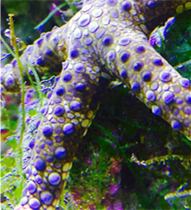
The genus Fromia
Starfish of the genus Fromia are much smaller (under 10 cm) than the genera mentioned so far and have flattened arms. Various species are often available in the specialist aquarium trade, each with its own typical colouring. In any case these often very colourful animals are unfortunately not among those that can be kept well in an aquarium, even though they are frequently bought by inexperienced aquarists.
Feeding them is more difficult than for the genera mentioned earlier. Fromia indica (Indo-Pacific) is red with dark arm tips, F. ghardaqana (Red Sea) shows white spots on a red background, F. monilis and F. nodosa have a red body disc with orange- and red-bordered fields on the arms, and F. milleporella (Indo-Pacific) is bright red on top. These and the other Fromia species feed on microscopic algae and the tiny invertebrates that live in them, as well as on detritus. They too should be introduced only into aquariums with enough micro-fauna.
The larger the area of reef tank available to a single starfish, the better its chances of survival.
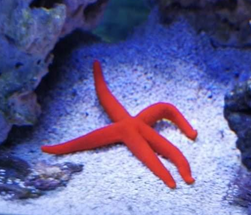
The genus Asterina
The starfish of the three genera Asterina, Disasterina and Nepanthia belong to a group that is still little studied, especially from a taxonomic point of view. These small animals arrive, and we find them, purely by chance, on live rock or on the rocky base of corals. They can reach a diameter of 3 or 4 and in some cases even 5 cm, but they often stay smaller. These starfish feed on microscopic invertebrates, decomposing organisms and microalgae, probably also on bacterial films. Their huge advantage lies in their small body size, which means they need only small amounts of food.
This has led to their wide spread in many reef aquariums, where they multiply vegetatively and can build up large populations, because the food supply that is perhaps too small for a large Linckia laevigata is more than enough for them.
For this reason they become a problem in some reef tanks, because beyond a certain population density food apparently starts to run short for them too, which turns their interest towards the corals.
So in these cases their population needs to be kept under control, by collecting the starfish or through natural predators such as harlequin shrimps.
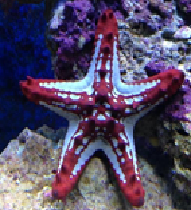
Protoreaster lincki
The starfish Protoreaster lincki (red-knobbed starfish) is red-grey in colour and widespread in the Indian Ocean and the Indo-Pacific. A beautiful (and large) predatory starfish, it can reach 20-30 cm. In nature its diet consists of small animals such as molluscs, sponges, corals and dead fish/shrimps. In the aquarium it behaves as a detritivore; it must go in a fish-only tank, since it could prey on corals, giant clams and sponges. This star appears to be able to overpower even small fish at night.
In nature it lives mainly in the shallow waters of lagoons and seagrass beds, sometimes also at great depth, but normally on sandy bottoms or relatively fine gravel. This echinoderm is very common in the trade.
Regeneration
Starfish are also able to re-form lost or damaged body parts through regeneration. In some cases they can even rebuild the whole individual from a single arm. In most cases, however, for regeneration to take place, at least a piece of the central disc must still be present.
Starfish have a well-developed ability to regenerate lost body parts.
One reason for this is that their organism is structured fairly simply; another is their five-rayed ("pentaradial") symmetry, which gives the body its circular shape, and the presence of five or more almost identical parts. A lost limb can easily regrow from the central body disc. Saying that a starfish can regenerate from a single limb is not entirely correct, because a fifth of the central body disc must be present. This in no way means that you can simply divide a starfish and reproduce it through "fragmentation". This also applies to a single limb that may have been taken by a predator. Asexual reproduction by splitting is a process that in a starfish does not start from an external event with the separation of a body part, but is fully prepared within the organism. It also requires an optimal food situation, since every regeneration involves building new body tissue, which uses much more energy than simply maintaining what is already there. A starfish living in an aquarium under less than optimal conditions reduces or completely suspends its ability to regenerate.
What regrows and what doesn't
- 1Lost limb regrows from the central disc
- 2Limb with disc needs a fifth of the disc, says the author
- 3Limb without disc as a rule doesn't regrow
- 4Exception: Linckia can regrow even without disc
Regenerating costs energy: a star that doesn't eat enough reduces or suspends regrowth.
Acclimatisation
All this becomes a problem above all when mistakes are made while introducing the animal into the reef tank. The water vascular system of all echinoderms contains fluid and, since they move extremely slowly, they are not used to sudden changes in their environment. In particular, a sudden rise or fall in salt content can cause serious complications. If starfish are placed in seawater with a higher salt concentration, the water inside them will flow out, causing the water vascular system to shrink. If, on the other hand, they end up in water with a lower salt content, osmotic pressure will push the surrounding water into the canal system, swelling it and destroying it.
What salt does to the water vascular system
- 1More salt outside inner water flows out, the system shrinks
- 2Equal salinity no swing: this is the goal
- 3Less salt outside water flows in, swells and destroys
Never a direct transfer: slow acclimatisation avoids the salinity swing.
Sources: [7]
An animal damaged in this way would hardly be able to recover even in natural conditions with an optimal supply of food. In the aquarium, where the food situation may not be adequate and where other environmental factors worse than those in nature may arise, the chances of survival are even lower. So a starfish, like all other echinoderms, should always be acclimatised slowly and with particular care, and never simply transferred from the transport container to the tank.
So correct acclimatisation requires a few basic rules: the starfish must never be taken out of the water; when introducing it into the tank we recommend submerging the whole bag. If it is taken out of the water, place it on the bottom with great care, with the oral side facing upwards, to prevent air embolisms from forming. When buying, bear in mind that the starfish is very sensitive to changes in salinity, so ask the shopkeeper what salinity their water is and, once home, if our tank's salinity differs, carry out a careful, long drip acclimatisation.
Predators and parasites
Like most reef organisms, starfish have predators and parasites too.
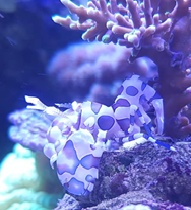
Predators, in the wild and in the aquarium, include various fish but also shrimps: the harlequin shrimp (Hymenocera picta), by now very well known in the hobby, has specialised so much in feeding on starfish that it wastes away if they are lacking.
Harlequin shrimps can be introduced into the aquarium to keep the reproduction of Asterina, Disasterina and Nepanthia starfish under control. However, you need to make sure the shrimps do not have to feed only on these starfish, by occasionally offering them others too (or parts of them).
"Starfish specialists" are found in other groups of animals too. The snail Thyca crystallina (family Eulimidae) lives on the underside of starfish, often deep in the ambulacral groove, sucking body fluid from inside the echinoderm.
Symbiosis
The symbiotic shrimp Periclimenes soror often lives in symbiosis on the starfish Linckia laevigata as a harmless commensal, perfectly matching its colour.
Other commensals of these echinoderms can be the tiny symbiotic shrimps that take on the same colour tones as their host, which lets them camouflage themselves effectively; in many cases their camouflage is improved further because they stay on the underside of the arms.
With their pedicellariae, starfish have tiny grasping limbs that can help remove certain organisms trying to settle on their body surface.
This defensive ability is limited to algae and small invertebrates such as bryozoans or sponges. Against larger animals the starfish cannot defend itself in this way.
Under the arm of a blue star
- 1Thyca crystallina snail that sucks body fluid
- 2Ambulacral groove the snail often nestles here
- 3Symbiotic shrimp harmless, takes on the host's colour
- 4Harlequin shrimp predator: feeds on starfish
- 5Grasping limbs remove algae and small invertebrates
Harmless guests, parasites and predators can live together on the same star.
Sources
- WoRMS Editorial Board (2026). World Register of Marine Species (entries for the names mentioned). Flanders Marine Institute.
- Mah C.L., Blake D.B. (2012). Global Diversity and Phylogeny of the Asteroidea (Echinodermata). PLoS ONE 7(4): e35644.
- Bos A.R., Gumanao G.S., van Katwijk M.M., Mueller B., Saceda M.M., Tejada R.L.P. (2011). Ontogenetic habitat shift, population growth, and burrowing behavior of the Indo-Pacific beach star, Archaster typicus (Echinodermata; Asteroidea). Marine Biology 158(3): 639-648.
- Prakash S., Kumar T.T.A. (2013). Feeding behavior of Harlequin Shrimp Hymenocera picta Dana, 1852 (Hymenoceridae) on Sea Star Linckia laevigata (Ophidiasteridae). Journal of Threatened Taxa 5(13): 4819-4821.
- Wickler W. (1973). Biology of Hymenocera picta Dana. Micronesica 9(2): 225-230.
- Bouillon J., Jangoux M. (1984). Note sur l'association entre le mollusque parasite Thyca crystallina (Gould) et l'astérie Linckia laevigata (L.) sur le récif de l'île de Laing (Papouasie Nouvelle-Guinée). Annales de la Société royale zoologique de Belgique 114(2): 249-256.
- Barrett N.J., Harper E.M., Last K.S., Reinardy H.C., Peck L.S. (2024). Behavioural and physiological impacts of low salinity on the sea urchin Echinus esculentus. Journal of Experimental Biology 227(2): jeb246707.
- Cortés Rivera Y., Hernández R.I., San Martín del Angel P., Zarza Meza E., Cuervo González R. (2016). Potencial regenerativo de la estrella de mar Linckia guildinguii. Hidrobiológica 26(1): 103-108.
- Edmondson C.H. (1935). Autotomy and regeneration in Hawaiian starfishes. Bernice P. Bishop Museum Occasional Papers 11(8).
On the same topic
Fireworm and Eunice
Who the fireworm is, what it eats, when it becomes a problem, what to do if you get stung, how to reduce its numbers…
Giant clams (Tridacna)
The mantle and its zooxanthellae, the five species easiest to find, predators and the fish that eat their parasites,…
Chemistry and biomineralisation
KH, calcium and magnesium are not just numbers to keep stable: they are the bricks, the cement and the additive on…