
Fireworm and Eunice
A scavenger not to fear and a predator to recognise
Often mistaken by the less experienced for a fearsome unwanted guest, it is in fact a useful friend and a silent inhabitant of our beloved reefs: we are talking about the FIREWORM, also called the bearded fireworm. Below are a few explanations so as not to be frightened at the sight of this unusual invertebrate.
Who the fireworm is
The fireworm belongs to the class Polychaeta and its scientific name is Hermodice carunculata. Many people don't know that this kind of animal is also found in the warmer waters of the Mediterranean, so much so that a few years ago there was a real invasion of these worms on the Sicilian coast! In the aquarium, as in nature, the fireworm ranges in length from a few centimetres up to 30! It lives among rocks and on the seabed and makes its den in the many crevices offered by the reef rock. It feeds on decomposing matter, uneaten food, dead or dying animals and other detritus. In short, a real scavenger! Because of this liking for suffering or dying animals it is often blamed for the death of giant clams, since it is among the first animals to rush in to clean out the dying shell. Like all annelids, the fireworm reproduces extremely fast, both asexually (by splitting) and sexually, which is why you may find even several dozen specimens in the tank.
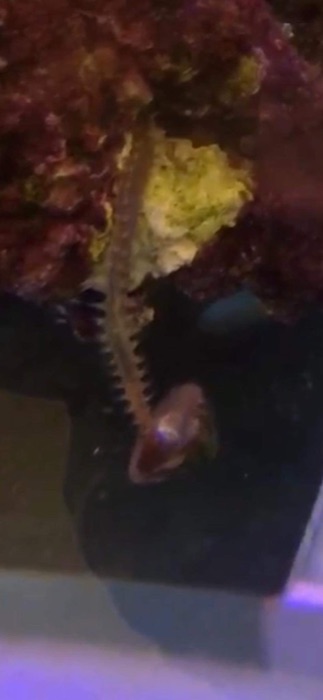
Where the fireworm lives and what it does
- 1The den in the crevices and hollows of the rocks
- 2From a few cm up to 30 in the aquarium, as in nature
- 3Uneaten food with decomposing matter and detritus
- 4Dying giant clam it arrives among the first: hence the blame
The author describes it as a scavenger: often it is just the first to reach an animal that is already suffering.
Although this detritivore is a valuable help for our reef aquarium, it looks dangerously like a predator feared by all marine aquarists: Eunice, also an annelid but with very expensive tastes in food. It preys on our beloved giant clams and in the aquarium it causes their death most of the time.
When it can become harmful
But now let's see how the fireworm can become harmful to the marine aquarium and to people.
For the aquarium ecosystem the fireworm becomes dangerous only if it multiplies fast, forming colonies that are too large, whose food needs are no longer met by the fish's organic waste alone. In these particular and unique cases fireworms can prey on corals, anemones, gorgonians, zoanthids...
As far as people are concerned, the fireworm has stinging bristles along its whole body, similar to soft cilia, which are unfortunately highly stinging if you unwisely decide to pick up a specimen without gloves. If you are stung, the symptoms are: redness, skin irritation, itching, in some people also swelling, hardening of the skin and, in the most serious cases, dizziness, nausea and vomiting. To remove the bristles, it is advisable to use sticky tape so as to pull away what remains firmly lodged in the outer layers of the skin.
How to remove the bristles
- 1Bristles break off and stay in the skin
- 2Outer layers this is where they stay lodged
- 3Redness and irritation with itching, in some also swelling
- 4Sticky tape pulls away what is left
Never pick up a fireworm with bare hands: to remove the bristles, start with sticky tape.
How to remove it if there are too many
If there are too many, how do you remove fireworms from the marine aquarium?
You can take a mechanical approach, but since the animal, as said above, also reproduces by splitting, if it is not removed completely it remains in the aquarium, so the exercise is rather pointless. You can lie in wait at night, when fireworms are most active, and remove them mechanically, always using protective gloves and stainless steel aquarium tweezers. Another effective and less invasive method is to use a fireworm trap, which is basically a plexiglass cylinder or box that the animals enter, attracted by bait, and cannot get out of. The last possible approach is adding worm predators: although in nature crabs are the main predators, they are not compatible with our reef tanks; you can, however, add Stenopus hispidus. Thanks to its claws this animal can catch and feed on even very large fireworms. Another useful animal is a snail, Hidatyna, hard to find and able to feed only on small specimens.
Four ways to reduce them
- 1Tweezers at night with gloves: when most active
- 2Trap they go in for the bait and can't get out
- 3Stenopus hispidus catches even large fireworms
- 4Hidatyna snail rare, small specimens only
If the animal is not removed whole, it can go on reproducing by splitting: removing just a piece is no use.
The difference between the fireworm and Eunice
The fireworm (Hermodice carunculata) must not be confused with Eunice (the bobbit worm, or more precisely Eunice aphroditois). The differences between the two marine aquarium worms are clear. Eunice is also a polychaete annelid, but it does not have the fireworm's typical bristles, its body is less flattened and above all the difference in appearance is very clear at the head end, where Eunice has five antennae. Eunice is dangerous to the life of fish and corals, so it must certainly be removed.
Fireworm and Eunice compared
- 1Stinging bristles along the fireworm's whole body
- 2Flatter body typical of the fireworm
- 3Five antennae scientifically: 3 antennae and 2 palps
- 4Without those bristles Eunice lacks the fireworm's bristles
- 5Less flattened body typical of Eunice
If in doubt, look at the head: that is where the difference is clearest.
Sources: [4]
To conclude, this animal, found in every reef tank, is a sign of good-quality rock (if bought live) and is also a valuable ally in cleaning the hidden crevices of our mini coral reefs. Removing it is never advisable except in the extreme cases of overpopulation mentioned above.
Article written by: Angelo Dell'Orso
Sources
- Schulze A., Grimes C.J., Rudek T.E. (2017). Tough, armed and omnivorous: Hermodice carunculata (Annelida: Amphinomidae) is prepared for ecological challenges. Journal of the Marine Biological Association of the UK 97: 1075-1080.
- Righi S., Forti L., Simonini R., Ferrari V., Prevedelli D., Mucci A. (2022). Novel Natural Compounds and Their Anatomical Distribution in the Stinging Fireworm Hermodice carunculata (Annelida). Marine Drugs 20(9): 585.
- Howe, Auburn University (1995). A Diver's First Aid Reference to Potentially Hazardous Marine Life. Auburn University Marine Extension & Research Center, Sea Grant (NOAA archive).
- Museums Victoria (2026). Polychaetes: Eunicidae, description (page accessed in 2026). Museums Victoria.
- WoRMS Editorial Board (2026). Hermodice carunculata (Pallas, 1766). World Register of Marine Species.
- WoRMS Editorial Board (2026). Eunice aphroditois (Pallas, 1788). World Register of Marine Species.
On the same topic
Starfish in the Reef Aquarium
How starfish are built, which species adapt to the reef aquarium and which do not, how they regrow, how to…
Giant clams (Tridacna)
The mantle and its zooxanthellae, the five species easiest to find, predators and the fish that eat their parasites,…
Chemistry and biomineralisation
KH, calcium and magnesium are not just numbers to keep stable: they are the bricks, the cement and the additive on…