
Giant clams (Tridacna)
The molluscs with a colourful mantle: how they live, what threatens them and what values they need in the tank
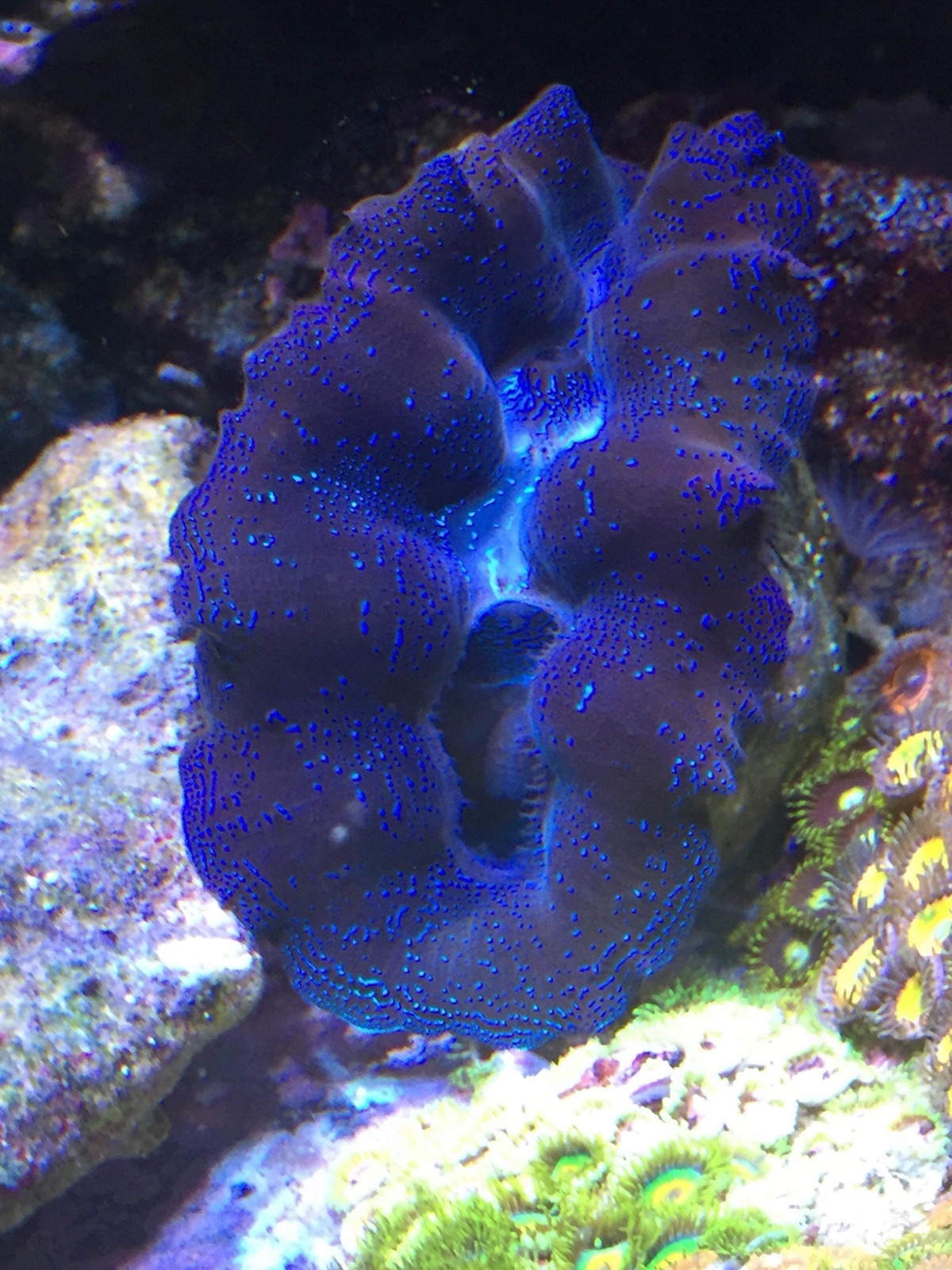
Tridacna is a bivalve mollusc much sought after by hobbyists for the many colours of its mantle, which range in shade from deep blue and purple to emerald green.
Where they live and which species
These bivalves are found mainly throughout the Pacific Ocean and belong to the family of molluscs, together with snails and cephalopods.
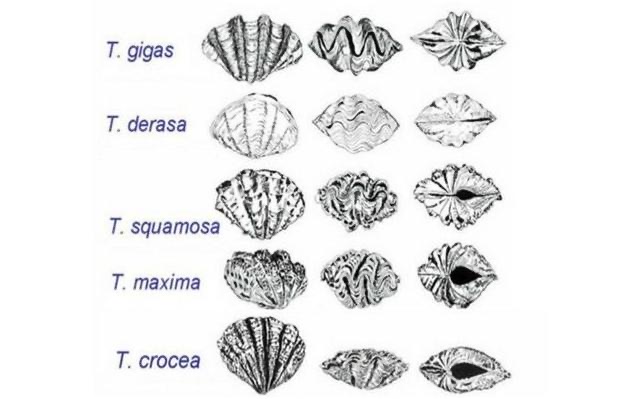
The five giant clam species easy to find in the trade are: maxima, squamosa, derasa, crocea and gigas.
The smallest and the largest, on the same ruler
- 1T. crocea the smallest species: up to about 15 cm
- 2T. gigas the largest: over 1 m and over 300 kg
- 3Same scale the other three species fall between these two extremes
From the 15 cm of T. crocea to over 1 m for T. gigas: very different sizes share the same name.
Sources: [1]
The mantle and the zooxanthellae
Unlike other bivalves (particle filter-feeders, or rather animals that mainly just filter phytoplankton and other organic matter floating in the water in order to grow and feed), giant clams have a connective tissue called the mantle, which wraps the upper part of the mollusc and gives it its magnificent colours.
In particular, inside this mantle live zooxanthellae (dinoflagellate algae, genus Symbiodinium), which through photosynthesis take up inorganic compounds to produce organic molecules: amino acids, carbohydrates and glycerol.
Two ways of feeding: light and filtering
- 1Shell the bivalve's two valves
- 2Mantle wraps the upper part and gives the colours
- 3Zooxanthellae algae in columns, inside tubules coming from the stomach
- 4Light powers photosynthesis
- 5Organic molecules amino acids, carbohydrates and glycerol
- 6Filtered particles phytoplankton and floating matter
- 7Iridocytes surface cells that spread the light
The giant clam filters the water and at the same time uses light through the algae in its mantle.
Predators and allies
The main natural predators of giant clams are: worms of the genus Eunice, flatworms, Pyramidellidae snails, and large crabs and hermit crabs, which may prey on specimens not yet attached to the substrate, and in any case on those being acclimatised.
The fish that feed on these parasites are wrasses of the genera Pseudocheilinus and Halichoeres, and above all Synchiropus marmoratus.
Unfortunately, some fish can also prey on this wonderful mollusc, such as triggerfish, butterflyfish and angelfish, and I would not rule out large wrasses either; in particular, some species of Centropyge, first of all the Bicolor, enjoy nipping at the mantle constantly until the mollusc dies.
Around a giant clam
- 1Worms and flatworms Eunice worms and flatworms
- 2Snails Pyramidellidae
- 3Large crabs, hermit crabs especially on specimens not yet attached
- 4Predatory fish triggers, butterflies, angels, large wrasses
- 5Centropyge bicolor keeps nipping the mantle
- 6Parasite eaters Pseudocheilinus, Halichoeres, Synchiropus marmoratus
Not all fish are enemies: some keep parasites in check, others attack the clam.
Parameters in the aquarium
In the aquarium it is strongly recommended to keep to the following chemical parameters:
- Temperature: 24-28°C;
- pH: 8.0/8.5;
- KH: 6.5/8.5;
- Ca: 390/425;
- Mg: 1300/1350;
- Salinity: 1023/1026.
Six parameters to keep to
- 1Temperature 24-28 °C
- 2pH 8.0-8.5
- 3KH 6.5-8.5
- 4Calcium 390-425
- 5Magnesium 1300-1350
- 6Salinity 1023-1026
These are the values recommended by the author, without units for KH, calcium, magnesium and salinity, as in the original text.
The various types of giant clam
The photo below shows the various types of giant clam
Article and photos by Ciro Murino
Sources
- Neo M.L. et al. (2017). Giant clams (Bivalvia: Cardiidae: Tridacninae): a comprehensive update of species and their distribution, current threats and conservation status. Oceanography and Marine Biology: An Annual Review 55: 87-388.
- Holt A.L., Vahidinia S., Gagnon Y.L., Morse D.E., Sweeney A.M. (2014). Photosymbiotic giant clams are transformers of solar flux. Journal of the Royal Society Interface 11(101): 20140678.
- WoRMS Editorial Board (2026). Tridacna gigas. World Register of Marine Species.
- Rossbach S., Subedi R.C., Ng T.K., Ooi B.S., Duarte C.M. (2020). Iridocytes Mediate Photonic Cooperation Between Giant Clams (Tridacninae) and Their Photosynthetic Symbionts. Frontiers in Marine Science 7: 465.
On the same topic
Starfish in the Reef Aquarium
How starfish are built, which species adapt to the reef aquarium and which do not, how they regrow, how to…
Fireworm and Eunice
Who the fireworm is, what it eats, when it becomes a problem, what to do if you get stung, how to reduce its numbers…
Chemistry and biomineralisation
KH, calcium and magnesium are not just numbers to keep stable: they are the bricks, the cement and the additive on…