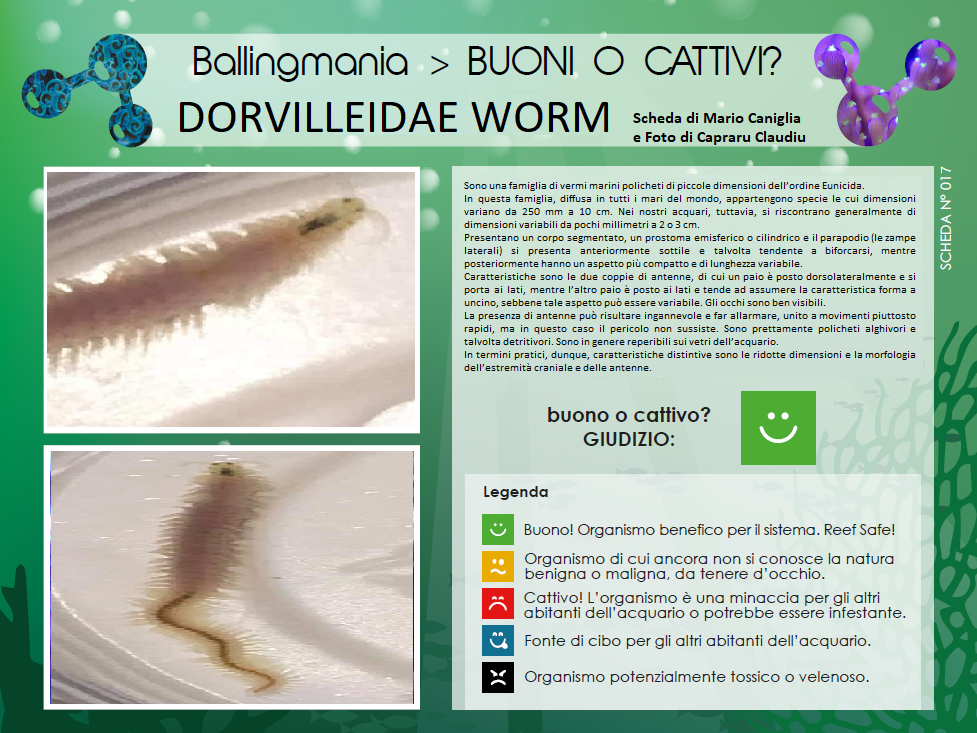
Dorvilleidae worm
Dorvilleidae is a whole family of polychaete worms, with about 200 species in 32 genera, including some of the smallest annelids known. 1 3 The species cannot be guessed from appearance: the useful features are often the jaws and bristles, visible only under a microscope. 3
At a glance
Data from the scientific sources listed at the bottom.
Conservation
IUCN Red List: not evaluated. The category refers to the family as a whole: there is no single assessment. A search for the name in Species+ gives no results. 6
How to recognise it
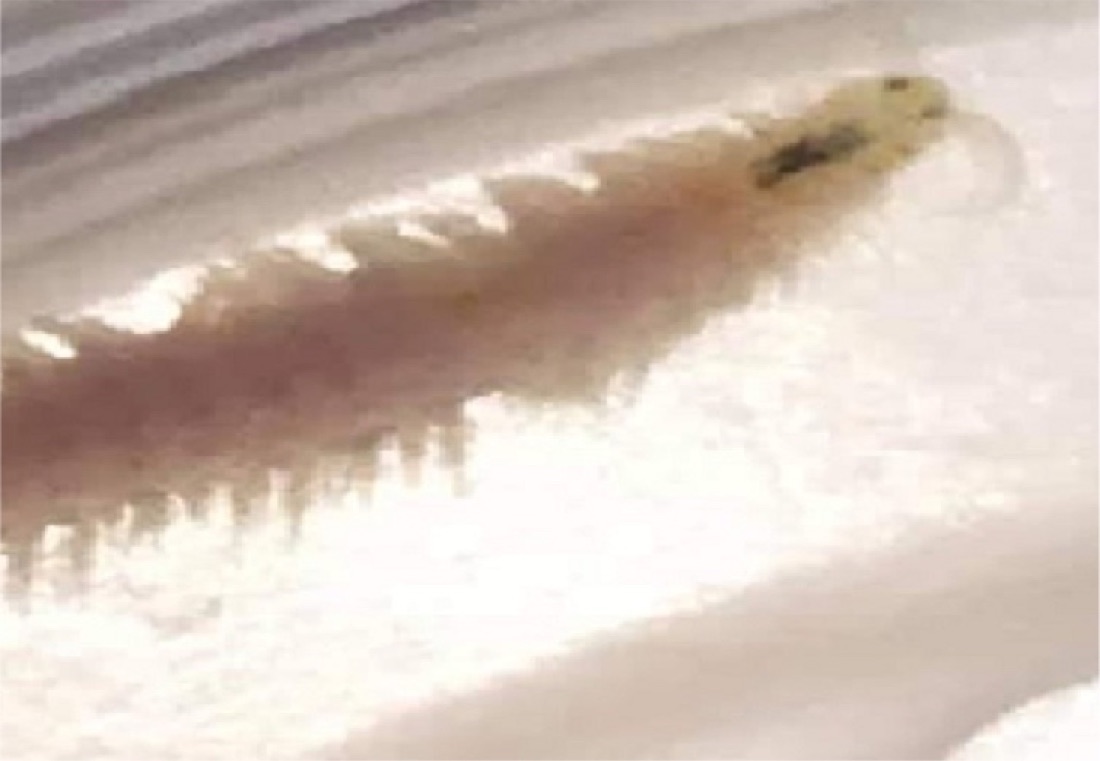
Tap a number on the photo: the key explains what to look for.
Life in the wild
Where it is found
From the intertidal zone to the abyss, on sand, mud and hard bottoms; some species live between sediment grains, others are commensals or parasites. 2 3 Species of the genus Ophryotrocha are found in shallow, nutrient-rich waters such as harbours. 4 Other dorvilleids are abundant where there is a lot of organic matter: hydrothermal vents, whale carcasses and fish farms. 5 Example locations: the south-western Atlantic, 3 the Gulf of Naples, Japan, North Carolina 4 and Newfoundland. 5
What it eats
There is no figure valid for the whole family. Ophryotrocha cyclops, beneath fish farms in Newfoundland, eats mainly decaying feed and faeces, with a contribution from bacterial mats; other dorvilleids consume bacteria and archaea. 5
Reproduction
The genus Ophryotrocha is very varied: it includes hermaphrodite species, species with separate sexes and species that give birth to live young. In the O. labronica group the sexes are separate, the eggs measure 110-180 thousandths of a millimetre and, depending on the species, are held in tube-shaped masses. 4 This does not apply to the whole family.
In the aquarium
From the experience of the BallingMania community.
They are a family of small marine polychaete worms of the order Eunicida.
This family, found in all the seas of the world, includes species ranging in size from 250 mm to 10 cm. In our aquariums, however, they are generally found in sizes ranging from a few millimetres to 2 or 3 cm.
They have a segmented body and a hemispherical or cylindrical prostomium, and the parapodia (the side legs) are thin at the front and sometimes tend to fork, while towards the rear they look more compact and vary in length.
Typical features are the two pairs of antennae: one pair is set dorsolaterally and points to the sides, while the other pair is set at the sides and tends to take on the typical hook shape, although this can vary. The eyes are clearly visible.
The presence of antennae, combined with fairly rapid movements, can be misleading and alarming, but in this case there is no danger. They are strictly algae-eating and sometimes detritus-eating polychaetes. They are generally found on the aquarium glass.
In practical terms, then, the distinguishing features are their small size and the shape of the head end and antennae.
good or bad?
VERDICT:
Key: Good! An organism beneficial to the system. Reef Safe!
An organism whose benign or harmful nature is not yet known, to be kept an eye on.
Bad! The organism is a threat to the other inhabitants of the aquarium or could become a pest. A food source for the other inhabitants of the aquarium.
A potentially toxic or venomous organism.
Photo by Capraru Claudiu, species sheet by Mario Caniglia
What studies say about keeping it
I found no studies on dorvilleids in reef aquariums. In the laboratory several species of the genus Ophryotrocha are kept in culture for research, 4 and Ophryotrocha costlowi has also been found in the aquariums of a marine biology station in Bermuda. 4 In fish farms O. cyclops is used as a sign of organic matter build-up and could help break it down. 5
Did you know?
Sources
- WoRMS Editorial Board (2026). Dorvilleidae Chamberlin, 1919. World Register of Marine Species.
- Museums Victoria (2026). Dorvilleidae: description. Museums Victoria.
- Bonaldo R.O., Steiner T.M., Amaral A.C.Z. (2022). Revision of Meiodorvillea Jumars, 1974 (Annelida: Dorvilleidae) including descriptions of three new species from the Southwestern Atlantic Ocean. PLoS ONE.
- Paxton H., Åkesson B. (2010). The Ophryotrocha labronica group (Annelida: Dorvilleidae), with the description of seven new species. Zootaxa.
- Salvo F., Dufour S.C., Hamoutene D., Parrish C.C. (2015). Lipid Classes and Fatty Acids in Ophryotrocha cyclops, a Dorvilleid from Newfoundland Aquaculture Sites. PLoS ONE.
- UNEP-WCMC (2026). Search for Dorvilleidae in the CITES lists. Species+.
Sources checked on 5 November 2026. Community texts and ratings are kept separate from the scientific data.