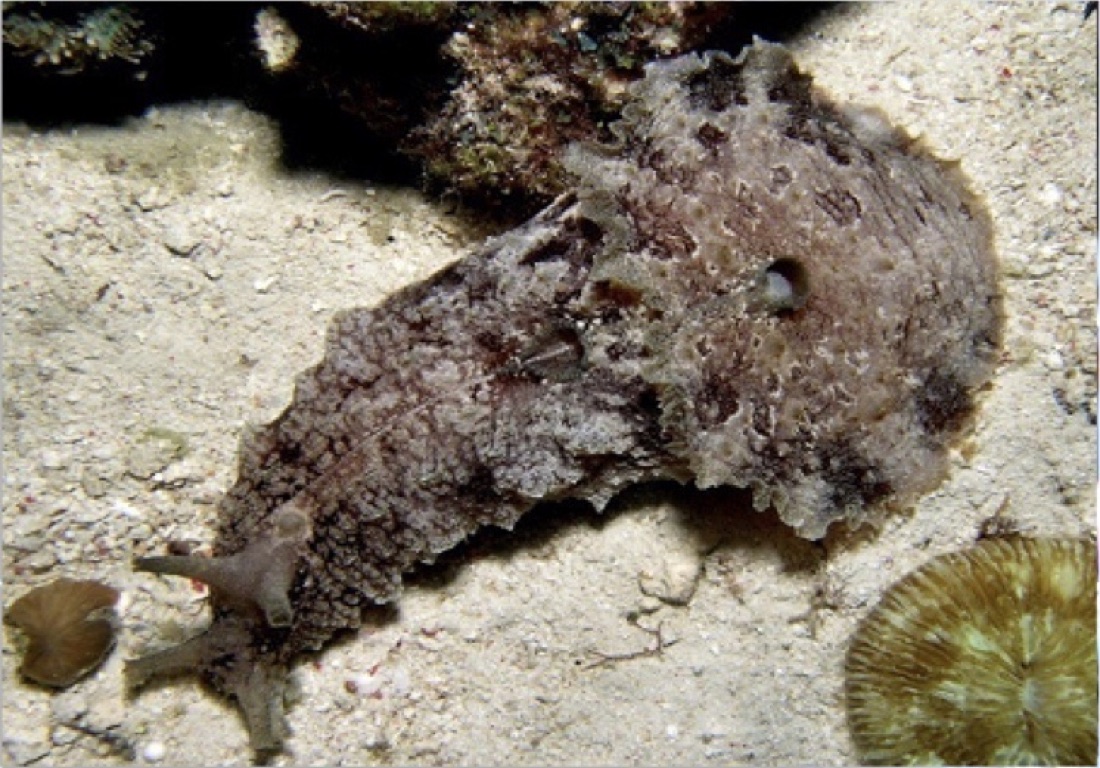
Dolabella auricularia
A herbivorous gastropod mollusc of the family Aplysiidae, one of those known in English as sea hares. 1 7 It lives on shallow, sheltered Indo-Pacific bottoms, is active mainly at night and, if disturbed, releases a purple ink. 2 3 7 The dolastatins, substances from which anti-cancer drugs are derived, were isolated from this species. 8 9
At a glance
Data from the scientific sources listed at the bottom.
Size
up to 12 cm
common length; SeaLifeBase and Reef Life Survey give a maximum of 50 cm
Conservation
IUCN Red List: not evaluated. Red List data taken from SeaLifeBase and GBIF. 2 11 It does not appear in the CITES lists checked on Species+. 12 In the Philippines and some Pacific islands the animal or its egg masses are collected as food; a Philippine study calls for the harvest to be managed so that it remains sustainable. 5
Where it lives
Indo-Pacific. 2 WoRMS records it, among other places, in Mozambique, Natal, the Mascarene Islands and Australian waters. 1 It is also known from Zanzibar, India and Indonesia, 7 the Philippines, Samoa, Kiribati and Fiji. 5
How to recognise it
Tap a number on the photo: the key explains what to look for.
Life in the wild
Where it is found
Shallow, sheltered water, such as bays and lagoons, among algae and seagrass beds; also reef flats and tide pools. 2 3 By day it stays under rocks. 2 SeaLifeBase gives depth limits of 2 and 71 m. 2 Reef Life Survey records water between 15.4 and 31.1 °C. 3 At Sorong, in Indonesia, it was found in shrimp ponds with water at about 31.5 °C, where it probably arrived with the seawater used to fill them. 7
Behaviour
Nocturnal: at night it moves over reef flats and seagrass beds. 2 In the Philippines it is active from late afternoon to early morning, especially at low tide, when it feeds, mates and lays eggs. 5 If disturbed it releases clear mucus and dark purple ink. 3 7 It can be green, brown or black. 7
Reproduction
It is a hermaphrodite: each individual has both sexes, but fertilisation is internal and takes place between two individuals. 2 5 It lays long jelly-like strings, usually attached to seagrasses or algae, with capsules each containing 50 to 150 embryos. 5 In the central Philippines spawning and the arrival of juveniles take place all year round, with peaks from May to July and from September to October. 4 The larvae feed in the plankton and can therefore be carried far by currents. 7
In the aquarium
From the experience of the BallingMania community.
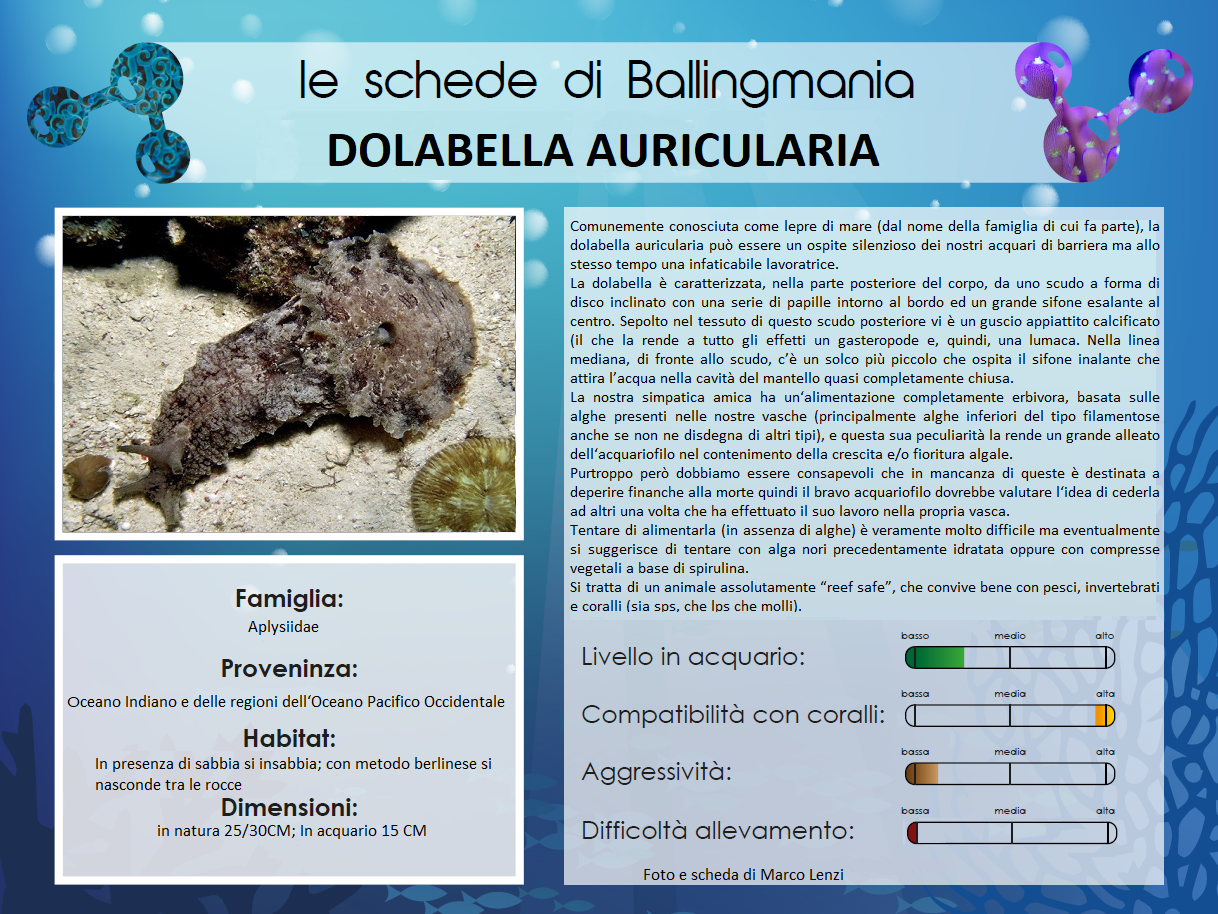
Commonly known as a sea hare (from the name of the family it belongs to), Dolabella auricularia can be a silent guest in our reef aquariums, but at the same time a tireless worker.
At the rear of its body Dolabella has a shield shaped like a tilted disc, with a series of papillae around the edge and a large exhalant siphon in the centre. Buried in the tissue of this rear shield there is a flattened, calcified shell (which makes it a gastropod in every respect, and therefore a snail). In the midline, in front of the shield, there is a smaller groove housing the inhalant siphon, which draws water into the almost completely closed mantle cavity.
Our friendly companion has a completely herbivorous diet, based on the algae in our tanks (mainly lower algae of the filamentous type, although it does not refuse other kinds), and this trait makes it a great ally of the aquarist in keeping algal growth and/or blooms in check.
Unfortunately, though, we must be aware that without them it is bound to waste away and even die, so the good aquarist should consider giving it to someone else once it has done its job in their own tank.
Trying to feed it (when there are no algae) is really very difficult, but if necessary it is suggested to try with Nori seaweed rehydrated beforehand or with spirulina-based vegetable tablets.
It is an absolutely "reef safe" animal that lives well with fish, invertebrates and corals (SPS, LPS and soft corals alike).
Photo and species sheet by Marco Lenzi
What studies say about keeping it
Data from sea cages and shrimp ponds, not advice for a home aquarium. In cages in the Philippines, fed for three months on different algae, it grew most on the red alga Gracilaria (0.28 g a day), with 80-86% survival, at about 31 °C. 6 In the shrimp farms of Sorong it is regarded as a pest: 80-100 juveniles a day were collected by hand, and the specimens measured from 5.8 to 11.2 cm, with a maximum weight of 170 g. 7
Did you know?
Sources
- MolluscaBase eds. (2026). Dolabella auricularia ([Lightfoot], 1786). World Register of Marine Species.
- SeaLifeBase (2026). Dolabella auricularia, Shoulderblade sea cat. SeaLifeBase.
- Reef Life Survey (2026). Dolabella auricularia - Shoulderblade sea cat. Reef Life Survey.
- Pauly D., Calumpong H. (1984). Growth, reproduction and mortality of the sea hare Dolabella auricularia (Gastropoda: Aplysiidae) in the Central Visayas, Philippines. Marine Biology.
- Delan G.G., Pepito A.R., Asakawa M. et al. (2015). Partial Biochemical Characterization of Egg Masses of the Wedge Seahare Dolabella Auricularia (Lightfoot, 1786). Tropical Technology Journal.
- Gunayan M.J.M. (2007). Growth And Survival of Sea Hare (Dolabella auricularia) Fed with Seaweeds under Cage Condition in Guang-Guang, Mati City, Davao Oriental. Davao Research Journal.
- Sofian A., Suhermanto A., Saidin, Sayuti M., Novianto D., Widyasari F. (2021). Short communication: Environment and morphometric of sea hare Dolabella auricularia from shrimp pond, Sorong, West Papua, Indonesia. Biodiversitas.
- Gao G., Wang Y., Hua H., Li D., Tang C. (2021). Marine Antitumor Peptide Dolastatin 10: Biological Activity, Structural Modification and Synthetic Chemistry. Marine Drugs.
- Haque N., Parveen S., Tang T., Wei J., Huang Z. (2022). Marine Natural Products in Clinical Use. Marine Drugs.
- Kallifidas D., Dhakal D., Chen M. et al. (2024). Biosynthesis of Dolastatin 10 in Marine Cyanobacteria, a Prototype for Multiple Approved Cancer Drugs. Organic Letters.
- GBIF Secretariat (2026). Dolabella auricularia, IUCN Red List category. GBIF.
- UNEP-WCMC (2026). Search for Dolabella auricularia in the CITES lists. Species+.
- Sun J., Ju H., Du X., Xu C., Chang M.S., Liu Z., Li X. (2026). An Annotated Checklist of Symbiotic Copepods of Mollusks in the Global Oceans: A Review of Diversity, Hosts and Geographical Distributions. Animals.
Sources checked on 5 November 2026. Community texts and ratings are kept separate from the scientific data.