
At a glance
Data from the scientific sources listed at the bottom.
How to recognise it
Tap a number on the photo: the key explains what to look for.
Life in the wild
Where it is found
The sources read do not describe a habitat common to the whole group. Coral-dwelling species have a cup-shaped base embedded in the skeleton of the host coral and a shell flush with the surface; the coral tissue often grows over the shell. 4 Some live on a single coral species, others on many. 4 5
What it eats
WoRMS classes them as filter feeders, but this does not apply to all. 1 Coral barnacles feed mainly on what is suspended in the water, and also obtain organic substances produced by the coral's zooxanthellae. 4 The exceptions are the Rhizocephala, which absorb nutrients from inside their host, and the genus Hoekia, which feeds on an outgrowth of the coral Hydnophora. 3 6
In the aquarium
From the experience of the BallingMania community.
Barnacles are an infraclass of marine crustaceans that attach permanently to rocks and other marine organisms such as corals.
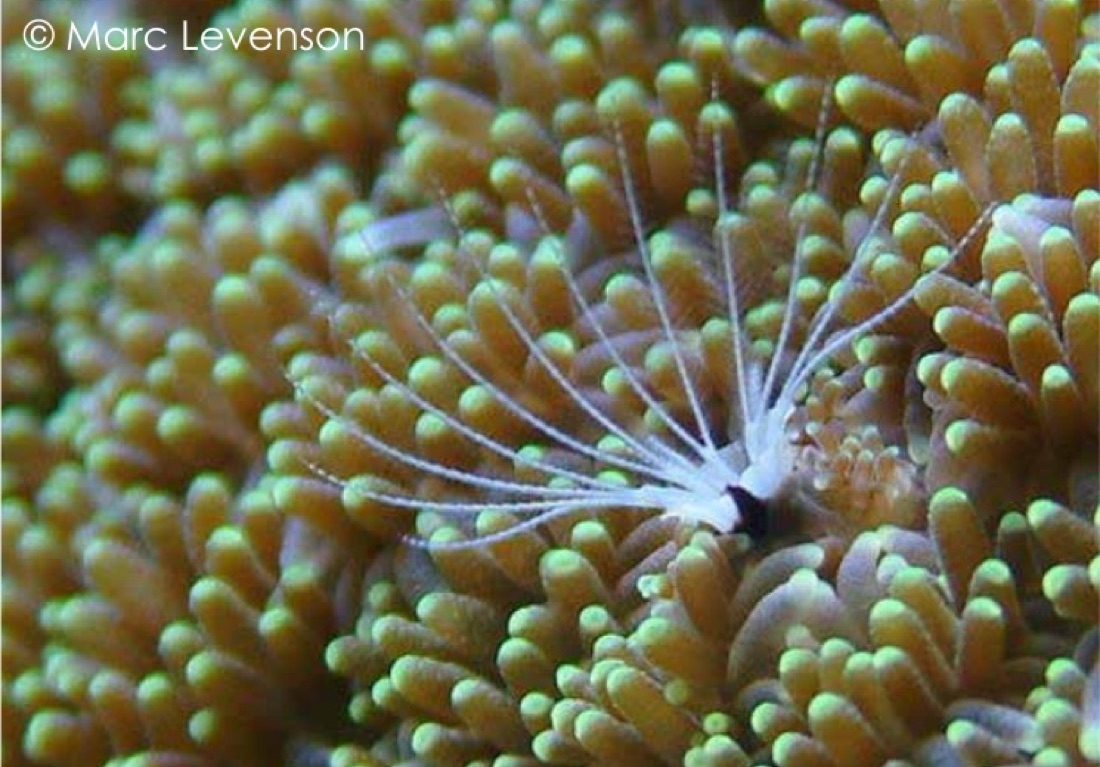
They are parasitic organisms that attach to their host without causing harm, and they have long feathery filaments (the cirri) which they extend to filter the water and catch plankton and suspended particles, or snap back in if they sense danger. Barnacles have a fleshy mantle made of strong calcareous plates that protect them from predators.
They often attach to SPS or LPS corals in a kind of symbiosis that brings no advantage to the coral; in any case no damage has been observed in corals hosting barnacles. There are about a thousand species in the wild, and their size ranges from 0.5 to 5 cm. good or bad?
VERDICT:
Key: Good! An organism beneficial to the system. Reef Safe!
An organism whose benign or harmful nature is not yet known, to be kept an eye on.
Bad! The organism is a threat to the other inhabitants of the aquarium or could become a pest.
A food source for the other inhabitants of the aquarium.
A potentially toxic or venomous organism.
© Marc Levenson · © Pwnm30rdi3
Did you know?
Sources
- WoRMS Editorial Board (2026). Cirripedia Burmeister, 1834. World Register of Marine Species.
- Liang, C.; Strickland, J.; Ye, Z.; Wu, W.; Hu, B.; Rittschof, D. (2019). Biochemistry of barnacle adhesion: an updated review. Frontiers in Marine Science 6: 565.
- Nagler, C.; Hörnig, M.K.; Haug, J.T.; Noever, C.; Høeg, J.T.; Glenner, H. (2017). The bigger, the better? Volume measurements of parasites and hosts: parasitic barnacles (Cirripedia, Rhizocephala) and their decapod hosts. PLoS ONE 12(7): e0179958.
- Yap, F.C.; Chen, H.N.; Chan, B.K.K. (2023). Host specificity and adaptive evolution in settlement behaviour of coral-associated barnacle larvae (Cirripedia: Pyrgomatidae). Scientific Reports 13.
- Kim, H.K.; Chan, B.K.K.; Song, S.J.; Khim, J.S. (2021). DNA-based diversity assessment reveals a new coral barnacle, Cantellius alveoporae sp. nov. (Balanomorpha: Pyrgomatidae) exclusively associated with the high latitude coral Alveopora japonica in the waters of southern Korea. PeerJ 9: e11284.
- Ross, A.; Newman, W.A. (1995). A coral-eating barnacle, revisited (Cirripedia, Pyrgomatidae). Contributions to Zoology 65(3): 129-175.
Sources checked on 5 November 2026. Community texts and ratings are kept separate from the scientific data.