Chelinodura varians
Currently accepted name: Chelidonura varians
A tropical sea slug from the western Indo-Pacific, of the cephalaspidean group: it is not a nudibranch, but a slug with a shield on its head, of the family Aglajidae. 1 2 It is about 3 cm long. 2 3 It was described in 1903 from specimens from Zanzibar. 3
At a glance
Data from the scientific sources listed at the bottom.
Size
up to 3 cm
maximum length given by SeaLifeBase; a live specimen from the Maldives measured 30 mm
Conservation
IUCN Red List: not evaluated. According to SeaLifeBase, it is not assessed in the CITES and CMS lists either. 2
Life in the wild
What it eats
No study on the diet of this species was found. In a species of the same genus, Chelidonura punctata, a study in Kenya documented it hunting small acoel flatworms that settle on a hard coral, Platygyra daedalea. 3
Reproduction
SeaLifeBase states that cephalaspideans are mostly simultaneous hermaphrodites, that is, each individual is both male and female at once; there are no data specific to this species. 2
In the aquarium
From the experience of the BallingMania community.
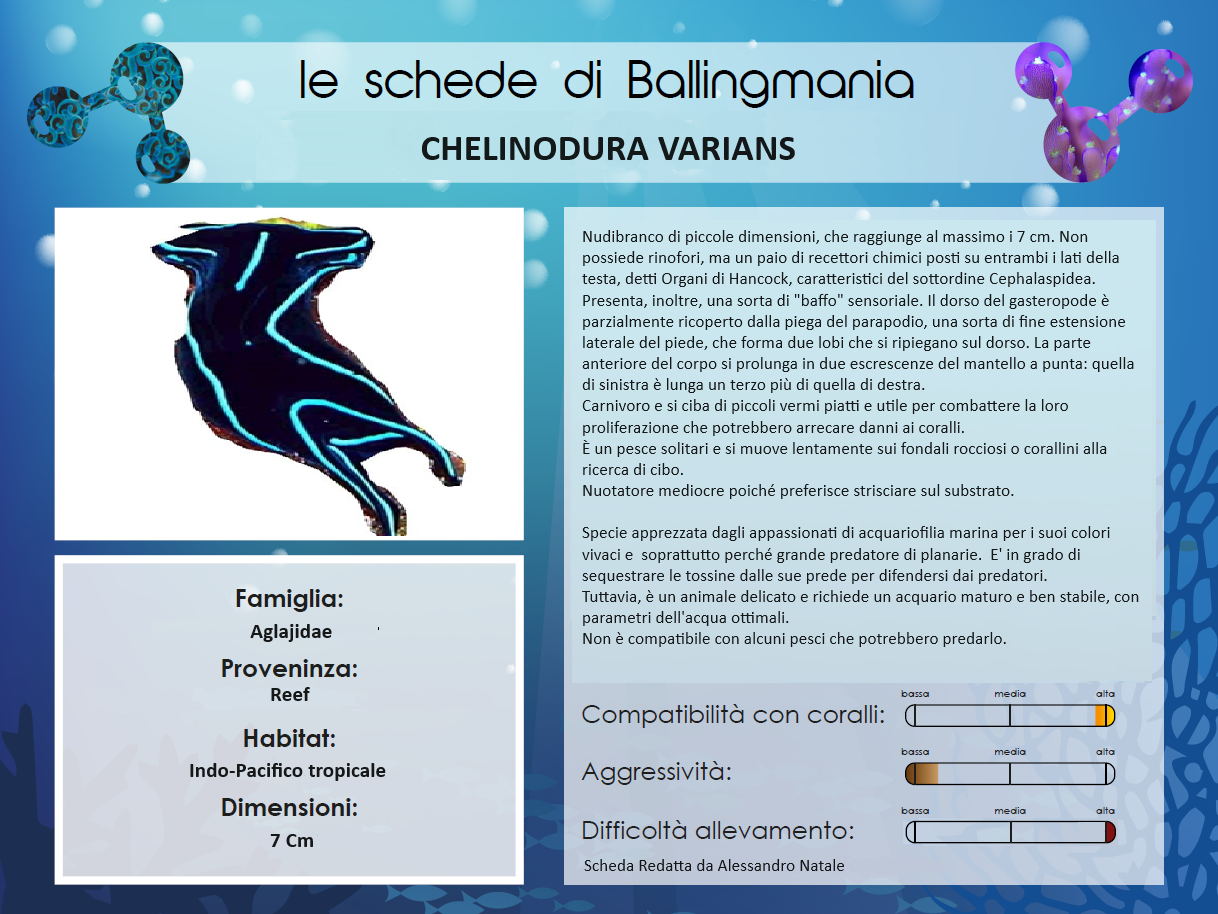
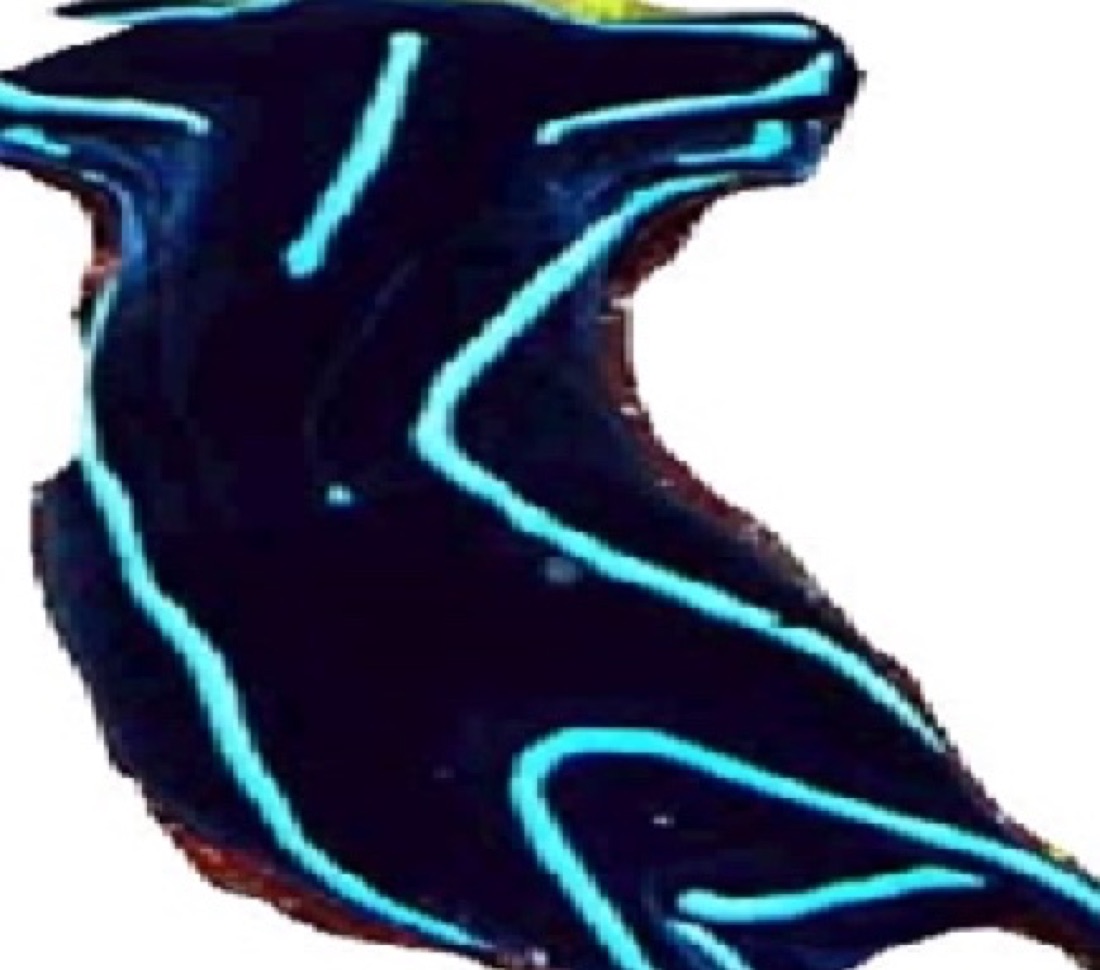
A small nudibranch, reaching at most 7 cm. It has no rhinophores, but a pair of chemical receptors on both sides of the head, called Hancock's organs, typical of the suborder Cephalaspidea. It also has a sort of sensory "whisker". The back of the gastropod is partly covered by the fold of the parapodium, a kind of thin lateral extension of the foot, which forms two lobes that fold over the back. The front of the body extends into two pointed outgrowths of the mantle: the left one is a third longer than the right one.
Carnivorous, it feeds on small flatworms and is useful for fighting their proliferation, which could harm corals.
It is a solitary fish and moves slowly over rocky or coral bottoms in search of food.
A mediocre swimmer, as it prefers to crawl over the substrate.
A species appreciated by marine aquarium enthusiasts for its bright colours and above all because it is a great predator of flatworms. It is able to sequester toxins from its prey to defend itself from predators.
However, it is a delicate animal and needs a mature, very stable aquarium with optimal water parameters.
It is not compatible with some fish that might prey on it.
Species sheet written by Alessandro Natale
Did you know?
Sources
- MolluscaBase, via WoRMS (2026). Chelidonura varians Eliot, 1903. World Register of Marine Species.
- Palomares M.L.D., Pauly D. (eds.) (2026). Chelidonura varians, Variable Chelidonura. SeaLifeBase.
- Yonow N. (2012). Opisthobranchs from the western Indian Ocean, with descriptions of two new species and ten new records (Mollusca, Gastropoda). ZooKeys 197: 1-129.
- Zamora-Silva A., Malaquias M.A.E. (2018). Molecular phylogeny of the Aglajidae head-shield sea slugs (Heterobranchia: Cephalaspidea): new evolutionary lineages revealed and proposal of a new classification. Zoological Journal of the Linnean Society 183(1): 1-51.
Sources checked on 5 November 2026. Community texts and ratings are kept separate from the scientific data.