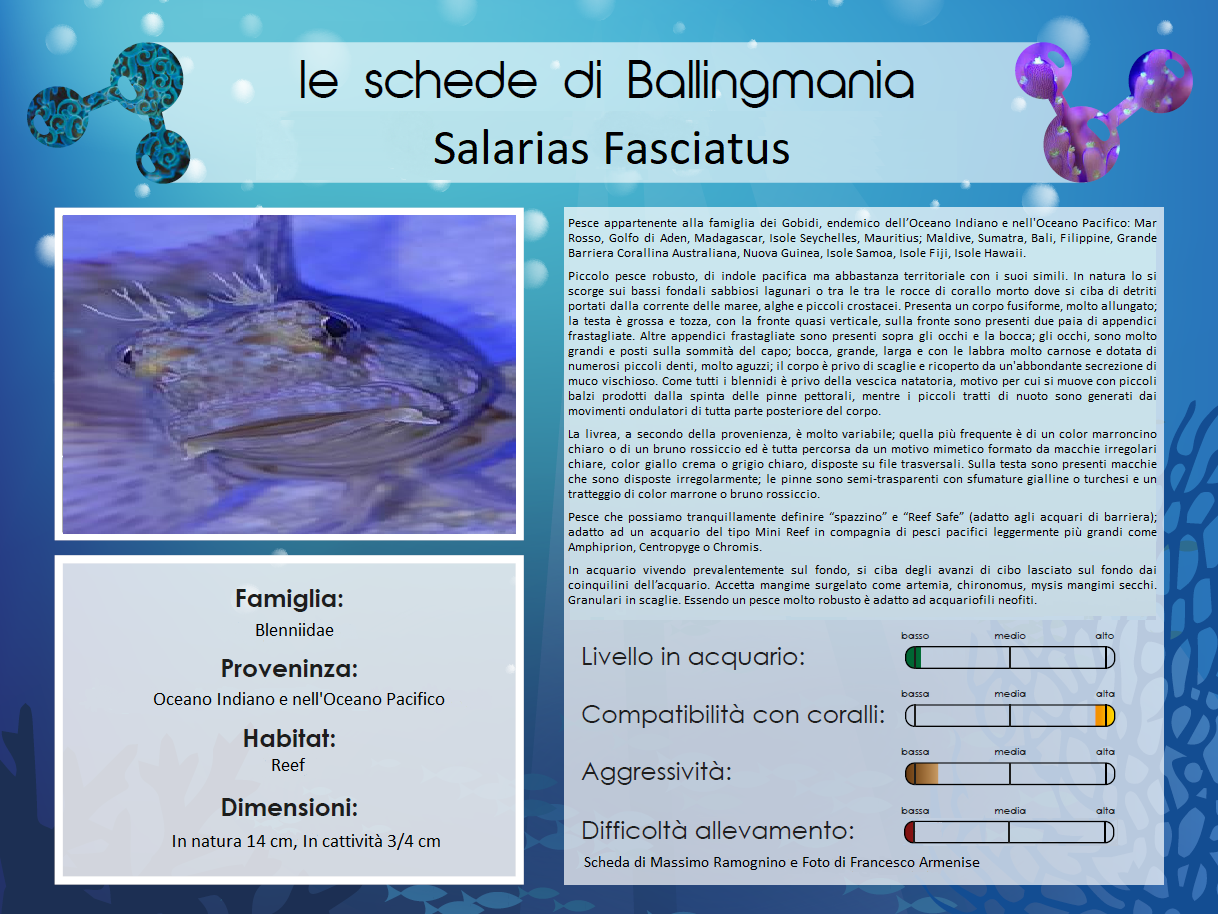
Salarias fasciatus
A blenny of very shallow water, up to 14 cm long, greenish or brown with a camouflage pattern of spots and blotches. 1 2 3 It spends its time sitting still among dead corals or combing the algal turf, from which it mainly gets detritus and other organic matter. 3 4
At a glance
Data from the scientific sources listed at the bottom.
Depth in the wild
0–8 m
Size
up to 14 cm
maximum total length
Conservation
IUCN Red List: least concern (2009). Red List data taken from FishBase. 2 It does not appear in the CITES lists checked on Species+. 8
Where it lives
From the Red Sea and East Africa to Samoa; north to the Ryukyu Islands, south to the Great Barrier Reef and New Caledonia. 2 In Australia it is found from Shark Bay to South West Rocks, in New South Wales, and in the Lord Howe Island province. 3
Life in the wild
What it eats
According to FishBase it scrapes algae; Fishes of Australia considers it a detritivore that gathers organic matter by combing the algal turf. 2 3 In gut content analysis of this species, detritus appeared in 100% of the fields examined, filamentous algae in 73% and invertebrates in 11%: this shows how often they were present, not how much they weighed. 6 The same group of studies concludes that detritus is the main food resource for these blennies. 5
Reproduction
It lays eggs that stick to the bottom; the larvae live in the plankton. 2
In the aquarium
From the experience of the BallingMania community.
A fish belonging to the goby family (Gobiidae), native to the Indian Ocean and the Pacific Ocean: the Red Sea, the Gulf of Aden, Madagascar, the Seychelles, Mauritius, the Maldives, Sumatra, Bali, the Philippines, the Australian Great Barrier Reef, New Guinea, the Samoa Islands, the Fiji Islands and the Hawaiian Islands.
A small, hardy fish with a peaceful temperament, but fairly territorial with its own kind. In the wild it can be spotted on shallow sandy lagoon bottoms or among dead coral rocks, where it feeds on detritus carried by the tidal current, algae and small crustaceans. It has a spindle-shaped, very elongated body; the head is large and stocky, with an almost vertical forehead, on which there are two pairs of fringed appendages. Other fringed appendages are found above the eyes and the mouth; the eyes are very large and set on top of the head; the mouth is large and wide, with very fleshy lips and many small, very sharp teeth; the body has no scales and is covered with an abundant secretion of sticky mucus. Like all blennies it has no swim bladder, which is why it moves in small hops pushed by its pectoral fins, while short stretches of swimming are produced by wave-like movements of the whole rear part of the body.
The livery varies a great deal depending on origin; the most common is a light brown or reddish brown, covered all over with a camouflage pattern of irregular pale spots, creamy yellow or light grey, arranged in vertical rows. On the head there are irregularly arranged spots; the fins are semi-transparent with yellowish or turquoise shading and brown or reddish-brown hatching.
A fish we can safely call a "clean-up" fish and "Reef Safe" (suitable for reef aquariums); suited to a mini reef aquarium in the company of slightly larger peaceful fish such as Amphiprion, Centropyge or Chromis.
In the aquarium, living mainly on the bottom, it feeds on leftover food left on the bottom by its tankmates. It accepts frozen food such as Artemia, chironomus, mysis, dry foods, granules and flakes. Being a very hardy fish, it is suitable for beginner aquarists.
Species sheet by Massimo Ramognino and photo by Francesco Armenise
What studies say about keeping it
Not advice for a home aquarium, but a figure on the trade: in the United States it was among the 20 most imported species, sixteenth in 2008 and seventeenth in 2009 and 2011, with 1.2-1.3% of specimens. 7
Did you know?
Sources
- WoRMS Editorial Board (2026). Salarias fasciatus (Bloch, 1786). World Register of Marine Species.
- Froese R., Pauly D. (eds.) (2026). Salarias fasciatus, Jewelled blenny. FishBase.
- Bray D.J. (2021). Banded Blenny, Salarias fasciatus (Bloch 1786). Fishes of Australia.
- Lizard Island Field Guide (2026). Banded Blenny, Salarias fasciatus. Australian Museum.
- Wilson S.K. (2000). Trophic status and feeding selectivity of blennies (Blenniidae: Salariini). Marine Biology.
- Wilson S.K. (2001). An investigation into the trophic nature of small reef fish from the tribe Salariini, family Blenniidae (PhD thesis). James Cook University.
- Rhyne A.L., Tlusty M.F., Szczebak J.T., Holmberg R.J. (2017). Expanding our understanding of the trade in marine aquarium animals. PeerJ.
- UNEP-WCMC (2026). Search for Salarias fasciatus in the CITES lists. Species+.
Sources checked on 5 November 2026. Community texts and ratings are kept separate from the scientific data.