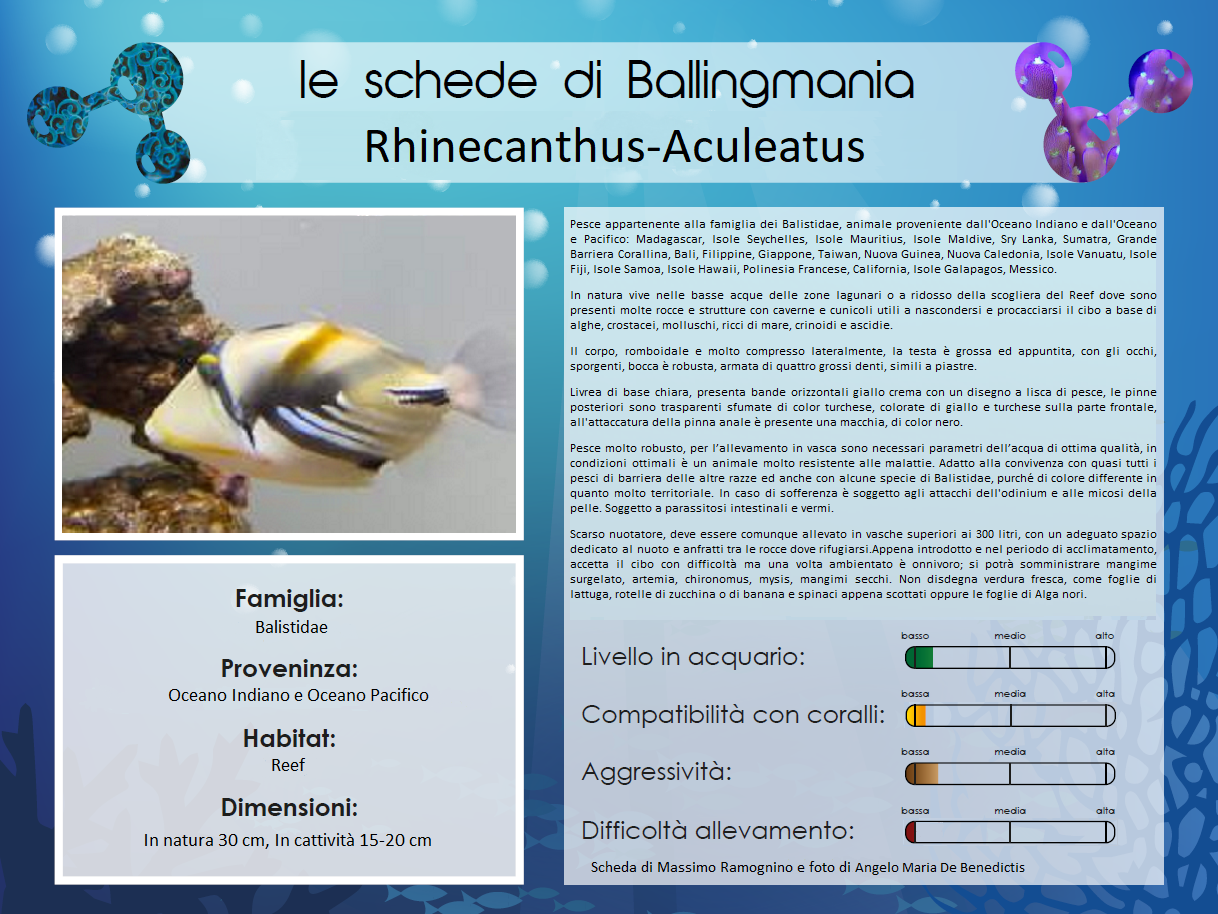
Rhinecanthus aculeatus
Picasso triggerfish
The Picasso triggerfish, known in Italian as pesce balestra Picasso 9, is a boldly patterned triggerfish 1, common on reef flats and shallow lagoons. 2 4 It is territorial, eats a bit of everything, corals included, and the females guard the eggs. 2 6
At a glance
Data from the scientific sources listed at the bottom.
Depth in the wild
1–50 m
Size
up to 30 cm
maximum total length; usually 15 cm [2]
Conservation
IUCN Red List: least concern (2022). Red List data taken from FishBase and GBIF. 2 9 It does not appear in the CITES lists checked on Species+. 10 It is of minor importance to fisheries and is traded for aquariums. 2
Where it lives
Tropical Indo-Pacific, from the Red Sea and East Africa to South Africa, east to Hawaii, the Marquesas, the Tuamotus and Pitcairn and north to southern Japan. 2 4 In Australia juveniles reach as far as Merimbula, in New South Wales. 4 The Smithsonian records it as introduced and occasional in south-east Florida. 5
How to recognise it
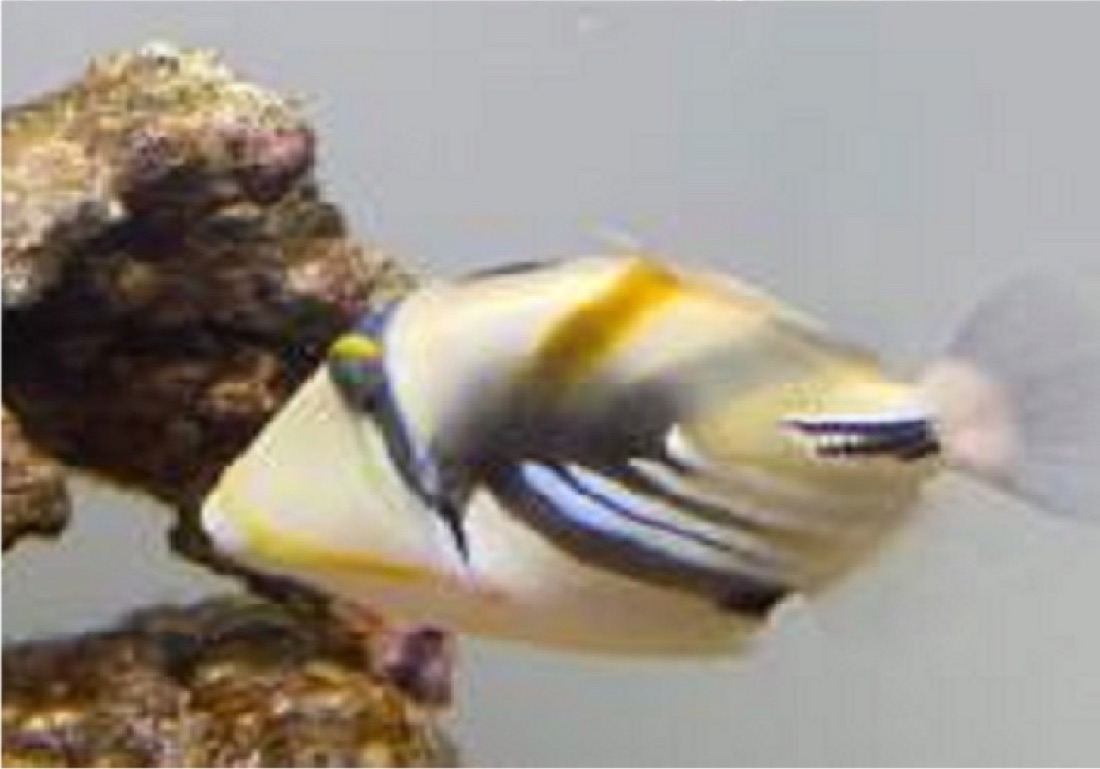
Tap a number on the photo: the key explains what to look for.
- 1Yellow band from the snout to below the pectoral fin 4 5
- 2Dark bar with blue lines it crosses the eye and runs down to the base of the pectoral fin 4 5
- 3Large dark area in the middle of the flank 4 5
- 4Oblique bands they start from the dark area and run above the anal fin 4
- 5Dark rows at the base of the tail 3 to 5 rows of small spines 3 4
Life in the wild
What it eats
Omnivore: algae, detritus, molluscs, crustaceans, worms, sea urchins, fish, corals, tunicates, foraminifera and eggs. 2
Reproduction
Both males and females defend a territory, some for more than 8 years, and a male's territory overlaps 2-3 female territories. 6 At Okinawa one male with several females is the most common arrangement, but pairs also exist. 7 Spawning takes place at dawn, in the days around the new or full moon. The eggs lie on the bottom, only the female tends them, and hatching comes just after sunset on the same day. 6
In the aquarium
From the experience of the BallingMania community.
A fish belonging to the family Balistidae, an animal coming from the Indian Ocean and the Pacific Ocean: Madagascar, the Seychelles, Mauritius, the Maldives, Sri Lanka, Sumatra, the Great Barrier Reef, Bali, the Philippines, Japan, Taiwan, New Guinea, New Caledonia, the Vanuatu Islands, the Fiji Islands, the Samoa Islands, the Hawaiian Islands, French Polynesia, California, the Galápagos Islands and Mexico.
In the wild it lives in the shallow waters of lagoon areas or close to the reef cliff, where there are many rocks and structures with caves and tunnels useful for hiding and for finding food: algae, crustaceans, molluscs, sea urchins, crinoids and sea squirts.
The body is rhomboid and strongly laterally compressed; the head is large and pointed, with protruding eyes; the mouth is strong, armed with four large plate-like teeth.
A pale base livery with creamy yellow horizontal bands in a herringbone pattern; the rear fins are transparent with turquoise shading, coloured yellow and turquoise at the front; at the base of the anal fin there is a black spot.
A very hardy fish; to keep it in a tank, excellent water quality is needed; in optimal conditions it is an animal very resistant to disease. Suitable for living with almost all reef fish of other kinds and even with some species of Balistidae, as long as they are a different colour, as it is very territorial. When stressed it is prone to attacks of Oodinium and to fungal skin infections. Prone to intestinal parasites and worms.
A poor swimmer, it must nevertheless be kept in tanks larger than 300 litres, with adequate room for swimming and crevices among the rocks to take refuge in. Once introduced and during acclimatisation it accepts food with difficulty, but once settled in it is omnivorous; it can be given frozen food, Artemia, chironomus, mysis and dry foods. It does not refuse fresh vegetables, such as lettuce leaves, rounds of courgette or banana and lightly blanched spinach, or sheets of Nori seaweed.
Species sheet by Massimo Ramognino and photo by Angelo Maria De Benedictis
Did you know?
Sources
- WoRMS Editorial Board (2026). Rhinecanthus aculeatus (Linnaeus, 1758). World Register of Marine Species.
- Froese R., Pauly D. (eds.) (2026). Rhinecanthus aculeatus, White-banded triggerfish. FishBase.
- Matsuura K., in Carpenter K.E., Niem V.H. (eds.) (2001). Balistidae. The living marine resources of the Western Central Pacific, vol. 6. FAO.
- Bray D.J. (2023). Rhinecanthus aculeatus, in Fishes of Australia. Museums Victoria.
- Smithsonian Tropical Research Institute (2026). Rhinecanthus aculeatus, in Shorefishes of the Greater Caribbean. Smithsonian Institution.
- Kuwamura T. (1997). Evolution of Female Egg Care in Haremic Triggerfish, Rhinecanthus aculeatus. Ethology.
- Ziadi-Künzli F., Tachihara K. (2016). Female defence polygyny and plasticity in the mating system of the demersal triggerfish Rhinecanthus aculeatus (Pisces: Balistidae) from Okinawa Island. Marine Biology.
- Parmentier E., Raick X., Lecchini D., Boyle K., Vanwassenbergh S., Bertucci F., Kéver L. (2017). Unusual sound production mechanism in the triggerfish Rhinecanthus aculeatus (Balistidae). Journal of Experimental Biology.
- GBIF Secretariat (2026). Rhinecanthus aculeatus, common names and IUCN Red List category. GBIF.
- UNEP-WCMC (2026). Search for Rhinecanthus aculeatus in the CITES lists. Species+.
Sources checked on 5 November 2026. Community texts and ratings are kept separate from the scientific data.