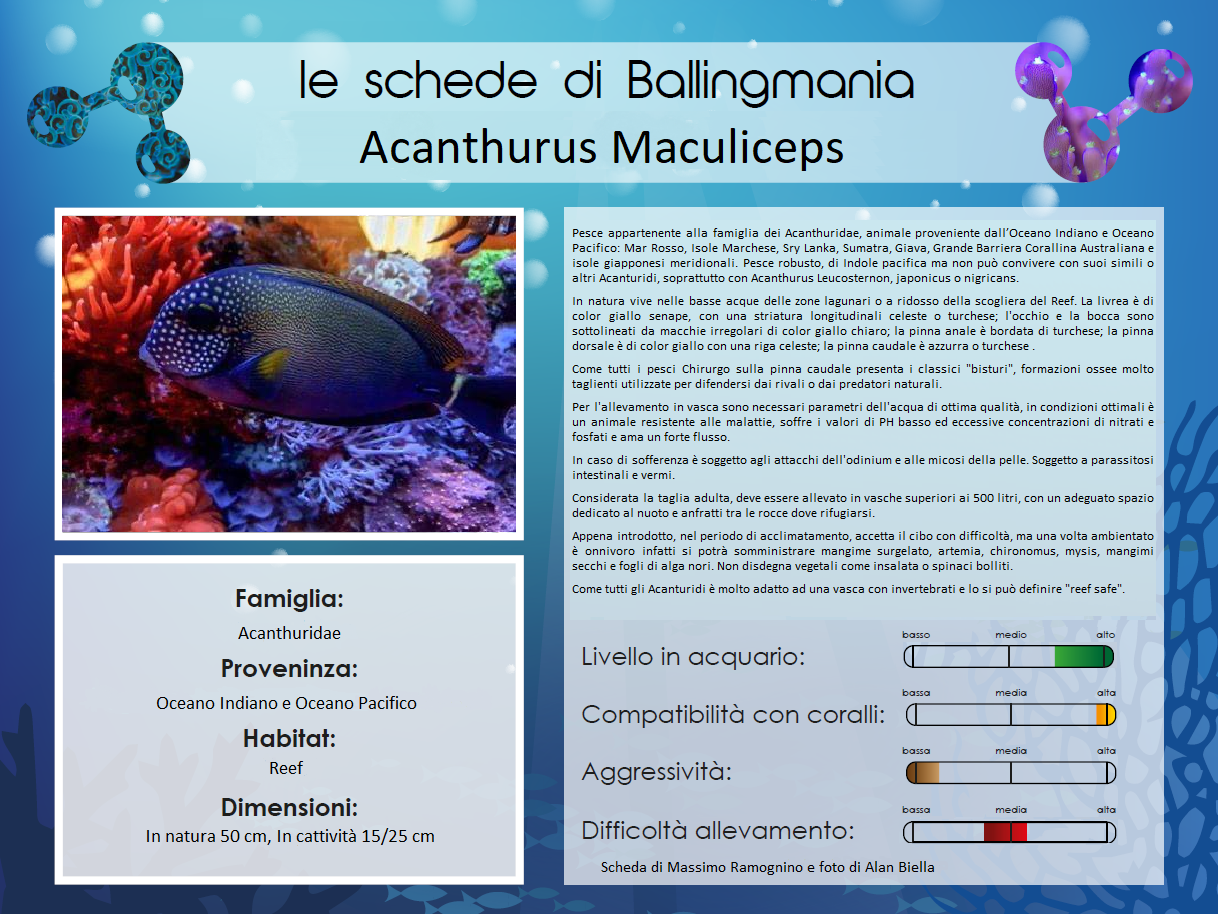
Acanthurus maculiceps
White-freckled surgeonfish
The white-freckled surgeonfish, known in Italian as pesce chirurgo faccia stellata 8, is a surgeonfish (family Acanthuridae) 1 up to 40 cm long, with tiny pale dots on the head and thin lines on the body. 4 5 It lives on the outer reefs of the Indo-Pacific, where it grazes on algae alone or in small groups. 2 6
At a glance
Data from the scientific sources listed at the bottom.
Depth in the wild
3–15 m
Size
up to 40 cm
maximum standard length, that is, without the tail fin
Temperature in the wild
24–28 °C
Where it lives
From the Maldives and the Andaman Sea, through Christmas Island and the Philippines, to the Line Islands; to the north it reaches the Ryukyu Islands and to the south Samoa. 2 In Australia it is found on the northern Great Barrier Reef, in the Coral Sea and at the Cocos (Keeling) and Christmas Islands; single specimens carried by currents reach Hawaii. 6
Conservation
IUCN Red List: least concern (2010). Red List data taken from FishBase. 2 FishBase states that the species is not assessed by CITES, and a search on Species+ gives no results. 2 7 It is caught together with other surgeonfish throughout its range and is rarely collected for aquariums. 6 In Reef Life Survey counts it appears at 3.4% of the sites checked within its range. 5
How to recognise it
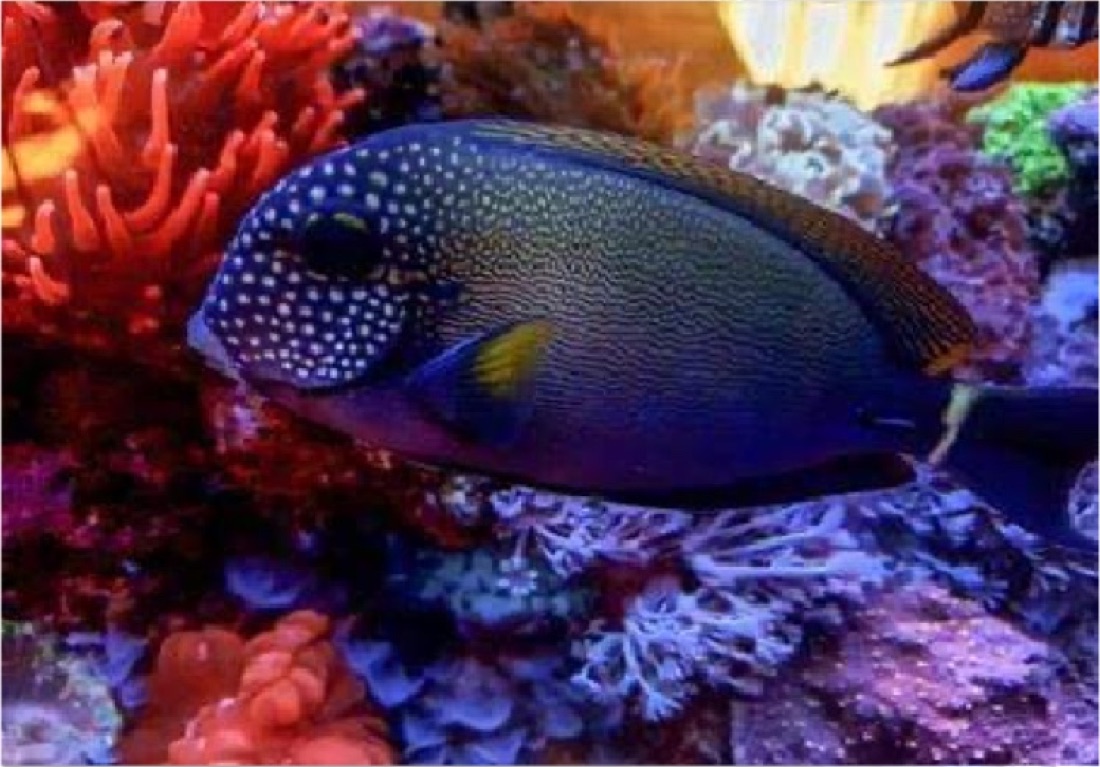
Tap a number on the photo: the key explains what to look for.
- 1Dots on head and nape small and dense; the sources describe them as yellow or pale, here they look white because of the lights 4 5
- 2Thin lines on the body thin, along the flanks 5
- 3Yellow patch on the pectoral fin large, in the upper outer part of the fin 4 5
- 4Striped dorsal fin 8 or 9 narrow bluish-brown stripes alternating with yellowish-orange stripes 4
- 5Pale band at the base of the tail often yellowish, near the pale tail blade 5
Life in the wild
In the aquarium
From the experience of the BallingMania community.
A fish belonging to the family Acanthuridae, an animal coming from the Indian Ocean and the Pacific Ocean: the Red Sea, the Marquesas Islands, Sri Lanka, Sumatra, Java, the Australian Great Barrier Reef and the southern Japanese islands. A hardy fish with a peaceful temperament, but it cannot live with others of its kind or other Acanthurids, especially Acanthurus leucosternon, japonicus or nigricans.
In the wild it lives in the shallow waters of lagoon areas or close to the reef cliff. The livery is mustard yellow, with light blue or turquoise lengthwise streaks; the eye and the mouth are highlighted by irregular pale yellow patches; the anal fin is edged with turquoise; the dorsal fin is yellow with a light blue line; the caudal fin is blue or turquoise.
Like all surgeonfish, on the caudal fin it has the classic "scalpels", very sharp bony structures used to defend itself from rivals or natural predators.
To keep it in a tank, excellent water quality is needed; in optimal conditions it is an animal resistant to disease; it suffers from low pH and excessive concentrations of nitrate and phosphate, and it loves a strong flow.
When stressed it is prone to attacks of Oodinium and to fungal skin infections. Prone to intestinal parasites and worms.
Considering its adult size, it must be kept in tanks larger than 500 litres, with adequate room for swimming and crevices among the rocks to take refuge in.
Once introduced, during acclimatisation, it accepts food with difficulty, but once settled in it is omnivorous; in fact it can be given frozen food, Artemia, chironomus, mysis, dry foods and sheets of Nori seaweed. It does not refuse vegetables such as lettuce or boiled spinach.
Like all Acanthurids it is very well suited to a tank with invertebrates and can be called "reef safe".
Species sheet by Massimo Ramognino and photo by Alan Biella
Did you know?
Sources
- Froese R., Pauly D. (eds.), via WoRMS (2026). Acanthurus maculiceps (Ahl, 1923). World Register of Marine Species.
- Froese R., Pauly D. (eds.) (2026). Acanthurus maculiceps, White-freckled surgeonfish. FishBase.
- Froese R., Pauly D. (eds.) (2026). Reproduction of Acanthurus maculiceps. FishBase.
- Randall J.E., in Carpenter K.E., Niem V.H. (eds.) (2001). Acanthuridae. The living marine resources of the Western Central Pacific, vol. 6. FAO.
- Reef Life Survey (2026). Acanthurus maculiceps. Reef Life Survey.
- Bray D.J. (2026). Spotted-face Surgeonfish, Acanthurus maculiceps (Ahl 1923). Fishes of Australia, Museums Victoria.
- UNEP-WCMC (2026). Search for Acanthurus maculiceps in the CITES lists. Species+.
- GBIF Secretariat (2026). Acanthurus maculiceps, nomi comuni. GBIF.
Sources checked on 5 November 2026. Community texts and ratings are kept separate from the scientific data.