
Acanthurus lineatus
Clown tang
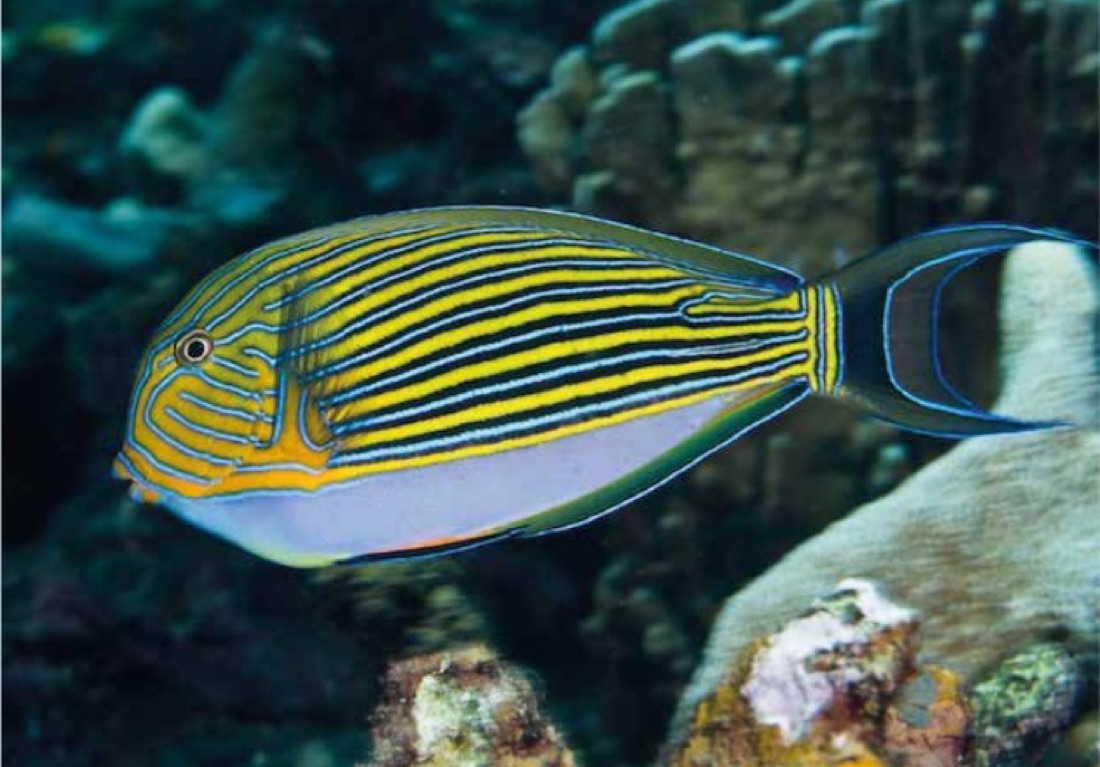
The lined surgeonfish, or clown tang, known in Italian as pesce chirurgo pigiama 5, belongs to the surgeonfish family (Acanthuridae). 1 It has yellow and blue stripes edged with black and a pale belly. 2 3 It lives in the wave-swept shallows of the Indo-Pacific, where it aggressively defends the territories in which it grazes on algae; on each side of the tail it has a venomous blade. 2 3
At a glance
Data from the scientific sources listed at the bottom.
Depth in the wild
1–3 m
Size
up to 38 cm
maximum total length; commonly up to 25 cm
Temperature in the wild
24–30 °C
Where it lives
From East Africa, as far as Delagoa Bay in Mozambique, and from the Mascarenes east to the Marquesas and the Tuamotus; to the north it reaches southern Japan, to the south the Great Barrier Reef and New Caledonia. 2 3 In Hawaii it is only an occasional visitor. 3 It is absent from the Red Sea and the other seas of the Arabian Peninsula; in the Red Sea it is replaced by the related species Acanthurus sohal. 2 3
Conservation
IUCN Red List: least concern (2010). Red List data taken from FishBase and GBIF. 2 6 It does not appear in the CITES lists checked on Species+. 7 In 1994 it made up 39% by weight of the catches of the small-scale fishery in American Samoa; nine years of indicators were uncertain but showed no significant overfishing. 8
How to recognise it
Tap a number on the photo: the key explains what to look for.
- 1Yellow and blue stripes alternating and edged with black, over the upper three quarters of the body 2 3
- 2Oblique stripes on the head on the head they are mostly diagonal 2 3
- 3Pale belly the lower quarter is lavender or bluish white 2 3
- 4Tail blade long and venomous, it folds into a groove: here it looks closed 2 3
- 5Crescent tail dark, with a large grey crescent edged with bluish white 2 3
Life in the wild
Where it is found
Coral reefs and rocky bottoms exposed to waves; common in the surge zone on the outer side of the reef. 2 3 It usually stays at 1-3 m, but goes down to 15 m. 2 4 In Reef Life Survey counts it was observed in the sea between 23.2 and 31.3 °C; in the study area in American Samoa the coastal water ranged from 27 to 31 °C. 4 8
What it eats
Herbivore: it grazes on algae on the bottom; FishBase reports that it also eats crustaceans. 2 3 A study using isotopes and fatty acids on the Great Barrier Reef indicates that it grazes mainly on red and green filamentous algae; macroalgae make up about 45% and there are also signs of diatoms. 9 In the Lakshadweep Islands it is one of five species that alone account for over 90% of herbivore bites. 10
Behaviour
Territorial, aggressive and almost always on the move. 2 3 The large male controls feeding territories and a harem of females. 2 Juveniles are solitary and secretive, over rubble in shallow water. 2 In American Samoa it defends territories in shallow water by day and spends the night in deeper crevices; about 60% of adults are estimated to have changed territory at least once in three years. 8
Reproduction
It gathers in groups to spawn, but spawns in pairs. 2 In American Samoa it breeds all year round, with a peak from October to February: groups of 50-200 fish spawn at dawn in the outer reef channel. 8 Maturity is reached at 15-21 cm: half the fish are mature at about 18 cm, at about 4 years of age. 8 There the young settle on the reef mainly in March-April. 8
In the aquarium
From the experience of the BallingMania community.
It is one of the most beautiful fish to keep in an aquarium, as it has a very bright yellow-orange livery with irregular horizontal lines, from which its name comes. Like Acanthurus Shoal (a very similar species, which should not be kept together with it), as an adult it needs tanks of at least 800 litres with strong current, since in the wild it loves areas swept by strong currents; this is why it is often found on the outer part of the coral reef.
A very aggressive and territorial fish towards other Acanthurids; for this reason it must be fed several times a day with both plant and animal food.
Although it is a reef safe fish, it is still not recommended for the aquarium, as only a small percentage of them manage to survive; in fact, even the specimens that get through the acclimatisation phase (parasites and feeding) are always at risk, and even after 2/3 months they can die for no apparent reason.
photo by: Marco Pedata
Did you know?
Sources
- Froese R., Pauly D. (eds.), via WoRMS (2026). Acanthurus lineatus (Linnaeus, 1758). World Register of Marine Species.
- Froese R., Pauly D. (eds.) (2026). Acanthurus lineatus, Lined surgeonfish. FishBase.
- Randall J.E., in Carpenter K.E., Niem V.H. (eds.) (2001). Acanthuridae. The living marine resources of the Western Central Pacific, vol. 6. FAO.
- Reef Life Survey (2026). Acanthurus lineatus, Lined surgeonfish. Reef Life Survey.
- GBIF Secretariat (2026). Acanthurus lineatus, nomi comuni. GBIF.
- GBIF Secretariat (2026). Acanthurus lineatus, IUCN Red List category. GBIF.
- UNEP-WCMC (2026). Search for Acanthurus lineatus in the CITES lists. Species+.
- Craig P.C., Choat J.H., Axe L.M., Saucerman S. (1997). Population biology and harvest of the coral reef surgeonfish Acanthurus lineatus in American Samoa. Fishery Bulletin.
- García-Seoane R., White W.L., Taylor B.M., Clements K.D. (2025). Characterizing the trophic ecology of herbivorous coral reef fishes using stable isotope and fatty acid biomarkers. PLOS ONE.
- Karkarey R., Rathod P., Arthur R., Yadav S., Theo A., Alcoverro T. (2020). Wave exposure reduces herbivory in post-disturbed reefs by filtering species composition, abundance and behaviour of key fish herbivores. Scientific Reports.
Sources checked on 5 November 2026. Community texts and ratings are kept separate from the scientific data.