
Seriatopora hystrix
A bushy hard coral made of thin, pointed branches, found from the Red Sea to the Pacific. 1 2 It lives in very different environments, from shallow sheltered water to deep slopes. 1 5 It does not release eggs into the sea: it keeps its larvae inside the polyps and releases them fully formed. 7
At a glance
Data from the scientific sources listed at the bottom.
Depth in the wild
0–30 m
Size
up to 30 cm
usual maximum colony diameter; in sheltered areas up to about 1 m
Conservation
IUCN Red List: vulnerable (2023). CITES: Appendix II. The listed criterion is A3ce, the same reported by WoRMS and SeaLifeBase. 1 3 4 For international trade, the listing currently in force dates back to 18 January 1990; in the European Union it is in Annex B. 2 At Okinawa it disappeared from a shallow reef after the 1998 and 2001 bleaching events, with no sign of returning, while it remains abundant in deeper water nearby. 8 In Singapore it is among the locally extinct Pocilloporidae. 12
Where it lives
Western Indo-Pacific. Recorded in the Red Sea (Egypt, Israel, Saudi Arabia, Sudan), in East Africa and the islands of the Indian Ocean, then from India and the Maldives to Indonesia, the Philippines, Japan and Australia, as far as Fiji, the Marshall Islands and Samoa. 1 2 4
The coral
Group: SPS
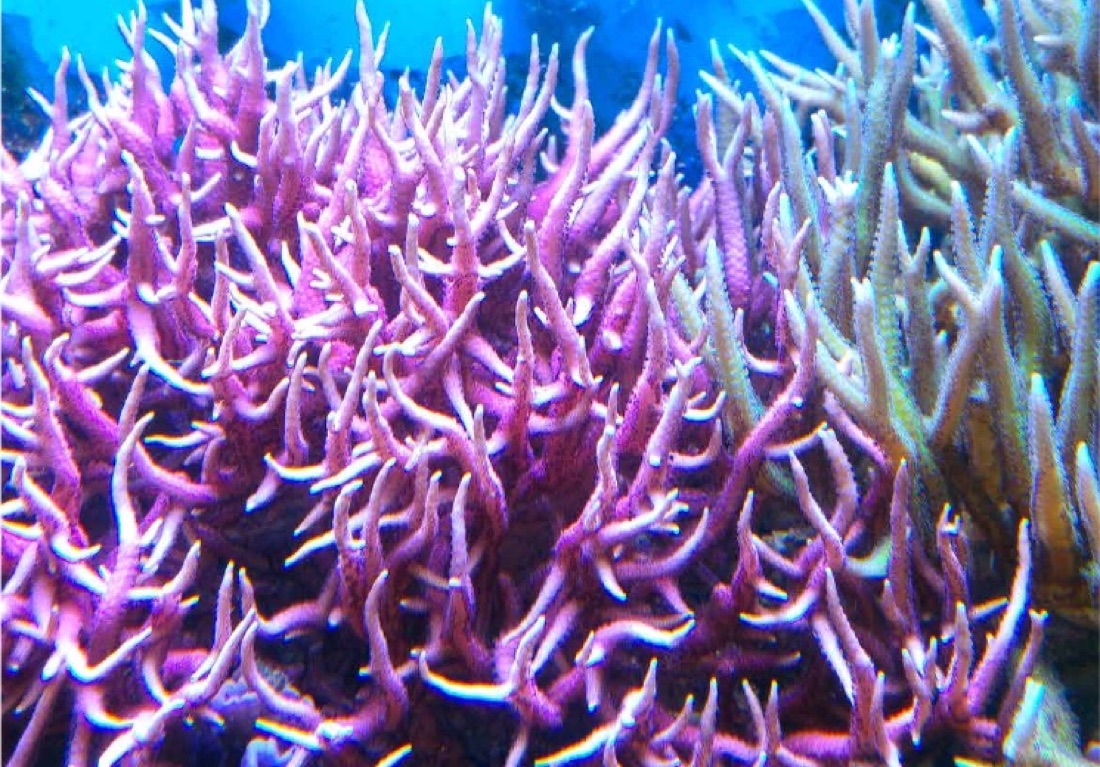
Growth form: bushy branching, with thin, pointed branches; more compact or more open depending on the environment
Zooxanthellae: yes
Growth: Values measured at individual sites: 16.7 mm a year at Lord Howe Island 15 17 and, on average, 22.1 mm a year at 3 m at Enewetak Atoll. 15 16 There the shade of table corals slows the growth of branching species. 16 In tank trials growth fell in low light. 12
How to recognise it
Tap a number on the photo: the key explains what to look for.
Life in the wild
Where it is found
On the reefs of the far northern Great Barrier Reef it lives from almost 0 to 30 m, in back-reef areas, on the upper slope and on the deep slope. 5 6 It is most abundant in shallow, sheltered water, in lagoons and behind the reef, where it can cover up to 30% of the bottom; on outer slopes colonies reach about 25 cm, in sheltered or sediment-rich areas about 1 m. 1 A FAO guide describes it in dense stands between about 6 and 20 m. 4 There are much deeper records: abundant colonies at about 40 m at Okinawa 7, 55 m on the Great Barrier Reef 15 18 and a maximum of 183 m in SeaLifeBase. 4 At Yonge Reef, over 26 months of measurements, monthly water averages ranged from 24.0 to 29.1 °C. 6
What it eats
It lives thanks to symbiotic algae (zooxanthellae), which the larvae already receive from the mother colony. 4 7 Colonies from different environments host different types of symbionts: shallow ones mainly C120, deep ones mainly C3n-t. 5 In a transplant experiment the symbionts did not change over 14 months, and in native colonies from deep areas there are indirect signs of a greater ability to feed on particles and small prey. 6
Behaviour
Once released, the planulae crawl over the bottom and the walls of the container; in a tank they preferred to settle on plastic rather than on limestone tiles, for unclear reasons. 7 Nearby colonies from different environments turn out to be genetically separate: in transplants, fragments returned to their home environment survived better. 5 6
Reproduction
A hermaphrodite that broods its larvae (planulae) inside the polyps; the planulae can be produced sexually or asexually. 7 In the shallow waters of Okinawa release runs from May to October, while at about 40 m it lasts mainly from July to early August, largely between midnight and 8 am. 7 In southern Taiwan release follows the moon and changes with the season, coming earlier when the water warms from 23 to 28 °C. 9 10 At Lord Howe Island, the southernmost reef in the world, planulae were found from November to February. 11
In the aquarium
From the experience of the BallingMania community.
Seriatopora hystrix, from the western Pacific Ocean, the Indian Ocean and the Red Sea, can easily be propagated in the aquarium by fragging, starting from coral fragments glued to the rocks with special glues. The growth is very dense and the branches are very fine, ending in thin, sharp tips. The shape of the colony can be more or less compact depending on the current flowing through it.
In the aquarium it does not need much light and its growth is fairly fast.
photo by: Vincenzo Milazzo
What studies say about keeping it
Data from tank research, not advice for a home aquarium. At the National Museum of Marine Biology and Aquarium in Taiwan, larval release was followed in freshly collected colonies kept in tanks. 10 In outdoor flow-through systems, also in Taiwan, larvae released later settled better within 24 hours. 9 After a month in captivity the colonies kept a photosynthetic efficiency almost equal to that in the wild, while chlorophyll roughly doubled, perhaps because of the different light. 14 In a seven-day trial at variable temperature (23-29 °C) the colonies increased their photosynthetic capacity compared with a constant 26 °C. 13 In other tank trials they coped with sediment and low light by adjusting photosynthesis, but grew less in low light and died more with heavy sediment. 12
Did you know?
Sources
- Hoeksema B.W., Cairns S., Samimi-Namin K. (2026). Seriatopora hystrix Dana, 1846. World List of Scleractinia, via WoRMS.
- UNEP-WCMC (2026). Seriatopora hystrix, CITES listings and distribution. Species+.
- GBIF Secretariat (2026). Seriatopora hystrix on the IUCN Red List (Cowburn et al.), data from GBIF. GBIF.
- Palomares M.L.D., Pauly D. (eds.) (2026). Seriatopora hystrix. SeaLifeBase.
- Bongaerts P., Riginos C., Ridgway T. et al. (2010). Genetic Divergence across Habitats in the Widespread Coral Seriatopora hystrix and Its Associated Symbiodinium. PLoS ONE.
- Bongaerts P. et al. (2011). Adaptive divergence in a scleractinian coral: physiological adaptation of Seriatopora hystrix to shallow and deep reef habitats. BMC Evolutionary Biology.
- Prasetia R., Sinniger F., Hashizume K., Harii S. (2017). Reproductive biology of the deep brooding coral Seriatopora hystrix: Implications for shallow reef recovery. PLoS ONE.
- Prasetia R., Sinniger F., Nakamura T., Harii S. (2022). Limited acclimation of early life stages of the coral Seriatopora hystrix from mesophotic depth to shallow reefs. Scientific Reports.
- Fan T.Y., Li J.J., Ie S.X., Fang L.S. (2002). Lunar periodicity of larval release by pocilloporid corals in southern Taiwan. Zoological Studies.
- Fan T.Y., Hsieh Y.C., Lin K.H. et al. (2017). Plasticity in lunar timing of larval release of two brooding pocilloporid corals in an internal tide-induced upwelling reef. Marine Ecology Progress Series.
- Baird A.H., Cumbo V.R., Gudge S. et al. (2015). Coral reproduction on the world's southernmost reef at Lord Howe Island, Australia. Aquatic Biology.
- Chew A.A.N., Yap Y.Z., Poquita-Du R.C., Huang D., Todd P.A. (2025). Potential drivers of pocilloporid coral extirpations in Singapore. Marine Pollution Bulletin.
- Mayfield A.B., Chan P.H., Putnam H.M., Chen C.S., Fan T.Y. (2012). The effects of a variable temperature regime on the physiology of the reef-building coral Seriatopora hystrix: results from a laboratory-based reciprocal transplant. Journal of Experimental Biology, Moorea Coral Reef LTER record.
- Mayfield A.B., Fan T.Y., Chen C.S. (2013). The Impacts of Ex Situ Transplantation on the Physiology of the Taiwanese Reef-Building Coral Seriatopora hystrix. Journal of Marine Biology, testo letto via Open Access Library.
- Madin J. et al. (eds.) (2026). Seriatopora hystrix. Coral Trait Database.
- Stimson J. (1985). The Effect of Shading by the Table Coral Acropora Hyacinthus on Understory Corals. Ecology, reference in the Coral Trait Database.
- Harriott V.J. (1999). Coral growth in subtropical eastern Australia. Coral Reefs, reference in the Coral Trait Database.
- Bridge T.C.L., Fabricius K.E., Bongaerts P. et al. (2011). Diversity of Scleractinia and Octocorallia in the mesophotic zone of the Great Barrier Reef, Australia. Coral Reefs, reference in the Coral Trait Database.
- Wilson B., Edmunds P.J. (2026). Survival, rarity, and extinction in tropical stony corals. Conservation Biology.
Sources checked on 5 November 2026. Community texts and ratings are kept separate from the scientific data.