
Seriatopora caliendrum
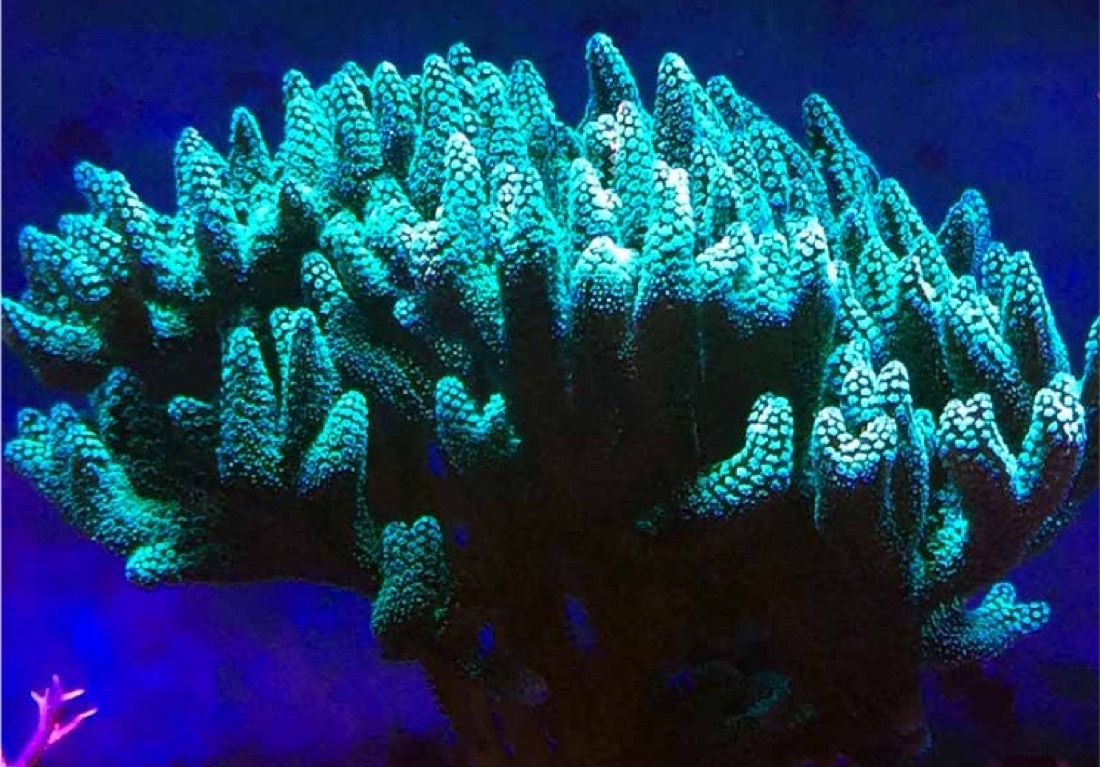
A branching hard coral, related to Seriatopora hystrix but with sturdier branches that do not taper towards the tip. 1 4 It is less common, but very widespread, from the Red Sea to the Pacific. 1 2 It broods its larvae and releases them fully formed. 5 10 11
At a glance
Data from the scientific sources listed at the bottom.
Depth in the wild
0–25 m
Size
up to 30 cm
maximum colony diameter, FAO data reported by SeaLifeBase
Conservation
IUCN Red List: vulnerable (2023). CITES: Appendix II. The listed criterion is A3ce, the same reported by WoRMS and SeaLifeBase. 1 3 4 For international trade, the listing currently in force dates back to 18 January 1990; in the European Union it is in Annex B. 2
Where it lives
Western Indo-Pacific; the type locality is the Red Sea. Recorded in Egypt, Israel, Saudi Arabia, Djibouti and Oman, in East Africa and the islands of the Indian Ocean, then from the Maldives and Thailand to Indonesia, the Philippines, Japan and Australia, as far as Fiji, Tonga and Samoa. 1 2 4
The coral
Group: SPS
Growth form: branching, with thicker branches than S. hystrix, sometimes almost straight and with blunt tips
Zooxanthellae: yes
Growth: In a research tank the specific growth rate stayed constant for seven weeks, rising from 0.84% to 1.15% per day with the addition of Artemia. 8
How to recognise it
Tap a number on the photo: the key explains what to look for.
Life in the wild
Where it is found
On reef slopes from the surface to 25 m, especially in sheltered waters and more often on the back reef than on the outer side. 1 Other records give 1-40 m 9 10 and 3-35 m, the latter based only on reports and marked by SeaLifeBase as data to be replaced. 4 In southern Taiwan it is the dominant pocilloporid in an area with upwelling of cold water: there the yearly temperature ranges from below 21 to above 31 °C and in the warm season it can change by 6 °C in a single day. 6
Reproduction
A hermaphrodite 4 that broods its larvae 10 11. In southern Taiwan it releases them all year round in sync with the new moon, over several days in a row. 5 Larvae released near the peak were 1.4 times larger and 33% more likely to settle in the first 5 hours than those released at the start. 5
In the aquarium
From the experience of the BallingMania community.
An SPS hard coral from the western Pacific, the Indian Ocean and the Red Sea. It is usually green/blue or cream, and there is also a “Rot”, or red, form. It lives in symbiosis with zooxanthellae, which provide part of the nourishment it needs, but it also feeds on zooplankton and bacterioplankton.
A robust coral with a fast growth rate, so it is advisable to leave it plenty of room when choosing where to place it in the tank.
top photo: Giuseppe Rogliano · bottom photo: Paolo Corbellini
What studies say about keeping it
Research data, not advice for a home aquarium. In the European CORALZOO project three genetically identical colonies were grown for seven weeks in a 500-litre tank and then for four weeks with an extra 20,000 Artemia nauplii per colony, five days a week: growth rose by 35%. 8 The same study estimates the production of 100 g colonies, starting from 10 g fragments, using data from the coral farm of the NAUSICAA public aquarium in France: up to 100 colonies per square metre of tank. 8
Did you know?
Sources
- Hoeksema B.W., Cairns S., Samimi-Namin K. (2026). Seriatopora caliendrum Hemprich & Ehrenberg, 1834. World List of Scleractinia, via WoRMS.
- UNEP-WCMC (2026). Seriatopora caliendrum, CITES listings and distribution. Species+.
- GBIF Secretariat (2026). Seriatopora caliendrum on the IUCN Red List (Crabbe et al.), data from GBIF. GBIF.
- Palomares M.L.D., Pauly D. (eds.) (2026). Seriatopora caliendrum. SeaLifeBase.
- Cumbo V.R., Fan T.Y., Edmunds P.J. (2012). Physiological development of brooded larvae from two pocilloporid corals in Taiwan. Marine Biology.
- Tang C.H., Fang L.S., Fan T.Y. et al. (2014). Cellular Membrane Accommodation to Thermal Oscillations in the Coral Seriatopora caliendrum. PLoS ONE.
- Seveso D., Montano S., Strona G., Orlandi I., Galli P., Vai M. (2016). Hsp60 expression profiles in the reef-building coral Seriatopora caliendrum subjected to heat and cold shock regimes. Marine Environmental Research.
- Osinga R., Schutter M., Griffioen B. et al. (2011). The biology and economics of coral growth. Marine Biotechnology.
- Carpenter K.E., Abrar M., Aeby G. et al. (2008). One-third of reef-building corals face elevated extinction risk from climate change and local impacts. Science.
- Madin J. et al. (eds.) (2026). Seriatopora caliendrum. Coral Trait Database.
- Shlesinger Y., Loya Y. (1985). Coral community reproductive patterns: Red Sea versus the Great Barrier Reef. Science.
- Bongaerts P., Riginos C., Ridgway T. et al. (2010). Genetic Divergence across Habitats in the Widespread Coral Seriatopora hystrix and Its Associated Symbiodinium. PLoS ONE.
- Silverstein R.N., Correa A., LaJeunesse T.C., Baker A.C. (2011). Novel algal symbiont (Symbiodinium spp.) diversity in reef corals of Western Australia. Marine Ecology Progress Series.
- Seveso D., Montano S., Strona G., Orlandi I., Galli P., Vai M. (2013). Exploring the effect of salinity changes on the levels of Hsp60 in the tropical coral Seriatopora caliendrum. Marine Environmental Research.
Sources checked on 5 November 2026. Community texts and ratings are kept separate from the scientific data.