Porites
Porites is a whole genus of hard corals, not a single species, valid on WoRMS. 1 It lives from the Red Sea to the eastern Pacific and in the tropical Atlantic, but its species are hard to tell apart: branching and massive colonies can turn out to be the same in genetic analysis. 3 4 5 Large massive colonies can live for centuries. 6
At a glance
Data from the scientific sources listed at the bottom.
Conservation
IUCN Red List: not evaluated. CITES: Appendix II. The Red List assesses individual species, not the genus as a whole. The CITES listing covers the whole order Scleractinia and has been in force since 18 January 1990; in the European Union it is in Annex B. 2
The coral
Group: SPS
Growth form: massive or branching depending on the species; both forms are found within the same genetic group 5
Zooxanthellae: yes
Growth: Slow: for the giant Goolboodi colony, with the sea at about 26 °C on average, upward growth is estimated at about 1.2 cm a year. 6
Where it lives
The range of the genus is derived from its species. P. lobata is recorded from the Red Sea and East Africa to French Polynesia, and also in Central and South America (Panama, Colombia, Ecuador). 3 P. astreoides lives in the Caribbean, Bermuda and Brazil, and reaches Cape Verde, in the eastern Atlantic. 4 A genetic study found colonies of the same group in the Caribbean, the eastern Pacific, Hawaii and the western Indo-Pacific. 5
How to recognise it
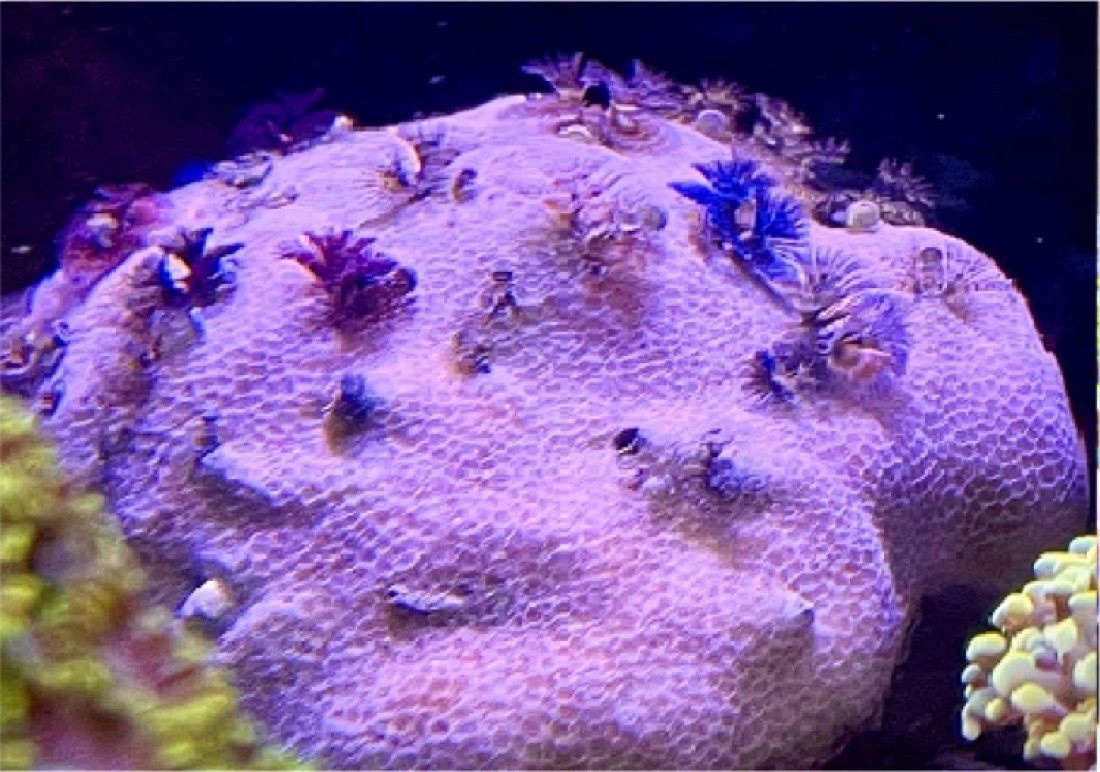
Tap a number on the photo: the key explains what to look for.
Life in the wild
Where it is found
It varies with the species. On the Great Barrier Reef very large massive colonies are rare and concentrated on the reef-front terrace, at 6-12 m, or on sheltered reefs near the coast. 6 P. astreoides was studied from 5 to 37 m in the US Virgin Islands, with the highest cover at around 10 m and at about 35 m. 8 Where upward growth is stopped by low tide, massive colonies form microatolls: discs with a living rim and a flat, largely dead top. 12
What it eats
It lives in symbiosis with microscopic algae (zooxanthellae): in P. cf. lobata the eggs already contain 95-155 of them. 7 It can also catch food, but after bleaching P. compressa and P. lobata did not increase the food they caught enough to cover their daily needs, as Montipora capitata did. 11
Behaviour
Many Porites periodically form a mucus sheet over their surface. In Panama P. furcata produced it around the full moon and P. astreoides about a week earlier. 9 The appearance of the sheet did not depend on salinity, temperature or sediment, but went hand in hand with the contraction of the polyps. 9
Reproduction
It varies between species. P. astreoides broods its larvae and releases them fully formed. 8 P. cf. lobata in Palau, on the other hand, releases its gametes into the water, in April and May, on the first day after the full moon: males do so before females, and the larvae can settle after about 2 days. 7
In the aquarium
From the experience of the BallingMania community.
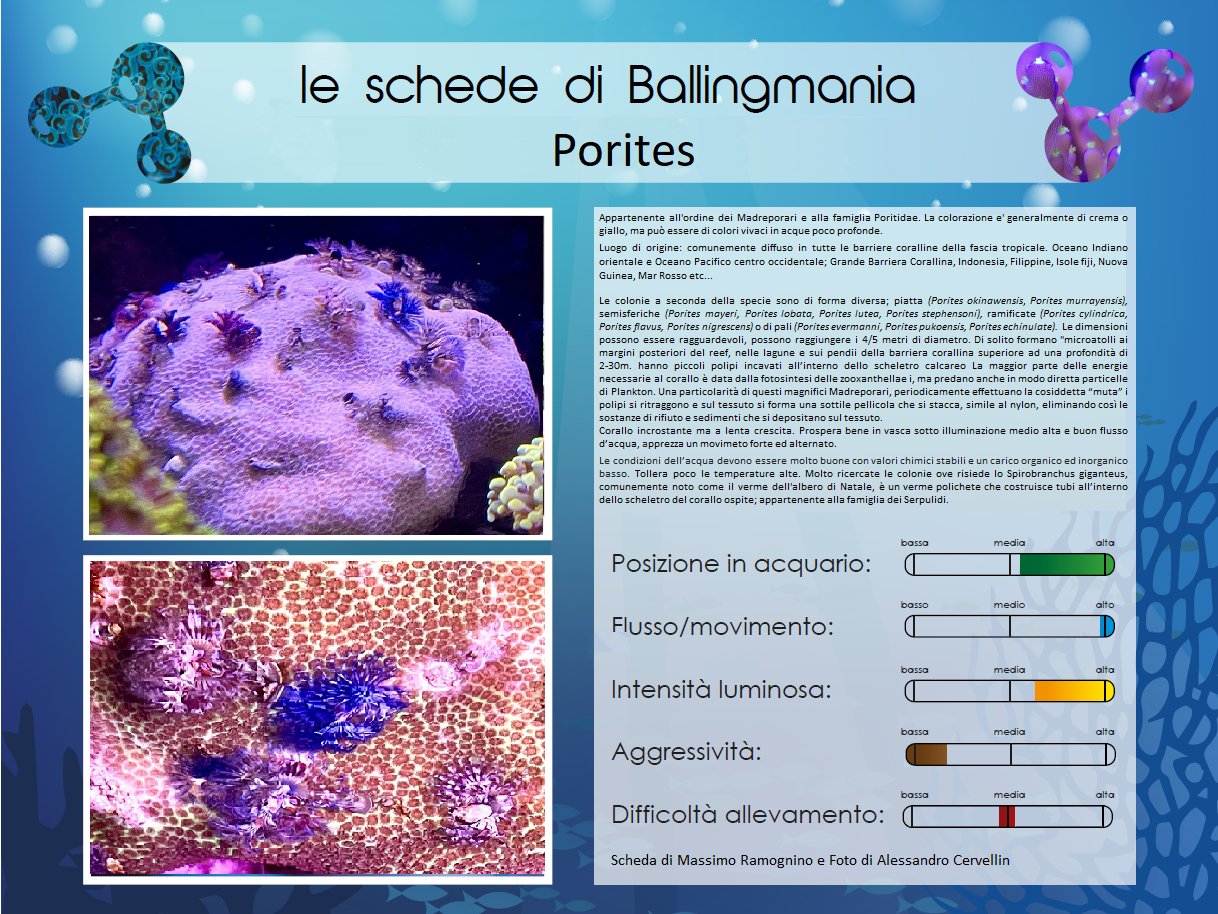
Belonging to the order of stony corals (Madreporaria) and the family Poritidae. Its colour is generally cream or yellow, but it can be brightly coloured in shallow water.
Place of origin: commonly widespread on all coral reefs in the tropical belt. The eastern Indian Ocean and the central-western Pacific Ocean; the Great Barrier Reef, Indonesia, the Philippines, the Fiji Islands, New Guinea, the Red Sea, etc.
Depending on the species, the colonies have different shapes: flat (Porites okinawensis, Porites murrayensis), hemispherical (Porites mayeri, Porites lobata, Porites lutea, Porites stephensoni), branching (Porites cylindrica, Porites flavus, Porites nigrescens) or pillar-shaped (Porites evermanni, Porites pukoensis, Porites echinulate). They can reach a considerable size, up to 4/5 metres in diameter. They usually form "microatolls" on back-reef margins, in lagoons and on the upper slopes of the coral reef at a depth of 2-30 m. They have small polyps sunk into the calcareous skeleton. Most of the energy the coral needs comes from the photosynthesis of the zooxanthellae, but they also prey directly on plankton particles. A peculiarity of these magnificent stony corals is that they periodically carry out the so-called "moult": the polyps retract and a thin film, similar to nylon, forms on the tissue and comes away, thus getting rid of waste substances and sediment that settle on the tissue.
An encrusting but slow-growing coral. It thrives in the tank under medium-high lighting and good water flow, and appreciates strong, alternating water movement.
Water conditions must be very good, with stable chemical values and a low organic and inorganic load. It does not tolerate high temperatures well. Colonies hosting Spirobranchus giganteus, commonly known as the Christmas tree worm, are much sought after; it is a polychaete worm that builds tubes inside the skeleton of the host coral and belongs to the family Serpulidae.
Species sheet by Massimo Ramognino and photo by Alessandro Cervellin
What studies say about keeping it
Research data, not advice for a home aquarium. In Palau, colonies of P. cf. lobata kept off the reef (ex situ) spawned; the young corals began calcifying about 2 days after metamorphosis and developed tentacles about 10 days after attaching to the bottom. 7
Did you know?
Sources
- Hoeksema B.W., Cairns S., Samimi-Namin K. (2026). Porites Link, 1807. World List of Scleractinia, via WoRMS.
- UNEP-WCMC (2026). Porites, CITES listings. Species+.
- UNEP-WCMC (2026). Porites lobata, distribuzione. Species+.
- UNEP-WCMC (2026). Porites astreoides, distribuzione. Species+.
- Forsman Z.H., Barshis D.J., Hunter C.L., Toonen R.J. (2009). Shape-shifting corals: molecular markers show morphology is evolutionarily plastic in Porites. BMC Evolutionary Biology.
- Smith A., Cook N., Cook K., Brown R., Woodgett R., Veron J., Saylor V. (2021). Field measurements of a massive Porites coral at Goolboodi (Orpheus Island), Great Barrier Reef. Scientific Reports.
- Bennett M.-J., Grupstra C.G.B., Da-Anoy J. et al. (2024). Ex situ spawning, larval development, and settlement in massive reef-building corals (Porites) in Palau. Invertebrate Biology, riassunto sul portale NSF.
- Holstein D.M., Smith T.B., Paris C.B. (2016). Depth-Independent Reproduction in the Reef Coral Porites astreoides from Shallow to Mesophotic Zones. PLOS ONE.
- Coffroth M.A. (1991). Cyclical mucous sheet formation on poritid corals in the San Blas Islands, Panama. Marine Biology, abstract on the University at Buffalo portal.
- Hoeksema B.W., Wels D., van der Schoot R.J., ten Hove H.A. (2019). Coral injuries caused by Spirobranchus opercula with and without epibiotic turf algae at Curaçao. Marine Biology.
- Grottoli A.G., Rodrigues L.J., Palardy J.E. (2006). Heterotrophic plasticity and resilience in bleached corals. Nature.
- Woodroffe C.D., Smithers S.G., McGregor H.V. (2008). Coral microatolls and their role as fixed biological indicators of Holocene sea-level changes. Western Pacific Geophysics Meeting, abstract on the James Cook University portal.
Sources checked on 5 November 2026. Community texts and ratings are kept separate from the scientific data.