Pocillopora tricolor
This species sheet describes the genus Pocillopora, because 'Pocillopora tricolor' is not listed on WoRMS. 1 They are branching hard corals recognisable by their verrucae, small bumps all over the colony. 1 The genus is easy to recognise, but telling the species apart by eye is very difficult. 4 5
At a glance
Data from the scientific sources listed at the bottom.
Conservation
IUCN Red List: not evaluated. CITES: Appendix II. The CITES listing covers the whole order and has been in force since 18 January 1990; in the European Union it is in Annex B. 2
The coral
Group: SPS
Growth form: branching with verrucae; very variable even within the same species
Zooxanthellae: yes
Where it lives
The genus is found throughout the Indo-Pacific. 5 The species differ in range: P. verrucosa runs from the Indian Ocean and the Red Sea to the tropical eastern Pacific, while P. damicornis is given from the Pacific to the Indian Ocean and seems to be absent from the tropical eastern Pacific. 3 WoRMS also lists the genus in Polynesia, Micronesia and Melanesia. 1
Life in the wild
Where it is found
From shallow water to mesophotic zones, depending on the species. 5 P. damicornis is abundant on the reef crest in exposed areas, but is also found in lagoons and on the slope below 8 m. 3 P. verrucosa often covers wide areas of the slope, and P. aliciae lives on rocky bottoms between 2 and 32 m. 3
Reproduction
It varies with the species. P. damicornis, P. acuta and P. aliciae combine brooded larvae of asexual origin with sexual spawning of gametes into the sea. 3 P. verrucosa spawns gametes into the sea. 3 On the Great Barrier Reef and in Hawaii, P. acuta and P. damicornis release their larvae at opposite lunar phases: P. damicornis around the full moon on the Great Barrier Reef, P. acuta after the new moon. 3
In the aquarium
From the experience of the BallingMania community.
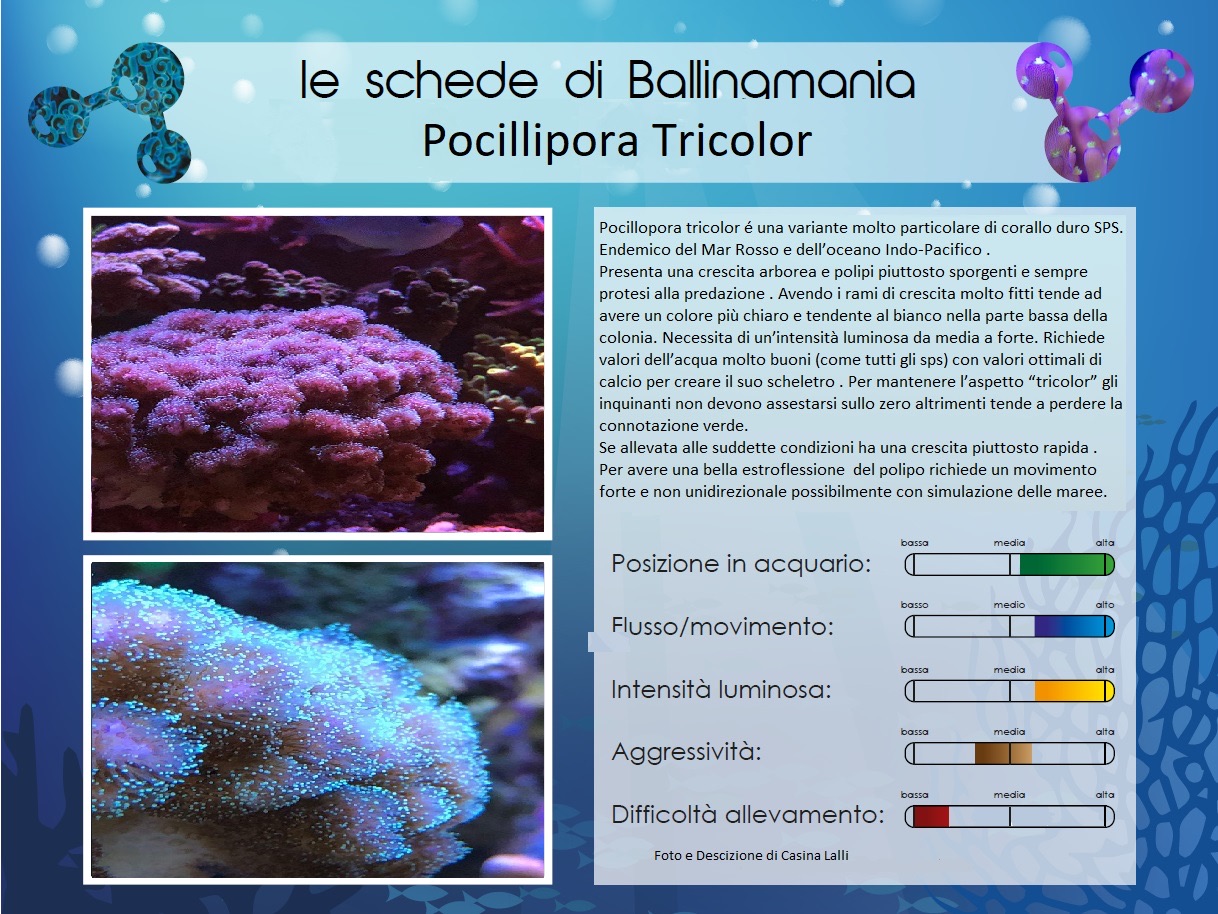
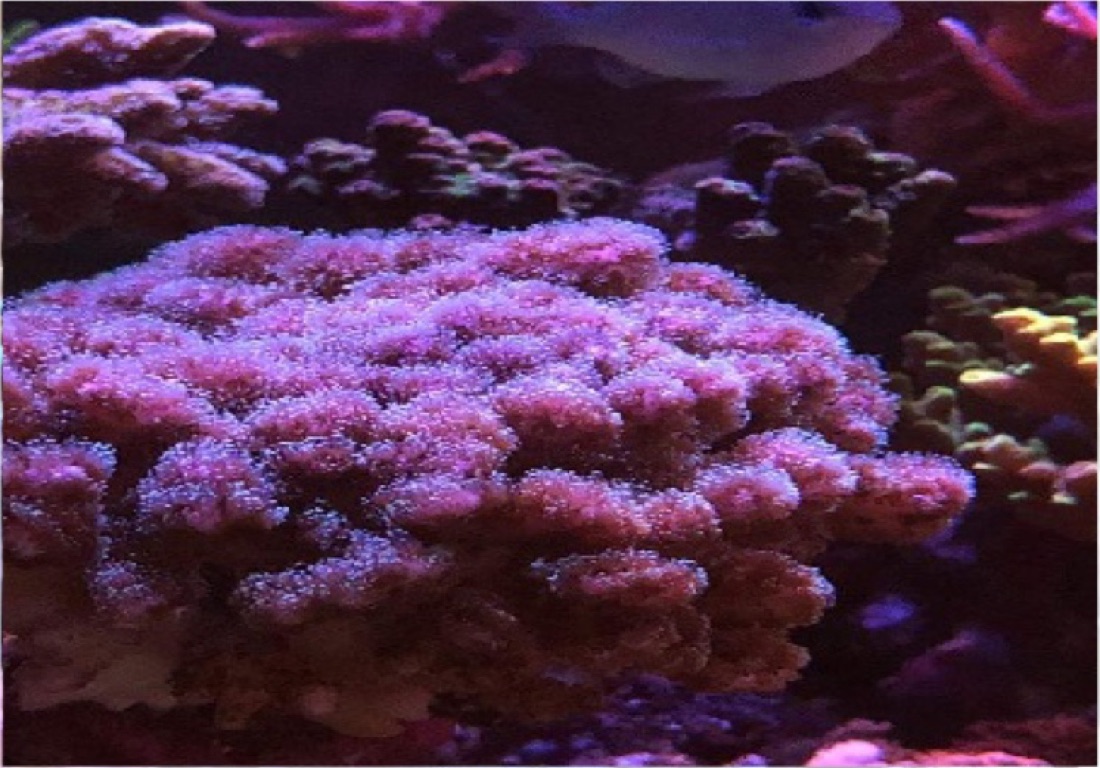
Pocillopora tricolor is a very distinctive variant of SPS hard coral, native to the Red Sea and the Indo-Pacific Ocean.
It has tree-like growth and rather prominent polyps, always extended to catch prey. As its growing branches are very dense, it tends to be paler, almost white, in the lower part of the colony. It needs medium to strong light intensity. It requires very good water values (like all SPS), with optimal calcium levels to build its skeleton. To keep the "tricolor" look, pollutants must not settle at zero, otherwise it tends to lose its green character.
If kept under these conditions it grows fairly quickly. To get good polyp extension it needs strong, non-unidirectional water movement, ideally with simulated tides.
Photo and description by Casina Lalli
What studies say about keeping it
Research data on individual species only, not advice for a home aquarium. Colonies of P. acuta in Taiwan, kept for about 3 months at 26 °C or 29.5 °C under LED light for 12 hours a day: at 29.5 °C they released their larvae earlier in the lunar cycle and in some cases produced fewer and smaller ones. 7 Again in P. acuta, at 24 °C fed colonies produced more larvae than unfed ones, while at 28 °C the opposite happened. 6 In P. damicornis, stronger blue light reduced colour, and food and light did not significantly change growth. 8
Did you know?
Sources
- Hoeksema B.W., Cairns S., Samimi-Namin K. (2026). Pocillopora Lamarck, 1816. World List of Scleractinia, via WoRMS.
- UNEP-WCMC (2026). Pocillopora, CITES listings. Species+.
- Schmidt-Roach S., Miller K.J., Lundgren P., Andreakis N. (2014). With eyes wide open: a revision of species within and closely related to the Pocillopora damicornis species complex (Scleractinia; Pocilloporidae) using morphology and genetics. Zoological Journal of the Linnean Society.
- Oury N., Noël C., Mona S., Aurelle D., Magalon H. (2023). From genomics to integrative species delimitation? The case study of the Indo-Pacific Pocillopora corals. Molecular Phylogenetics and Evolution.
- Hsiao W.V., Denis V., De Palmas S., Beger M. (2025). Genus-Scale Taxonomic Resolution Is Appropriate to Study Coral Demographics: A Case Study With Pocillopora. Ecology and Evolution.
- Lam K.W., McRae C.J., Liu Z.T., Zhang X.C., Fan T.Y. (2023). Effective Techniques for the Feeding and Ex Situ Culture of a Brooding Scleractinian Coral, Pocillopora acuta. Journal of Visualized Experiments.
- McRae C.J., Huang W.B., Fan T.Y., Côté I.M. (2021). Effects of thermal conditioning on the performance of Pocillopora acuta adult coral colonies and their offspring. Coral Reefs.
- Zhang S.C., Lin Y.C., Wu C.Y. et al. (2026). Effects of Blue Light and Feeding on the Physiological Performance of Reef Corals, Stylophora pistillata and Pocillopora damicornis. Zoological Studies.
Sources checked on 5 November 2026. Community texts and ratings are kept separate from the scientific data.