At a glance
Data from the scientific sources listed at the bottom.
Conservation
IUCN Red List: not evaluated. CITES: Appendix II. The Red List assesses species: a trade name has no assessment of its own. Appendix II applies to the genus Acropora as a whole, as part of the order Scleractinia; in the European Union it is in Annex B. 2
The coral
Group: SPS
In the aquarium
From the experience of the BallingMania community.
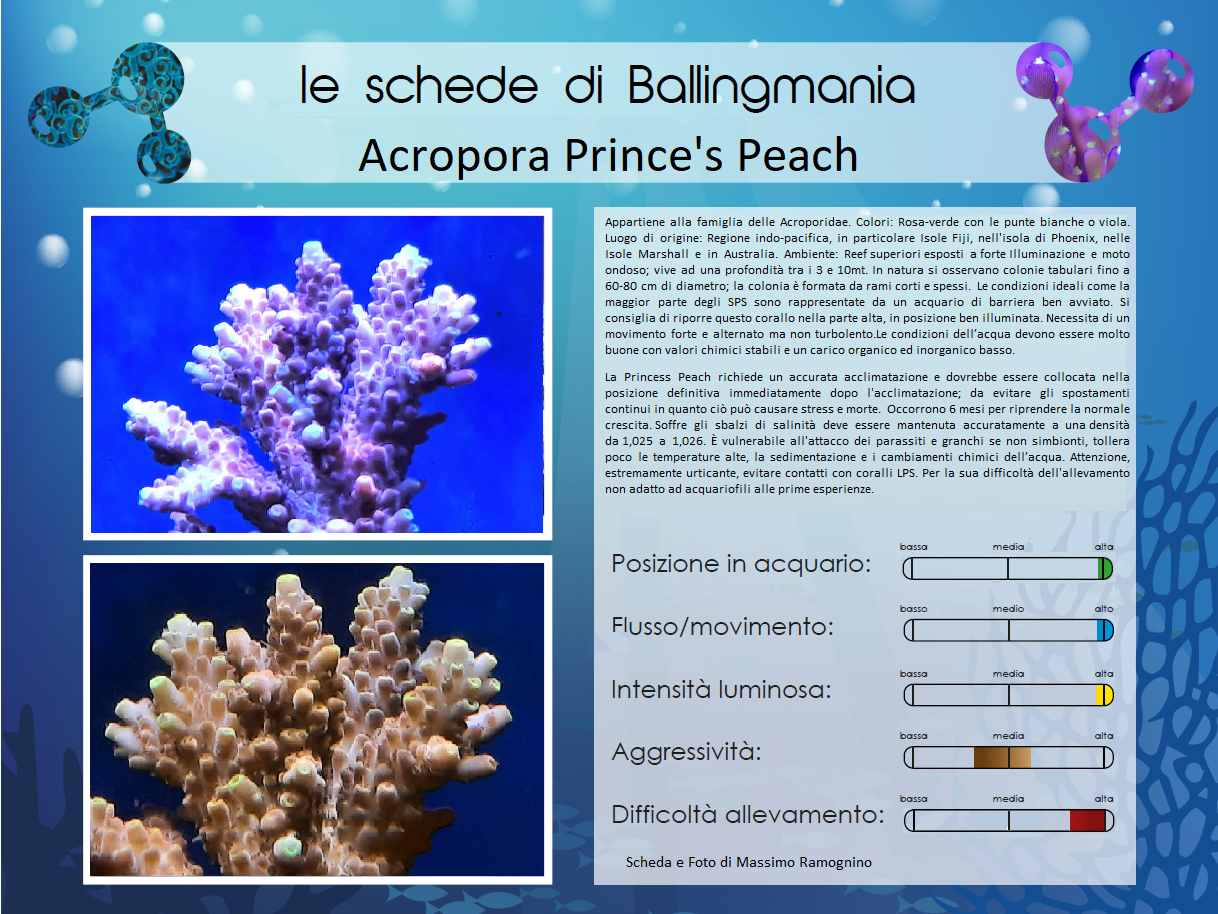
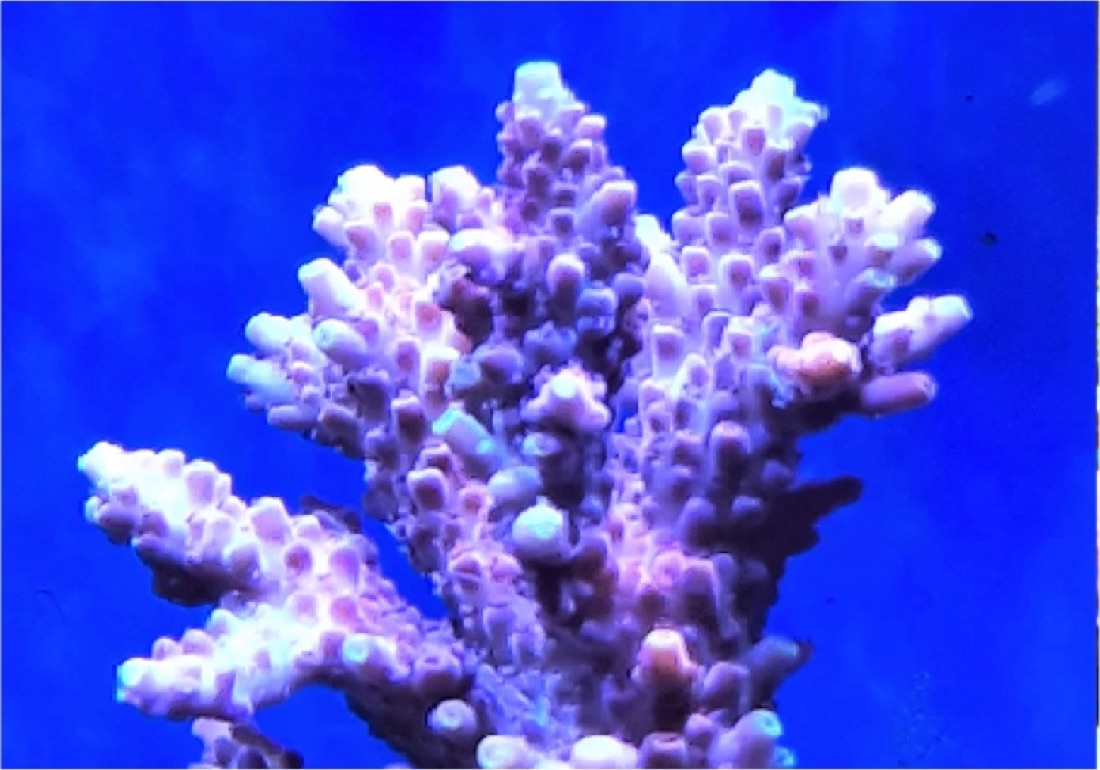
It belongs to the family Acroporidae. Colours: pink-green with white or purple tips. Place of origin: the Indo-Pacific region, in particular the Fiji Islands, Phoenix Island, the Marshall Islands and Australia. Habitat: upper reefs exposed to strong light and wave action; it lives at a depth of 3 to 10 m. In the wild tabular colonies up to 60-80 cm in diameter are seen; the colony is made up of short, thick branches. Like most SPS, the ideal conditions are a well-established reef aquarium. It is advisable to place this coral in the upper part, in a well-lit position. It needs strong, alternating but not turbulent water movement. Water conditions must be very good, with stable chemical values and a low organic and inorganic load.
Princess Peach needs careful acclimatisation and should be placed in its final position immediately after acclimatisation; avoid moving it repeatedly, as this can cause stress and death. It takes 6 months to resume normal growth. It suffers from swings in salinity and must be kept carefully at a specific gravity of 1.025 to 1.026. It is vulnerable to attack by pests and by crabs, if not symbiotic ones, and does not tolerate high temperatures, sedimentation or chemical changes in the water well. Warning: extremely stinging, avoid contact with LPS corals. Because it is difficult to keep, it is not suitable for aquarists with little experience.
Species sheet and photo by Massimo Ramognino
Sources
- Hoeksema B.W., Cairns S., Samimi-Namin K. (2026). Acropora Oken, 1815. World List of Scleractinia, via WoRMS.
- UNEP-WCMC (2026). Acropora, CITES listings. Species+.
Sources checked on 5 November 2026. Community texts and ratings are kept separate from the scientific data.