
Acropora nobilis
Currently accepted name: Acropora robusta
The name Acropora nobilis is no longer valid: WoRMS considers it a synonym of Acropora robusta. 1 2 The data in this species sheet therefore concern A. robusta, a hard coral of shallow water and wave-swept reef margins, with thick conical branches in the centre of the colony, found from the Red Sea to the Pacific. 1 4
At a glance
Data from the scientific sources listed at the bottom.
Depth in the wild
1–8 m
Conservation
IUCN Red List: endangered. CITES: Appendix II. The CITES listing currently in force dates from 18 January 1990 and applies to all Scleractinia; in the European Union it is in Annex B. 3 The category is confirmed by GBIF and WoRMS. 1 7
The coral
Group: SPS
Growth form: arborescent-tabular, with strongly tapering branches
Zooxanthellae: yes
Growth: One dataset reports 22.4 mm a year at the Solitary Islands, subtropical waters of eastern Australia (Harriott, 1999). 5
Where it lives
From the Red Sea (Yemen, Djibouti, Israel) to East Africa, Madagascar, Réunion and the Seychelles; then the Maldives, Sri Lanka, Thailand, Malaysia and Indonesia; finally the Philippines, Japan, Taiwan, Australia, Papua New Guinea and the Pacific islands as far as Samoa, the Cook Islands, French Polynesia and Pitcairn. 1 3 4
Life in the wild
In the aquarium
From the experience of the BallingMania community.
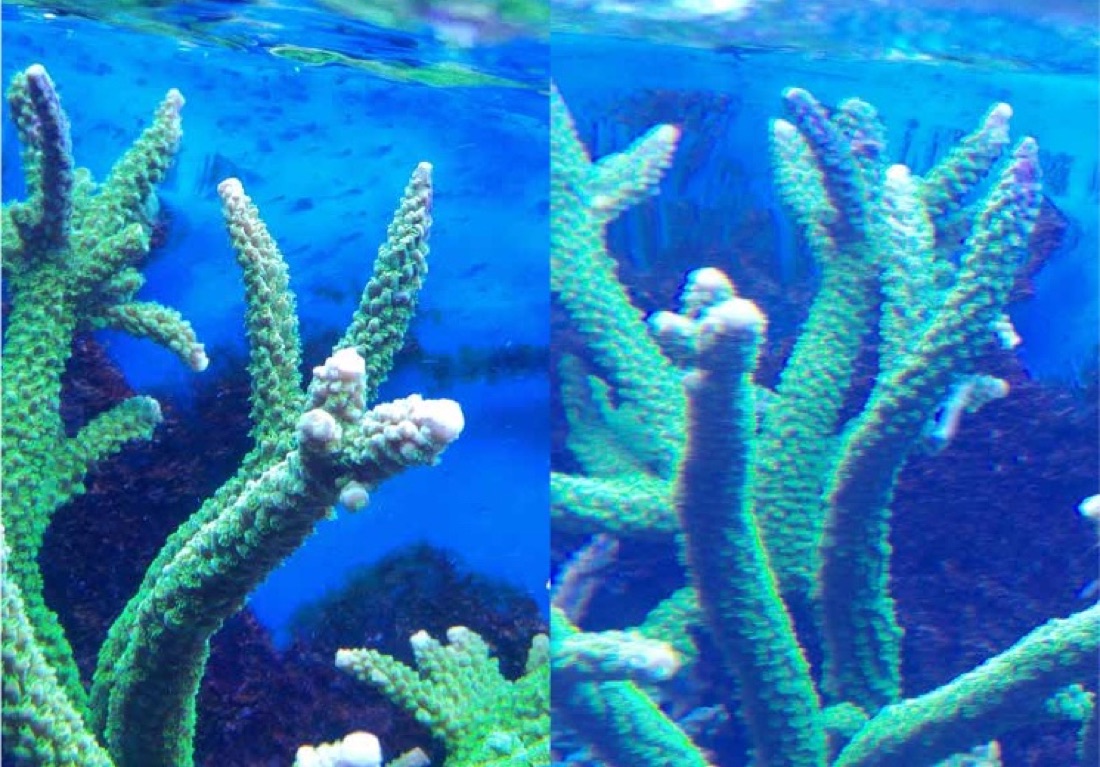
Acropora nobilis, origin the Pacific Ocean, grows in arborescent colonies with large cylindrical, vertical branches. They can form stands more than 5 metres wide; besides the more common green shade, nobilis can also be cream, brown, blue and yellow. It is a very hardy Acropora, with rapid and very extensive growth; to keep it successfully it needs strong lighting and must be exposed to strong water movement.
photo by: Vincenzo Milazzo
Did you know?
Sources
- Hoeksema B.W., Cairns S., Samimi-Namin K. (2026). Acropora robusta (Dana, 1846). World List of Scleractinia, via WoRMS.
- Hoeksema B.W., Cairns S., Samimi-Namin K. (2026). Acropora nobilis (Dana, 1846), sinonimo. World List of Scleractinia, via WoRMS.
- UNEP-WCMC (2026). Acropora robusta, CITES listings and distribution. Species+.
- Wallace C.C., Done B.J., Muir P.R. (2012). Acropora robusta (Dana, 1846), in: Revision and catalogue of worldwide staghorn corals Acropora and Isopora (Scleractinia: Acroporidae) in the Museum of Tropical Queensland. Memoirs of the Queensland Museum - Nature.
- Madin J. et al. (eds.) (2026). Acropora robusta: data from Carpenter 2008, Muir 2015, La Jeunesse 2010, Li 2008, Wallace 1985, Harriott 1999. Coral Trait Database.
- Vo Si Tuan, Ho Son Lam, Dang Tran Tu Tram, Phan Kim Hoang, Doan Van Than, Mai Xuan Dat (2022). A study on the spawning season of 3 Acropora species in Nha Trang bay, Southern waters of Vietnam. Vietnam Journal of Marine Science and Technology.
- GBIF Secretariat (2026). Acropora robusta, IUCN Red List category. GBIF.
Sources checked on 5 November 2026. Community texts and ratings are kept separate from the scientific data.