
Acropora nasuta
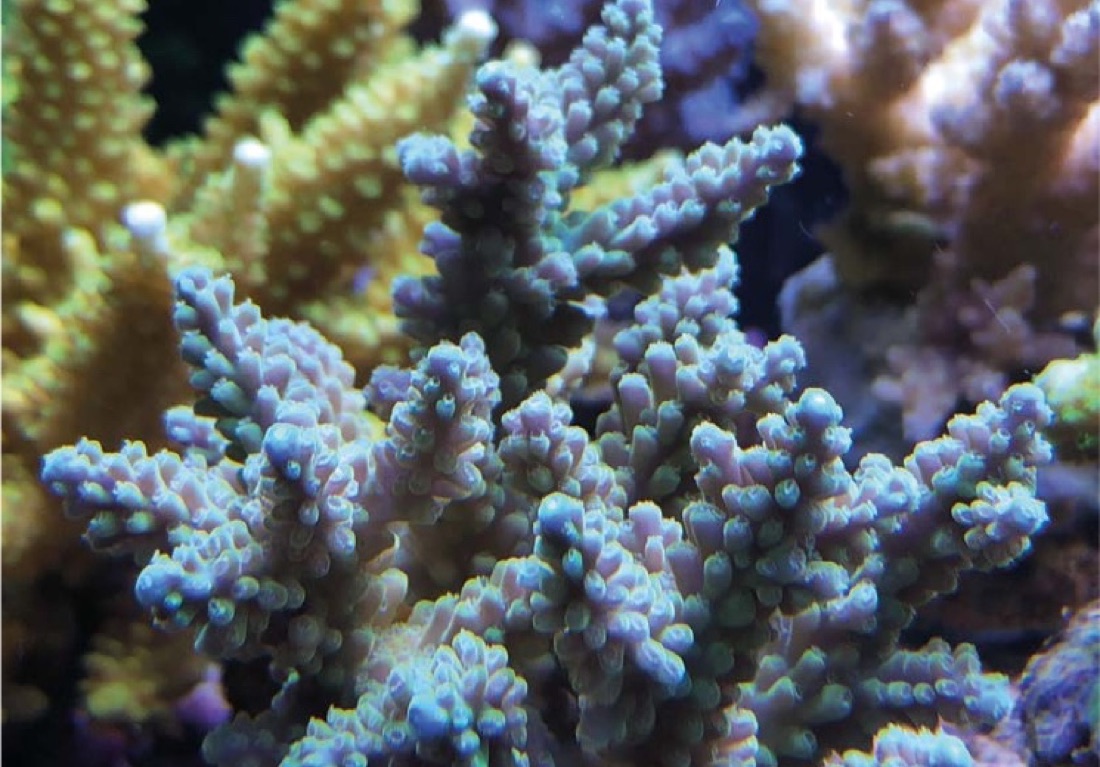
An Indo-Pacific hard coral that forms compact corymbose colonies, with tapering branches and numerous nose-shaped side corallites. 1 3 5 It is a hermaphrodite and releases eggs and sperm bundled together into the sea. 6 It lives mainly in shallow water on the upper part of reefs. 3
At a glance
Data from the scientific sources listed at the bottom.
Depth in the wild
3–15 m
Size
up to 80 cm
maximum colony diameter
Conservation
IUCN Red List: endangered (2023). CITES: Appendix II. The listed criterion is A3ce. 3 The CITES listing currently in force dates back to 18 January 1990; in the European Union it is in Annex B. 2 At Lizard Island, during the 2016 bleaching, it was among the least affected species, but the authors warn that in photos it is easily confused with A. valida. 8
Where it lives
From the Red Sea and East Africa, across the Indian Ocean and the central Indo-Pacific, to the islands of the central Pacific. 1 2 Species+ lists it in 48 countries and territories, including Egypt, Mozambique, the Maldives, Indonesia, Australia, Japan, the Marshall Islands, French Polynesia and the Pitcairn Islands. 2
How to recognise it
Tap a number on the photo: the key explains what to look for.
Life in the wild
Reproduction
A hermaphrodite, with eggs and sperm packed into bundles. 6 At Akajima the eggs can be seen from October and spawning usually takes place in May or June of the following year; small colonies of 5-8 cm were not yet mature. 6 In the Maldives, 23 colonies spawned in March and April, 5 of them on consecutive days. 7 Fragments of about 5 cm reabsorb their eggs, while larger ones keep developing them. 6
In the aquarium
From the experience of the BallingMania community.
Acropora nasuta, belonging to the family Acroporidae, is found in the Indian Ocean, the Pacific Ocean and the Red Sea. This Acropora grows in shallow water, between 3 and 15 metres deep, mostly on the upper slopes of the coral reef and on reef edges. The ideal conditions in the tank for Acropora nasuta are strong lighting and strong water movement, ideally intermittent, with balanced and stable alkalinity, calcium and magnesium levels.
photo by: Matteo De Benedictis
Did you know?
Sources
- Hoeksema B.W., Cairns S., Samimi-Namin K. (2026). Acropora nasuta (Dana, 1846). World List of Scleractinia, via WoRMS.
- UNEP-WCMC (2026). Acropora nasuta, CITES listings and distribution. Species+.
- Palomares M.L.D., Pauly D. (eds.) (2026). Acropora nasuta, Branching staghorn coral. SeaLifeBase.
- Madin J. et al. (eds.) (2026). Acropora nasuta. Coral Trait Database.
- Sola E., Silva I.M. da, Glassom D. (2015). An annotated and illustrated checklist of species of the coral genus Acropora (Cnidaria: Scleractinia) from Vamizi Island, Mozambique. African Invertebrates, record on Plazi.
- Okubo N., Taniguchi H., Omori M. (2009). Sexual Reproduction in Transplanted Coral Fragments of Acropora nasuta. Zoological Studies.
- Monfared M.A.A., Sheridan K., Dixon S.P., Gledhill M., Le Berre T. (2023). Coral spawning patterns of Acropora across two Maldivian reef ecosystems. PeerJ.
- Hoogenboom M.O., Frank G.E., Chase T.J. et al. (2017). Environmental Drivers of Variation in Bleaching Severity of Acropora Species during an Extreme Thermal Anomaly. Frontiers in Marine Science.
- Morgan K.M., Kench P.S. (2012). Skeletal extension and calcification of reef-building corals in the central Indian Ocean. Marine Environmental Research, reference in the Coral Trait Database.
- Muir P.R., Wallace C.C., Done T., Aguirre J.D. (2015). Limited scope for latitudinal extension of reef corals. Science, reference in the Coral Trait Database.
- Wallace C.C., Wolstenholme J. (1998). Revision of the coral genus Acropora (Scleractinia: Astrocoeniina: Acroporidae) in Indonesia. Zoological Journal of the Linnean Society, reference in the Coral Trait Database.
- Stat M., Pochon X., Cowie R.O.M., Gates R.D. (2009). Specificity in communities of Symbiodinium in corals from Johnston Atoll. Marine Ecology Progress Series.
Sources checked on 5 November 2026. Community texts and ratings are kept separate from the scientific data.