
Acropora millepora
A reef-building hard coral with low, branching colonies, common in the shallow waters of the Indo-Pacific. 1 2 5 It is one of the most studied species on the Great Barrier Reef 12 and is also used to understand bleaching. 5 The IUCN Red List now lists it as Endangered. 4
At a glance
Data from the scientific sources listed at the bottom.
Depth in the wild
2–12 m
Conservation
IUCN Red List: endangered. CITES: Appendix II. Listed as Endangered in the IUCN Red List data reported by GBIF; an earlier dataset gave it as Near Threatened. 2 4 Like all Scleractinia it has been in CITES Appendix II since 18 January 1990. 3 Bleaching caused by excessively warm seas is one of the threats studied for this species. 5
The coral
Group: SPS
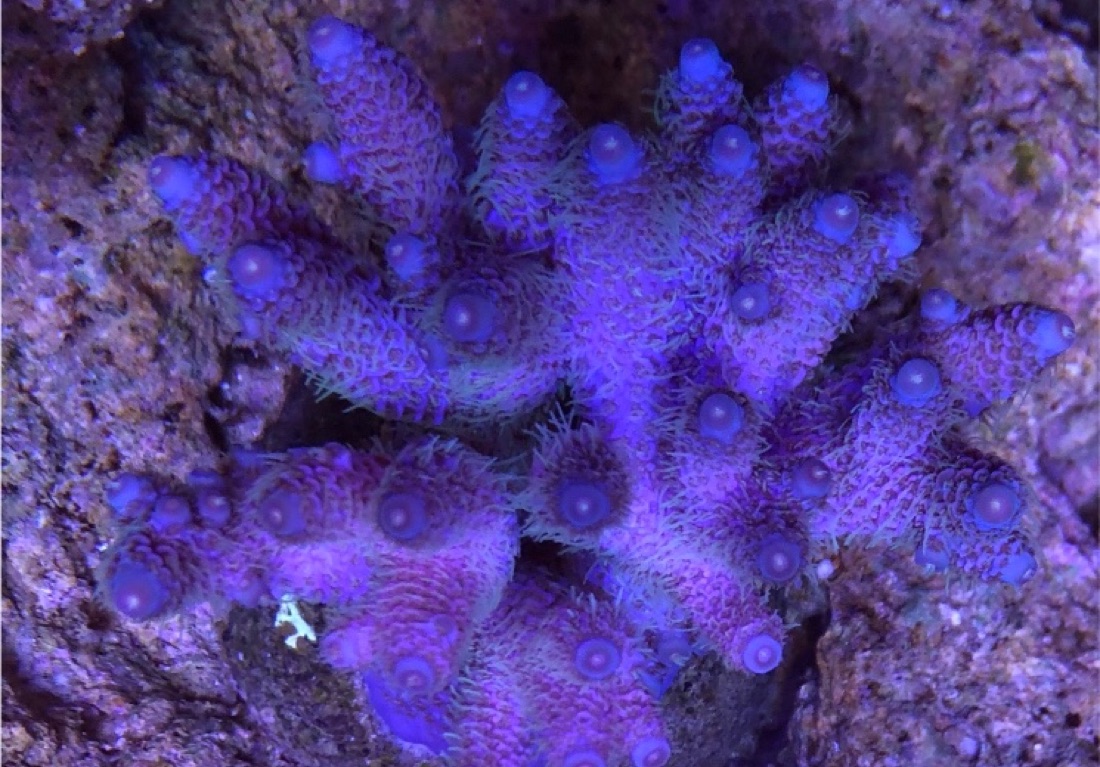
Growth form: corymbose, sometimes tubular, with short branches
Zooxanthellae: yes
Growth: In the wild growth changes with the type of symbiont: in the Keppel Islands colonies with type D zooxanthellae grew 38% less than those with type C2, and after a bleaching event growth fell by more than 50% for up to 18 months. 10 In an ocean nursery the fragments gained about 3.2 cm² a month. 11
Where it lives
Indo-Pacific. Recorded in Kenya, Mozambique, South Africa and the Maldives, then in India, Sri Lanka, Thailand, Malaysia, Singapore, Indonesia and the Philippines, as far as Japan, Taiwan and Australia and in the Pacific islands, including Fiji, Tonga, the Marshall Islands and American Samoa. 1 3
How to recognise it
Tap a number on the photo: the key explains what to look for.
Life in the wild
Where it is found
Restricted to shallow water: usually reef flats, but also lagoons and the upper part of reef slopes. 1 On the Great Barrier Reef, the colonies sampled for a genetic study lived between 1.2 and 7.2 m. 5 A second dataset puts the lower limit at 30 m. 2 It prefers clear water and tolerates different degrees of wave exposure. 2
Behaviour
Neighbouring colonies of the same species can fuse: in two Australian populations at least 2-5% of colonies were chimeras, that is, they contained more than one genetically distinct individual. 9
Reproduction
A hermaphrodite that releases eggs and sperm into the open sea. 2 5 On the Great Barrier Reef spawning takes place between October and November, 3 to 6 nights after the full moon, about 1-4 hours after sunset. 7 Over a stretch of about 300 km the genetic structure turned out to be almost uniform, probably because of this very mode of reproduction. 5 Across the whole Great Barrier Reef, however, some populations often exchange new individuals while others largely sustain themselves. 8
In the aquarium
From the experience of the BallingMania community.
Acropora millepora is a small-polyp stony coral (SPS); it is a common species found in the western and central Indo-Pacific. Its range extends from the Red Sea to Kenya and from South Africa to India, Malaysia, Japan, Indonesia and Australia.
This coral grows in shallow water, between 2 and 12 metres, mainly on reefs, but also on shallow slopes and in lagoons.
photo by: Matteo De Benedictis
What studies say about keeping it
Data from public aquarium research, not advice for a home aquarium. At the Horniman Museum in London two closed systems reproduced the light, lunar phases and seasonal temperature of the corals' home areas: for the first time broadcast-spawning corals spawned in an entirely artificial system. All five A. millepora fragments brought from the Great Barrier Reef completed their reproductive cycle. Spawning began on the date expected in the wild, but stretched over three months. 7
Did you know?
Sources
- Hoeksema B.W., Cairns S., Samimi-Namin K. (2026). Acropora millepora (Ehrenberg, 1834). World List of Scleractinia, via WoRMS.
- Madin J. et al. (eds.) (2026). Acropora millepora. Coral Trait Database.
- UNEP-WCMC (2026). Acropora millepora, CITES listings and distribution. Species+.
- GBIF Secretariat (2026). Acropora millepora, IUCN Red List category. GBIF.
- Fuller Z.L., Mocellin V.J.L., Morris L.A. et al. (2020). Population genetics of the coral Acropora millepora: Toward genomic prediction of bleaching. Science.
- Cooper T.F., Berkelmans R., Ulstrup K.E. et al. (2011). Environmental Factors Controlling the Distribution of Symbiodinium Harboured by the Coral Acropora millepora on the Great Barrier Reef. PLoS ONE.
- Craggs J., Guest J.R., Davis M., Simmons J., Dashti E., Sweet M. (2017). Inducing broadcast coral spawning ex situ: Closed system mesocosm design and husbandry protocol. Ecology and Evolution.
- van Oppen M.J., Peplow L.M., Kininmonth S., Berkelmans R. (2011). Historical and contemporary factors shape the population genetic structure of the broadcast spawning coral, Acropora millepora, on the Great Barrier Reef. Molecular Ecology.
- Puill-Stephan E., Willis B.L., van Herwerden L., van Oppen M.J.H. (2009). Chimerism in Wild Adult Populations of the Broadcast Spawning Coral Acropora millepora on the Great Barrier Reef. PLoS ONE.
- Jones A., Berkelmans R. (2010). Potential Costs of Acclimatization to a Warmer Climate: Growth of a Reef Coral with Heat Tolerant vs. Sensitive Symbiont Types. PLoS ONE.
- Howlett L., Camp E.F., Edmondson J., Henderson N., Suggett D.J. (2021). Coral growth, survivorship and return-on-effort within nurseries at high-value sites on the Great Barrier Reef. PLoS ONE.
- Ramos-Silva P. et al. (2014). The Skeleton of the Staghorn Coral Acropora millepora: Molecular and Structural Characterization. PLoS ONE.
Sources checked on 4 November 2026. Community texts and ratings are kept separate from the scientific data.