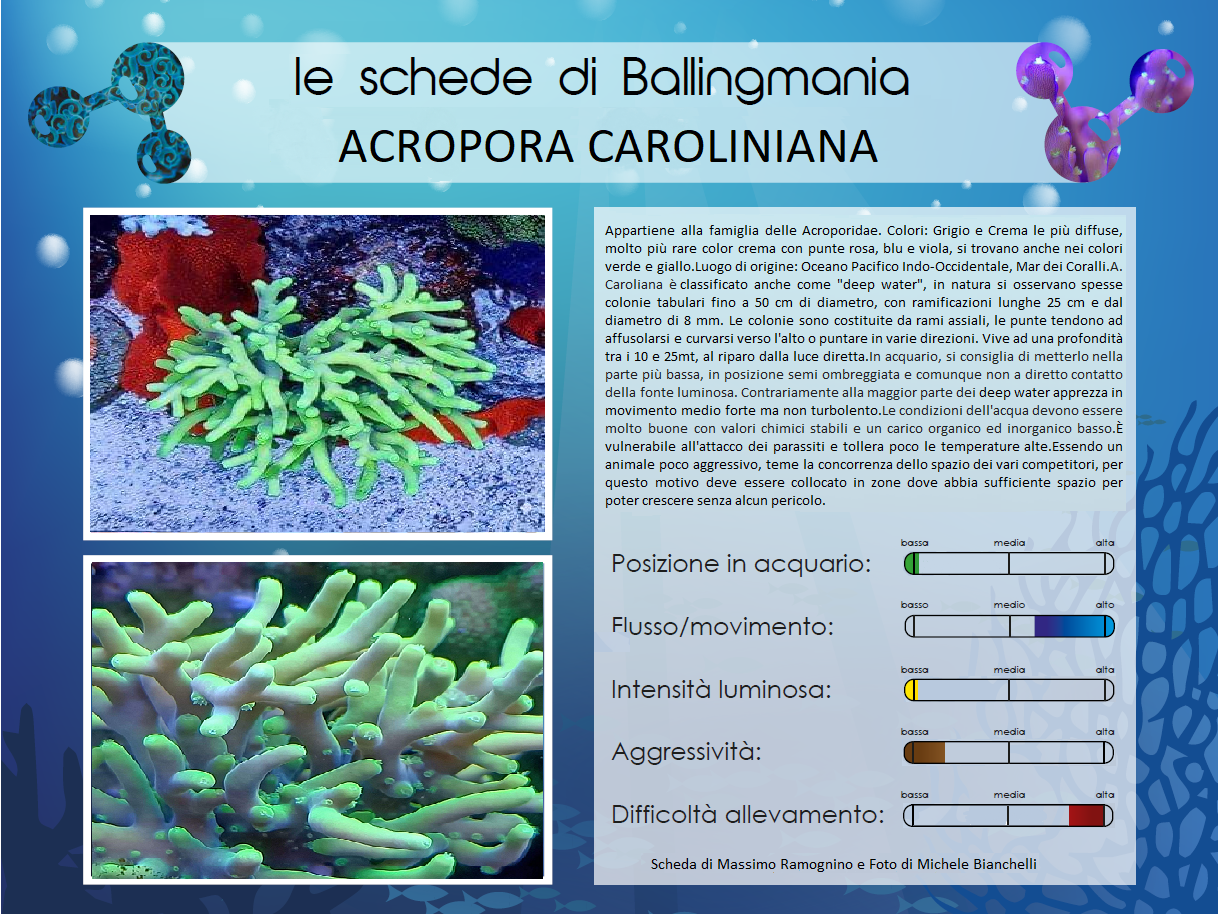
Acropora caroliniana
A hard coral of the genus Acropora, described in 1976 from a specimen from the Philippines. 1 2 The colonies have a defined outline and a low, bushy look, with short, cylindrical branches. 2 It lives from the Indian Ocean to the western Pacific, usually between 10 and 25 m deep. 2 4 6
At a glance
Data from the scientific sources listed at the bottom.
Depth in the wild
10–25 m
Size
up to 50 cm
maximum colony diameter [5] [8] [9]
Conservation
IUCN Red List: vulnerable (2023). CITES: Appendix II. The listed criterion is A3ce. 3 The CITES listing currently in force dates back to 18 January 1990; in the European Union it is in Annex B. 4
Where it lives
WoRMS records it from the central Indo-Pacific and the Ashmore and Cartier Islands. 1 The Queensland reference collection holds specimens from Mayotte, the Maldives, Malaysia, Indonesia, the Philippines, the Great Barrier Reef, Papua New Guinea, Pohnpei and the Solomon Islands; the authors note that these data shift the known limit of the species much further west. 2 Species+ adds Japan, Palau, Vanuatu, New Caledonia, Fiji, Tonga and Samoa. 4 It is also present in the Coral Sea. 7 A study on ranges, which does not include the westernmost specimens, gives limits of about 95° E and 176° W, between 29° N and 33° S. 5 10
The coral
Group: SPS
Growth form: low bushy (caespito-corymbose) with a defined outline, with branches less than 25 mm long and 5-10 mm thick 2
Zooxanthellae: yes
How to recognise it
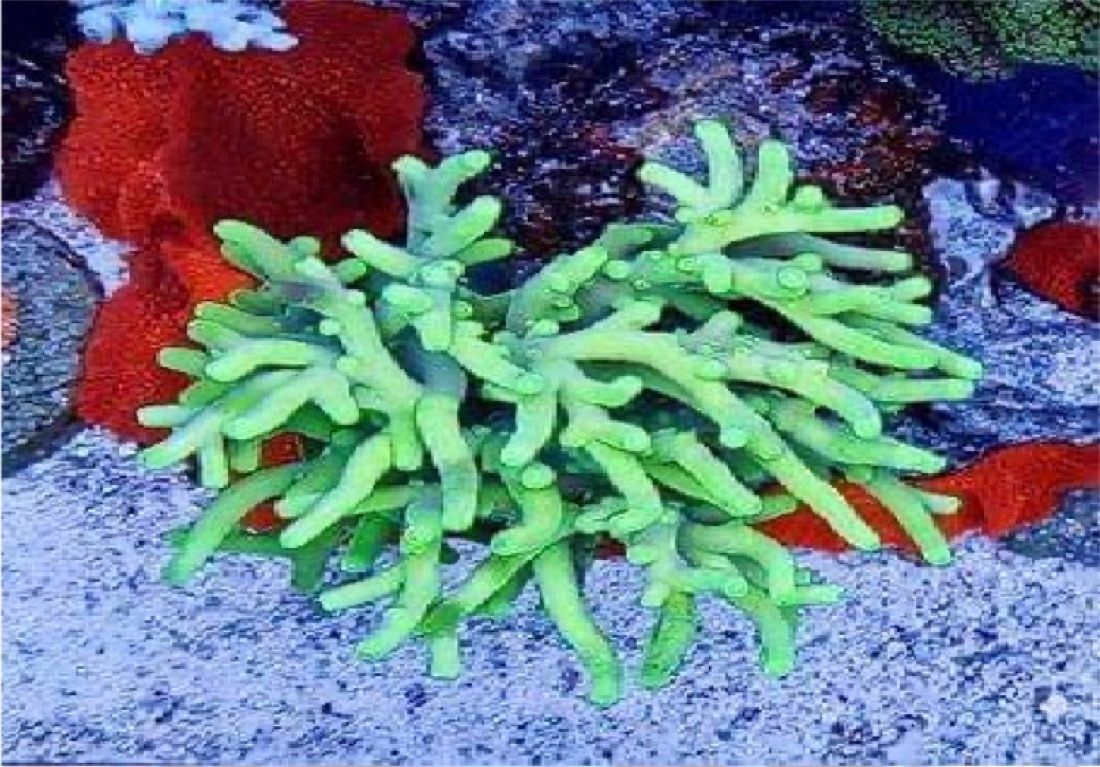
Tap a number on the photo: the key explains what to look for.
Life in the wild
In the aquarium
From the experience of the BallingMania community.
It belongs to the family Acroporidae. Colours: grey and cream are the most common; cream with pink, blue and purple tips is much rarer, and it is also found in green and yellow. Place of origin: the Indo-West Pacific Ocean, the Coral Sea. A. caroliniana is also classed as "deep water"; in the wild thick tabular colonies up to 50 cm in diameter can be seen, with branches 25 cm long and 8 mm in diameter. The colonies are made up of axial branches; the tips tend to taper and curve upwards or point in various directions. It lives at a depth of 10 to 25 m, sheltered from direct light. In the aquarium it is advisable to place it in the lowest part, in a semi-shaded position and in any case not directly exposed to the light source. Unlike most deep-water corals it appreciates medium-strong but not turbulent water movement. Water conditions must be very good, with stable chemical values and a low organic and inorganic load. It is vulnerable to attack by pests and does not tolerate high temperatures well. Being a not very aggressive animal, it fears competition for space from its various rivals, which is why it must be placed in areas where it has enough room to grow without any danger.
Species sheet by Massimo Ramognino and photo by Michele Bianchelli
Did you know?
Sources
- Hoeksema B.W., Cairns S., Samimi-Namin K. (2026). Acropora caroliniana Nemenzo, 1976. World List of Scleractinia, via WoRMS.
- Wallace C.C., Done B.J., Muir P.R. (2012). Revision and catalogue of worldwide staghorn corals Acropora and Isopora (Scleractinia: Acroporidae) in the Museum of Tropical Queensland. Memoirs of the Queensland Museum - Nature.
- Palomares M.L.D., Pauly D. (eds.) (2026). Acropora caroliniana. SeaLifeBase.
- UNEP-WCMC (2026). Acropora caroliniana, CITES listings and distribution. Species+.
- Madin J. et al. (eds.) (2026). Acropora caroliniana. Coral Trait Database.
- Carpenter K.E., Abrar M., Aeby G. et al. (2008). One-Third of Reef-Building Corals Face Elevated Extinction Risk from Climate Change and Local Impacts. Science, reference in the Coral Trait Database.
- Muir P., Wallace C., Bridge T.C.L., Bongaerts P. (2015). Diverse Staghorn Coral Fauna on the Mesophotic Reefs of North-East Australia. PLOS ONE.
- Wallace C. (1999). Staghorn Corals of the World: A revision of the genus Acropora. CSIRO Publishing, reference in the Coral Trait Database.
- Wallace C.C., Wolstenholme J. (1998). Revision of the coral genus Acropora (Scleractinia: Astrocoeniina: Acroporidae) in Indonesia. Zoological Journal of the Linnean Society, reference in the Coral Trait Database.
- Hughes T.P., Connolly S.R., Keith S.A. (2013). Geographic ranges of reef corals (Cnidaria: Anthozoa: Scleractinia) in the Indo-Pacific. Ecology, reference in the Coral Trait Database.
- Cairns S.D. (1999). Species richness of recent Scleractinia. Atoll Research Bulletin, reference in the Coral Trait Database.
- Hadi T.A., Utama R.S., Arfianti T. (2023). Species richness and the dynamics of coral cover in Bangka Belitung Islands, Indonesia. PeerJ.
Sources checked on 5 November 2026. Community texts and ratings are kept separate from the scientific data.