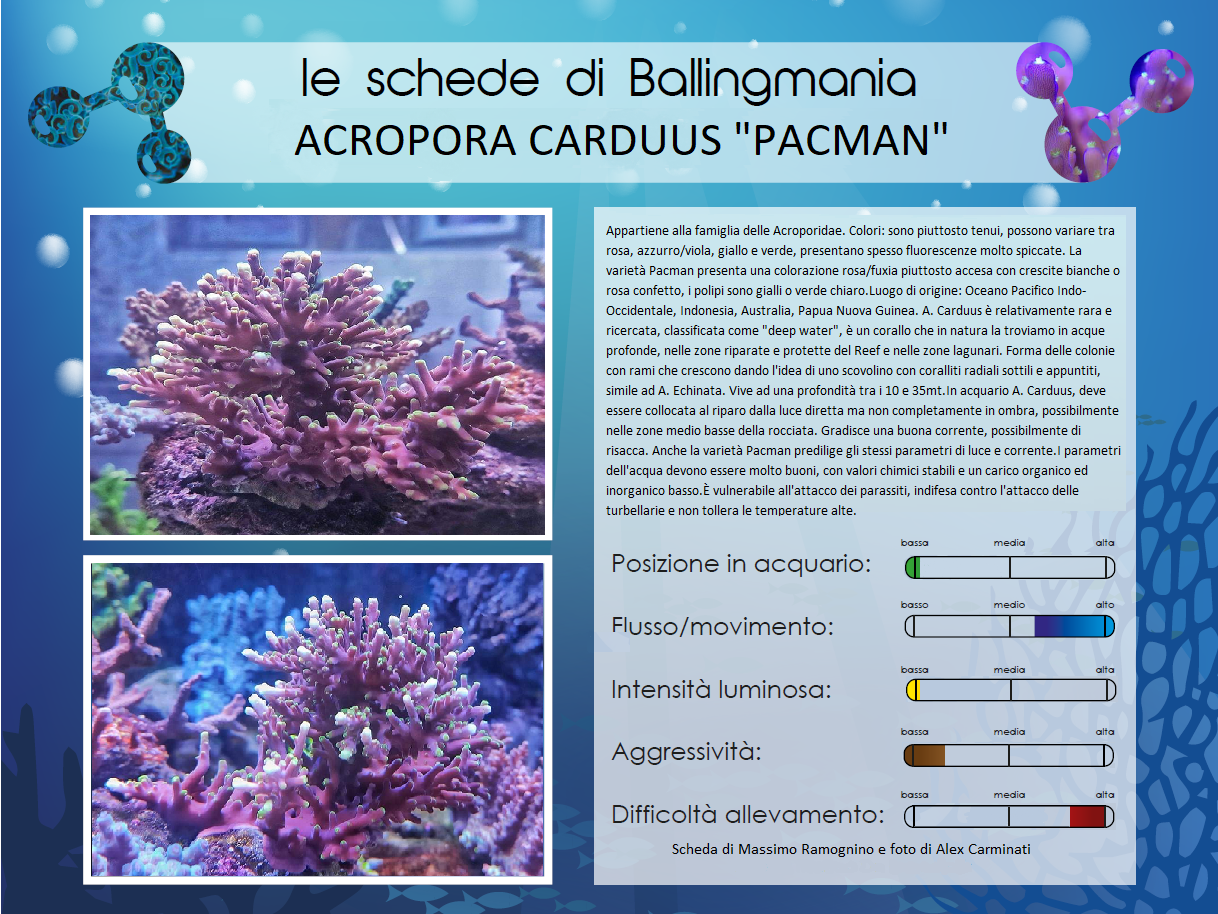
Acropora carduus "Pacman"
A hard coral of the genus Acropora, described by Dana in 1846 from a specimen from Fiji. 1 2 The colonies have an undefined outline and a 'bottlebrush' look, with thin branches thick with side branchlets. 2 It lives from the eastern Indian Ocean to the Pacific, mainly on sheltered sandy slopes. 3 4 10
At a glance
Data from the scientific sources listed at the bottom.
Depth in the wild
3–40 m
Conservation
IUCN Red List: endangered (2023). CITES: Appendix II. The listed criterion is A3ce. 3 The CITES listing currently in force dates back to 18 January 1990; in the European Union it is in Annex B. 4
The coral
Group: SPS
Growth form: hispidose ('bottlebrush') with an undefined outline, with branches 25-50 mm long and 2.5-4.9 mm thick 2
Zooxanthellae: yes
Where it lives
WoRMS records it from the central Indo-Pacific. 1 The Queensland reference collection holds specimens from Thailand, Indonesia, the Great Barrier Reef, the Coral Sea, Palau, Papua New Guinea, the Solomon Islands, Fiji and Samoa. 2 Species+ adds, among others, Japan, Taiwan, the Philippines, Vietnam, Malaysia, Guam, Vanuatu, New Caledonia, Tonga and French Polynesia. 4 Its presence in American Samoa is confirmed by several specimens. 8 A study on ranges gives limits of about 80° E and 136° W, between 31° N and 26° S. 5 10
How to recognise it
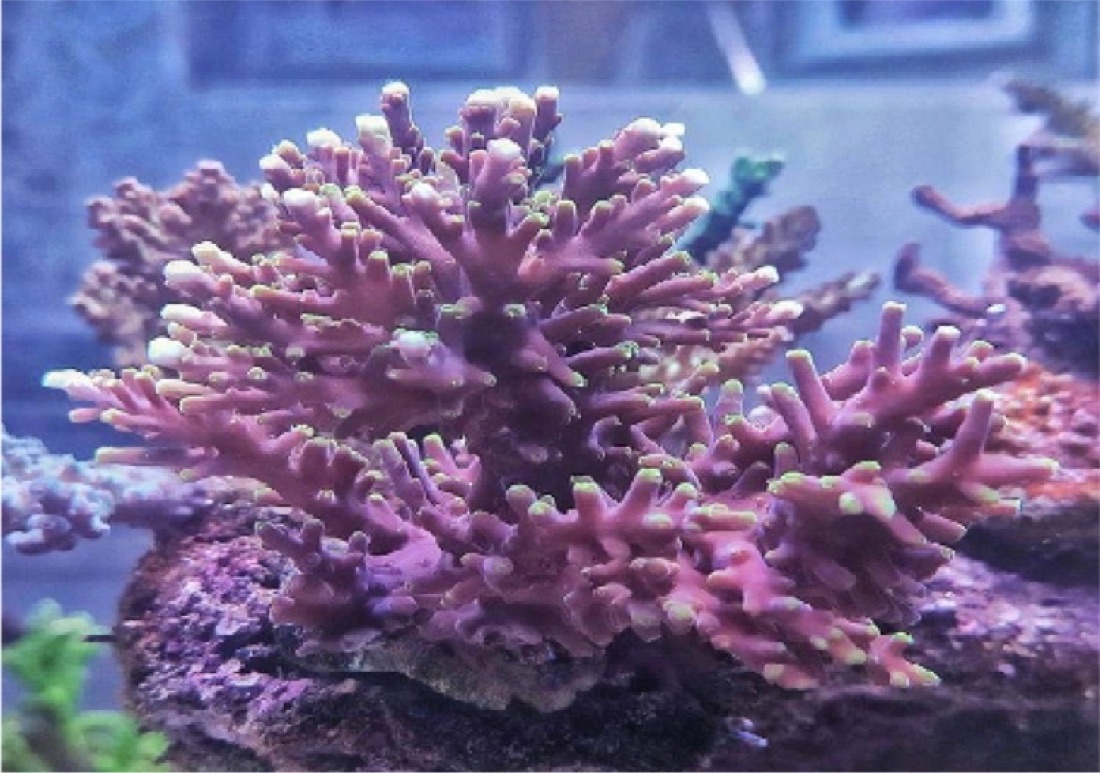
Tap a number on the photo: the key explains what to look for.
Life in the wild
Where it is found
It is very common on sandy bottoms, particularly on sheltered sandy slopes below the low-tide line. 3 In north-eastern Australia it has been recorded down to 40 m, rarely below 30 m. 7 A global estimate goes down to 50 m; 5 6 3 on a single Great Barrier Reef reef, Big Broadhurst, it was instead observed between 5 and 15 m. 5 9
In the aquarium
From the experience of the BallingMania community.
It belongs to the family Acroporidae. Colours: they are rather soft and can range from pink to light blue/purple, yellow and green, often with very marked fluorescence. The Pacman variety has a rather bright pink/fuchsia colouring with white or candy-pink growth, and the polyps are yellow or light green. Place of origin: the Indo-West Pacific Ocean, Indonesia, Australia, Papua New Guinea. A. carduus is relatively rare and sought after; classed as "deep water", it is a coral that in the wild is found in deep water, in sheltered and protected areas of the reef and in lagoons. It forms colonies with branches that grow giving the impression of a bottlebrush, with thin, pointed radial corallites, similar to A. echinata. It lives at a depth of 10 to 35 m. In the aquarium A. carduus must be placed out of direct light but not completely in shade, preferably in the middle-to-lower areas of the rockwork. It likes a good current, ideally surge-like. The Pacman variety prefers the same light and current parameters too. Water parameters must be very good, with stable chemical values and a low organic and inorganic load. It is vulnerable to attack by pests, defenceless against flatworm attacks, and does not tolerate high temperatures.
Species sheet by Massimo Ramognino and photo by Alex Carminati
Did you know?
Sources
- Hoeksema B.W., Cairns S., Samimi-Namin K. (2026). Acropora carduus (Dana, 1846). World List of Scleractinia, via WoRMS.
- Wallace C.C., Done B.J., Muir P.R. (2012). Revision and catalogue of worldwide staghorn corals Acropora and Isopora (Scleractinia: Acroporidae) in the Museum of Tropical Queensland. Memoirs of the Queensland Museum - Nature.
- Palomares M.L.D., Pauly D. (eds.) (2026). Acropora carduus. SeaLifeBase.
- UNEP-WCMC (2026). Acropora carduus, CITES listings and distribution. Species+.
- Madin J. et al. (eds.) (2026). Acropora carduus. Coral Trait Database.
- Carpenter K.E., Abrar M., Aeby G. et al. (2008). One-Third of Reef-Building Corals Face Elevated Extinction Risk from Climate Change and Local Impacts. Science, reference in the Coral Trait Database.
- Muir P., Wallace C., Bridge T.C.L., Bongaerts P. (2015). Diverse Staghorn Coral Fauna on the Mesophotic Reefs of North-East Australia. PLOS ONE.
- Montgomery A.D., Fenner D., Toonen R.J. (2019). Annotated checklist for stony corals of American Sāmoa with reference to mesophotic depth records. ZooKeys.
- Wallace C., Dale M.B. (1978). An Information Analysis Approach to Zonation Patterns of the Coral Genus Acropora on Outer Reef Buttresses. Atoll Research Bulletin, reference in the Coral Trait Database.
- Hughes T.P., Connolly S.R., Keith S.A. (2013). Geographic ranges of reef corals (Cnidaria: Anthozoa: Scleractinia) in the Indo-Pacific. Ecology, reference in the Coral Trait Database.
- Kenyon J.C. (1995). Latitudinal Differences between Palau and Yap in Coral Reproductive Synchrony. Pacific Science, reference in the Coral Trait Database.
- Cairns S.D. (1999). Species richness of recent Scleractinia. Atoll Research Bulletin, reference in the Coral Trait Database.
Sources checked on 5 November 2026. Community texts and ratings are kept separate from the scientific data.