
pH, total alkalinity, KH and how they interact
Three measurements we all take: what they tell us when read together
pH, KH and total alkalinity are routine measurements among marine fishkeepers: many of us measure them regularly to monitor the health of our tanks. Often, though, we do not keep in mind the interactions and the information we can get by combining the results; before going into these, let's do a short refresher.
pH
pH is an index of the activity of the H+ ions in a solution; by convention pH takes values between 0 (extremely acidic) and 14 (extremely alkaline), and the mathematical formula for determining it correctly is:
Perhaps not everyone knows that you can also determine pOH, which by analogy is an index of the activity of OH- ions, with the formula:
You can also go from one to the other simply by subtraction (pOH = 14 - pH and vice versa). When a solution is perfectly balanced in H+ and OH- ions, the resulting pH will be 7; this is due to the properties of water. In an aqueous solution, a small part of the water molecules (H2O) dissociates, setting up an equilibrium, as in the following reaction:
whose equilibrium constant is:
The product of Keq and [H2O] is constant, so it can be folded into the constant itself; this is usually written as Kw and has a value of 1.0·10^-14, so:
and since the concentrations are equal it follows that:
So the pH of pure water is:
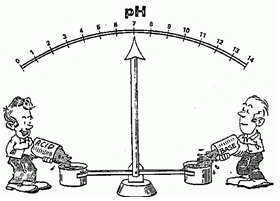
Any substance that shifts this equilibrium changes the pH; in the marine aquarium, where the average pH is 8.2, the equilibrium is shifted slightly towards alkaline, and the amount of these substances can be measured as total alkalinity.
Where our tank sits
- 1Acidic zone more H+ ions than OH- ions
- 2Pure water: pH 7 H+ and OH- in equal parts
- 3Marine aquarium: pH 8.2 slightly towards alkaline
- 4Alkaline zone more OH- ions than H+ ions
With an average pH of 8.2, the marine aquarium is shifted slightly towards alkaline.
Total alkalinity
Total alkalinity means the water's capacity to neutralise acidic compounds; it is usually expressed as meq/l of OH-, and it is the sum of all the bases that can be titrated with acid. In seawater it is normally due to the concentration of bicarbonates, carbonates and hydroxides, but also to other bases derived from borates, phosphates, silicates and ammonia 1. More concisely, we can define total alkalinity as:
Since most of the total alkalinity comes from bicarbonate and carbonate ions (they make up almost all of it in percentage terms), total alkalinity is often equated with carbonate hardness, better known as KH.
KH
Carbonate hardness, better known as KH (from the German Karbonathärte), represents the concentration of carbonates and bicarbonates in the water; it is measured in German degrees, that is:
The mixture of carbonates and bicarbonates forms what is called a "buffer", because the mixture can neutralise acids (H+) and bases (OH-) almost without changing the pH of the solution, since:
- in the presence of acids: HCO3- + CO3-- + H+ → 2 HCO3-
- in the presence of bases: HCO3- + CO3-- + OH- → 2 CO3-- + H2O
Carbonates and bicarbonates swap roles
- 1An acid added carbonate becomes bicarbonate
- 2A base added bicarbonate becomes carbonate
- 3Bicarbonate HCO3- blue ball
- 4Carbonate CO3-- yellow ball
The mixture neutralises acids and bases almost without changing pH: what changes is the ratio between carbonates and bicarbonates.
It follows that the CO3--/HCO3- ratio changes over the day-night cycle in our aquariums, according to the metabolic processes in our tanks. How far the CO3--/HCO3- ratio is shifted towards bicarbonates or towards carbonates is not shown by the KH test because, as described above, it measures only their equivalent sum.
Interactions and considerations on the three measurements
As we have seen, bicarbonate and carbonate ions change into each other according to the tank's acid/alkaline profile; bear in mind that in our tanks there is another enemy that plays an important part in the HCO3-/CO3-- ratio: carbon dioxide. CO2 is also a risk for the world's seas, because industrialisation releases huge amounts of greenhouse gases into the atmosphere and its concentration keeps increasing over time; this phenomenon is known as "ocean acidification". Let's see what it is: the rise in carbon dioxide concentration in the atmosphere causes more of the gas to dissolve in water (all gases are soluble and their solubility increases as temperature falls); this can be written as:
Part of the CO2 that dissolves in water reacts by hydrolysis, forming carbonic acid, which then dissociates into H+ and bicarbonate, that is:
It follows that the seas and our tanks become more acidic as the concentration of CO2 dissolved in the water rises; this acidity is buffered by KH, which, however, with a large excess of acidity shifts the carbonate/bicarbonate equilibrium towards the carbonic acid/bicarbonate pair. An excellent indicator of the situation we are in is pH, as is easy to see from the Bjerrum plot:
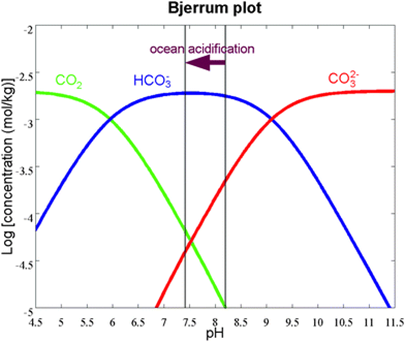
So it is clear that a drop in pH leads to a substantial drop in carbonates in the water even while the KH value stays the same.
Same KH, fewer carbonates
- 1Carbon dioxide dominates at low pH
- 2Bicarbonate HCO3- dominates at tank pH
- 3Carbonate CO3-- falls as pH drops
- 4The tank zone between pH 8.2 and 7.4 on the plot
If pH drops, KH can stay the same but carbonates decrease. Schematic curves, with the crossover points read from the article's plot.
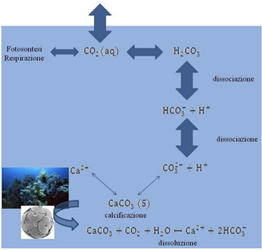
It is worth stressing that our corals carry out biomineralisation, that is all the processes by which they produce and deposit the mineral phases and organic components they need to grow. The main minerals deposited are calcium carbonates (CaCO3) in crystal forms called aragonite and calcite; these compounds are not pure: the calcium ion is sometimes replaced by a magnesium or strontium ion, depending on environmental factors such as temperature, the ratio of Ca to other cations, and pH. Several studies have established that a drop in the availability of carbonates (CO3--) causes a drop in biogenic calcification, slowing the growth rate, and in some cases can cause the coral skeleton to dissolve. This is due to the crystal properties of aragonite and calcite, which in more acidic environments, and to a lesser extent even slightly alkaline ones, go back into solution (the principle of the calcium reactor); dissolution is written as:
By removing the CO3-- ion (neutralised by the acidity), the reaction will shift further to the right, that is towards the reaction products, because the solid salt will dissolve to restore the proper equilibrium.
How CO2 ends up dissolving calcium carbonate
- 1CO2 from the air the more there is, the more dissolves
- 2CO2 in water reacts with the water
- 3Carbonic acid splits into H+ and bicarbonate
- 4H+ ions neutralise the carbonates
- 5Fewer carbonates less left for the corals
- 6CaCO3 skeleton dissolves into Ca++ and CO3--
Removing carbonate from the water pushes the reaction to the right: the solid dissolves to restore equilibrium.
Sources: [2]
The degree of dissociation described above also depends on the crystal structure of the mineral deposited, since aragonite has a dissolution constant 1.5 times higher than calcite, and this value can be higher still in some high-magnesium calcites biomineralised by certain organisms such as coralline algae; dissolution of these could even increase or block the actual consumption of calcium and magnesium in Balling, which in reality is due to this type of mineral dissolving.
Ways to counter acidity
In view of the above, it is clear that low pH affects pure Berlin tanks in particular; in DSBs or in Berlin tanks with a "dusting" of sand, the amount of sand present "buffers" the acidity, preventing dissolution. Try to keep temperatures steady even through the hot/cold seasonal changes since CO2, like all gases, becomes more soluble as temperature falls. An important source of acidity is the skimmer: these devices process many litres of air per hour, and by forming bubbles they provide a very large air/water contact surface where carbon dioxide dissolves. A good aid is a soda lime filter fitted on the skimmer's air intake: these filters absorb the CO2 present, preventing the reaction:
In this case you need to watch KH consumption since, as well as removing acidity (H+), the hydrogen carbonate (HCO3-) part will also be removed, showing the reefkeeper an immediate rise in KH consumption.
Those who use a calcium reactor, as well as soda lime for the skimmer, could add a further filter of coral sand or aragonite itself on the reactor's outflow, so as to neutralise as much as possible of the acidity still present.
Ways to keep acidity in check
- 1Sand on the bottom buffers acidity
- 2Steady temperature more CO2 dissolves when cold
- 3Skimmer lots of air in contact with water
- 4Soda lime filter absorbs CO2 from the incoming air
- 5Calcium reactor outflow may still be acidic
- 6Coral sand filter neutralises outflow acidity
With a soda lime filter on the air, keep an eye on KH: the author reports an immediate rise in consumption.
Author: M. Paci
Sources
- Dickson A.G., Sabine C.L., Christian J.R. (eds.) (2007). Guide to Best Practices for Ocean CO2 Measurements, chapter 2. PICES Special Publication 3.
- NOAA (2026). Ocean acidification. National Oceanic and Atmospheric Administration.
- Sass E., Morse J.W., Millero F.J. (1983). Dependence of the values of calcite and aragonite thermodynamic solubility products on ionic models. American Journal of Science 283(3): 218-229.
- Chan N.C.S., Connolly S.R. (2013). Sensitivity of coral calcification to ocean acidification: a meta-analysis. Global Change Biology 19(1): 282-290.
- Carvalho R.T., Rocha G.M., Karez C.S. et al. (2022). Global assessment of coralline algae mineralogy points to high vulnerability of Southwestern Atlantic reefs and rhodolith beds to ocean acidification. Scientific Reports 12: 9589.
- NIOSH (2019). Pocket Guide to Chemical Hazards: Calcium hydroxide. Centers for Disease Control and Prevention.
- NOAA, CAMEO Chemicals (2024). Soda lime, with more than 4% sodium hydroxide. NOAA Office of Response and Restoration.
On the same topic
Chemistry and biomineralisation
KH, calcium and magnesium are not just numbers to keep stable: they are the bricks, the cement and the additive on…
Trace elements and metals
Elements we weigh in micrograms per litre but that govern entire biochemical reactions. Chapter 4: what they are for,…
Using clay mineral compounds in the marine aquarium
What clay mineral compounds are, the difference between physical and chemical adsorption, how the product is prepared…
Comments (1, in Italian)
Articolo molto interessante ed esaustivo