
ORP or redox potential
What a redox probe really measures, and what it does not
ORP (redox potential) in the marine aquarium
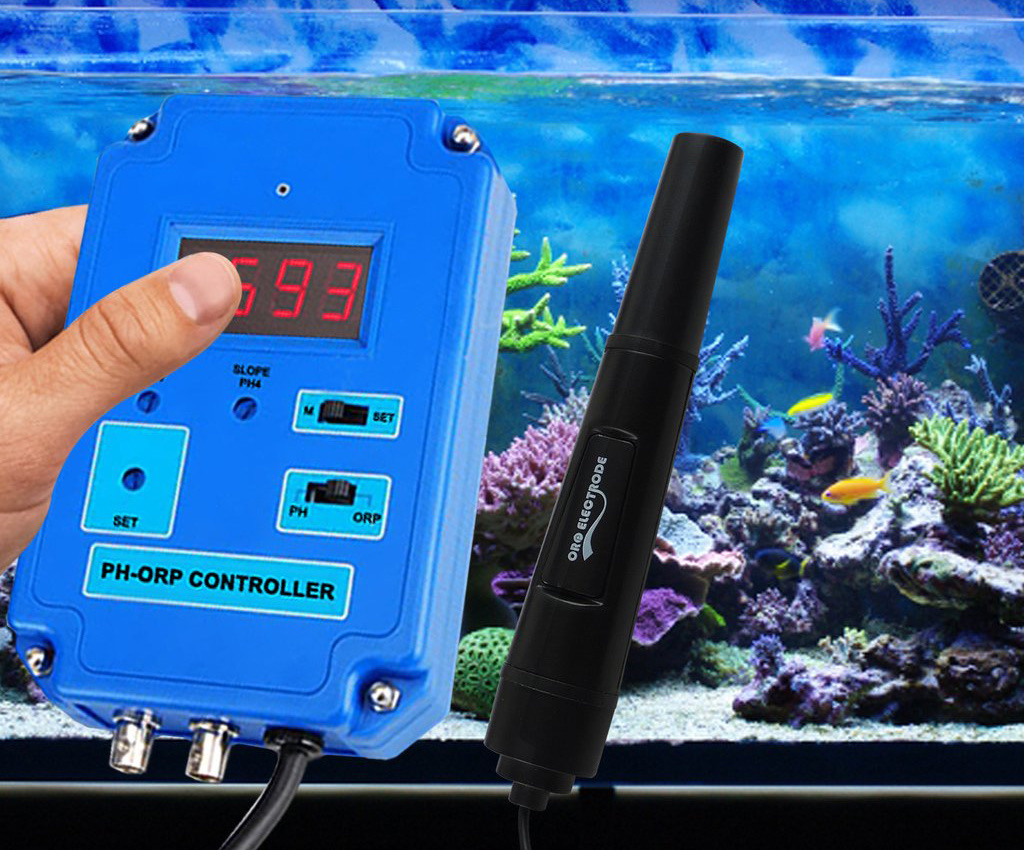
Introduction
The oxidation-reduction potential (ORP) of marine aquariums is a measure of the oxidising power of the water. It is often recommended to hobbyists as an important water parameter, and some companies sell products (equipment and chemicals) meant to control ORP. Many of those who recommend controlling ORP are hobbyists convinced that it measures the relative "purity" of the aquarium water, even though this is far from certain...
How ORP is measured
- 1The tank water tends to gain or give up electrons
- 2Platinum electrode in contact with the water
- 3Reference electrode the point of comparison
- 4Meter reads the difference in millivolts
ORP is an electrical potential, measured in millivolts against a reference electrode.
Sources: [1]
Many substances, one number
- 1Many substances together give a mixed potential
- 2Temperature and pH change the reading: note them down
- 3A single number shows intensity, not capacity
- 4Purity? for the author it is far from certain
A single ORP value does not describe the whole water: in natural waters it is only a semi-quantitative measure.
Sources: [1]
Keep reading the article by clicking the button below (the document is in Italian):
Sources
- U.S. EPA Region 4, Laboratory Services and Applied Science Division (2024). Field Measurement of Oxidation-Reduction Potential (FSBPROC-113-R5). U.S. Environmental Protection Agency.
- Li X., Blancheton J.-P., Liu Y., Triplet S., Michaud L. (2014). Effect of oxidation-reduction potential on performance of European sea bass (Dicentrarchus labrax) in recirculating aquaculture systems. Aquaculture International 22(4): 1263-1282.
- Li X., Przybyla C., Triplet S., Liu Y., Blancheton J.-P. (2015). Long-term effects of moderate elevation of oxidation-reduction potential on European seabass (Dicentrarchus labrax) in recirculating aquaculture systems. Aquacultural Engineering 64: 15-19.
On the same topic
Chemistry and biomineralisation
KH, calcium and magnesium are not just numbers to keep stable: they are the bricks, the cement and the additive on…
Trace elements and metals
Elements we weigh in micrograms per litre but that govern entire biochemical reactions. Chapter 4: what they are for,…
Using clay mineral compounds in the marine aquarium
What clay mineral compounds are, the difference between physical and chemical adsorption, how the product is prepared…