
A guide to my first tank with the Zeovit method
A 200-litre tank for those willing to keep at it every day
"This article is dedicated to all those who are approaching the wonderful world of the marine aquarium for the first time and have neither the time nor the wish to read a couple of good books on the biology of tropical seas."
That is how, a few years ago, I began my "Guide to the first marine aquarium", in three parts, which you can still find here on the Ballingmania site. Taking it for granted that by now anyone who has read that guide can consider themselves a fully fledged aquarist (watch out, sooner or later I'll test you), let's try to move on. Let's think about a tank a little bigger than the 90-litre one I talked about in the guide and, above all, one with more "performance". One of those tanks that, if managed well, gives enormous satisfaction and draws extravagant "ooohhh"s of wonder from friends and relatives.
Not a regime for the lazy
Ready? Okay, let's go. Actually no, one more thing, a really important thing: if you are a "lazy" aquarist, the kind who thinks the aquarium runs by itself and has no intention of spending even a quarter of an hour a day on it, forget it. The tank I am about to present to you, which is in fact the one I set up a few months ago, is a bit of a "tinkerer's" tank: you have to keep on top of it. You have to look after it, observe it and understand it, day by day: only then will you get the results you hope for, namely a garden of SPS and LPS corals that takes your breath away. And then, very importantly, you also have to negotiate with your wife (or your husband, as the case may be) to reserve a couple of shelves in the fridge for the "kit", that is, a series of charming little blue bottles.
That's right, we are going to set up a tank with the Zeovit protocol, a method that has made marine aquarium history over the last twenty years and that belongs to the German company Korallenzucht, whose "guru" is Thomas Pohl. Rivers of words have been written about this method (fiumi di parole, as the Italian duo Jalisse would put it): aquarium treatises not always understandable to the layman, which I will take good care not to invite you to read. Just as my "Guide to the first marine aquarium" was meant "for those who have neither the wish nor the time to read a couple of good books on tropical marine biology", this guide to the "Zeovit tank" is meant for those who have neither the wish nor the time to sit through Mr Pohl's complex treatises.
So let's sum up. What is the Zeovit method based on? On bacterial reproduction. Big news, many of you will say: bacteria work and reproduce in any marine or freshwater aquarium. True, and in fact the difference is that in the Zeovit method bacterial growth is enormously boosted, to the point of having water with nutrients close to zero even in heavily stocked tanks. In practice bacterial reproduction is "turbocharged", thanks to specific products and technical measures that we will describe, so as to obtain water quality close to the natural one in which even the most delicate SPS thrive.
But that's not all. This extreme reduction in phosphates and nitrates means that the corals take on particularly fascinating colours (the famous "pastel shades" typical of Zeovit tanks), due mainly to the decrease of zooxanthellae in the tissues and to the action of chromoproteins; but it also means that the corals must be fed properly to thrive, otherwise, with nutrients at zero, they would not live long. Of course our friend Pohl took all this into account, and in fact the Zeovit method is basically divided into two "lines of action": equipment and products to reduce nutrients through bacterial reproduction, and a line of supplements and foods meant to give the corals all the elements they need to live happily.
Live rock, please
To adopt the Zeovit system I chose a 90 by 50 by 50 tank with a sump, so about 200 litres net. The basic equipment is more or less that of the Berlin method: you need an excellent skimmer, excellent lights, excellent flow pumps and excellent live rock. I can already hear those who say: what, isn't synthetic rock any good? Everyone uses synthetic rock these days... But no, my friends: the Zeovit system calls for live rock, and live rock it is. If you then want to do things differently, don't complain if something perhaps doesn't go the right way.
So, as we were saying: equipment similar to the Berlin method's. But there in the sump, between the skimmer and the return pump, the real "heart" of the Zeovit system makes its appearance: the zeolite reactor, which you can see in the first and second photos accompanying this article.
Where the zeolite reactor sits
- 1Tank about 200 litres net, with sump
- 2Skimmer an excellent one, as in the Berlin method
- 3Zeolite reactor 1000 ml per 400 litres of tank
- 4Reactor pump maximum flow: 400 litres per hour
- 5Carbon sock in an area of good flow
- 6Return pump sends water back to the tank
The equipment is the Berlin method's: what's new is the reactor, between skimmer and return pump.
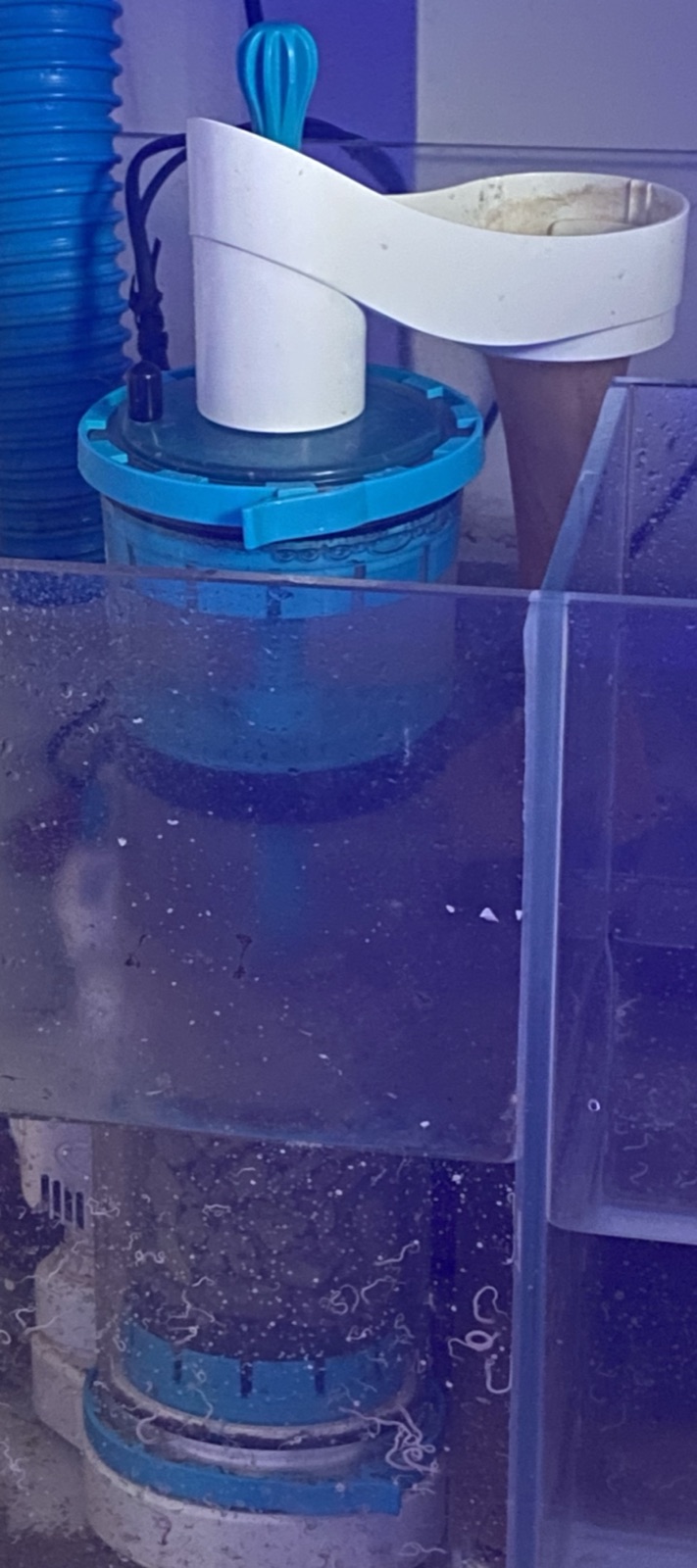

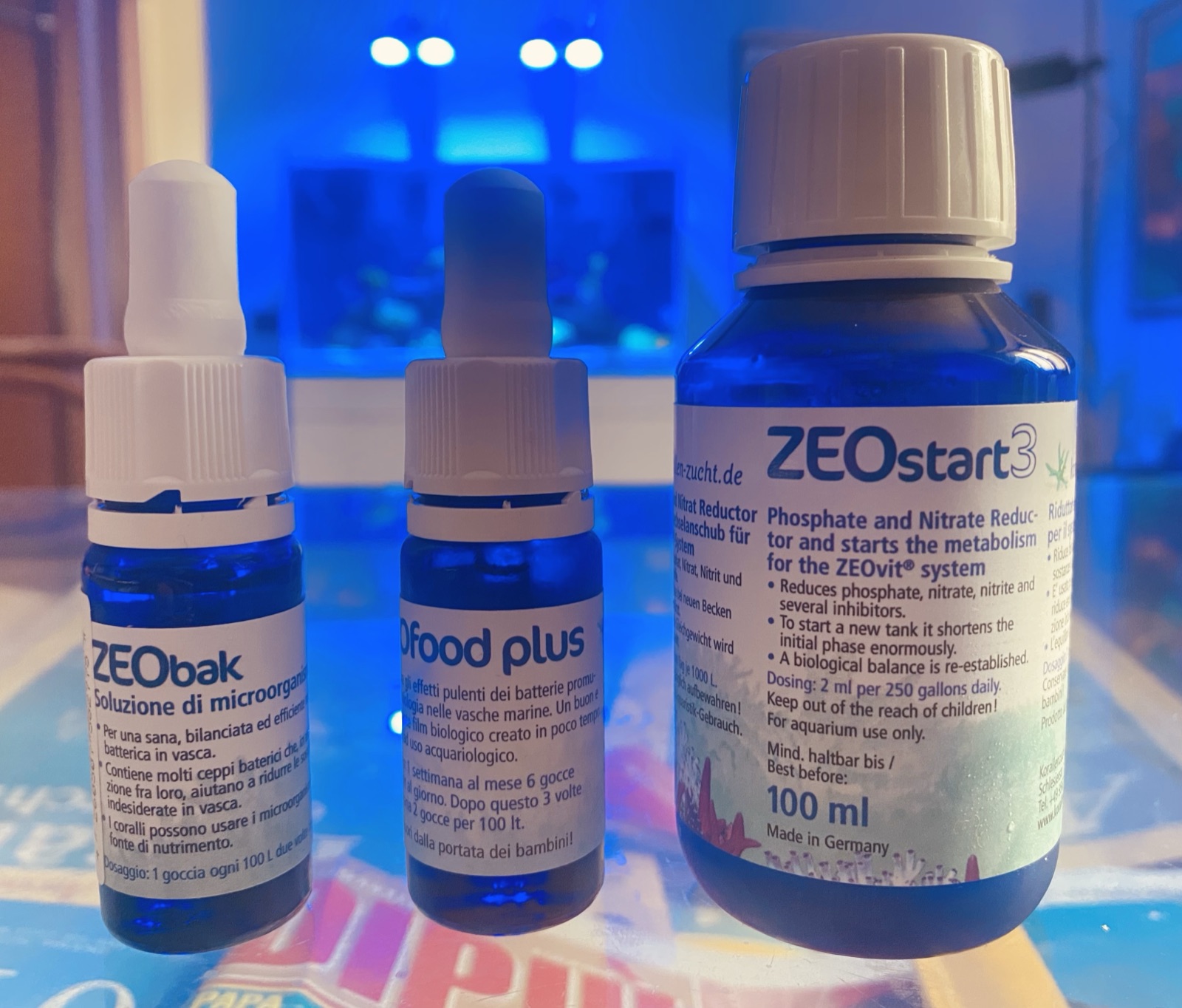
This is where the bacteria get "turbocharged", settling in beautifully in the pores of the zeolite, thanks also to the three key products of the method developed by Dr Pohl: ZeoBak, Zeofood and Zeostart, which you see in the third photo, and also in the fourth together with the zeolite and the activated carbon, which as we will see is also essential. ZeoBak is a blend of bacteria; Zeofood and Zeostart, in a nutshell, are their food, based on carbon sources, while the reactor is their home. The beating engine of Zeovit is all here: you dose the right amounts of the three products as prescribed, and in the zeolite reactor the bacteria settle and multiply enormously.
From three products to pastel colours
More bacteria, fewer nutrients: that is why the corals must be fed properly.

Every excess costs dearly
But watch out, it's not all that easy. It so happens that the bacterial potential unleashed in the zeolite is truly extraordinary, which means that if you are not careful and do not SCRUPULOUSLY respect the product doses and the water flow through the reactor, the water suddenly becomes too lean and the corals start to recede. So, to avoid nasty surprises, it is best to take the recommendations in the official Zeovit guide as gospel: for a 400-litre tank you must use 1000 ml of zeolite, not one more, and the reactor pump must be set so that the flow is 400 litres per hour at most. As for the doses of ZeoBak, Zeofood and Zeostart, stick to their leaflets: to give an example, ZeoBak goes in at 1-2 drops per 100 litres a couple of times a week, while for Zeostart the dose is 2 ml per 1000 litres! We are talking about drops and ml, which gives an idea of how concentrated the products are: this means that any overdose, even of a single drop, could be dangerous for the stability of the tank. Thomas Pohl's advice: "You can safely forget to add the products for a day or two, or even take a week's holiday, and then start dosing normally again. But never, ever overdose, not even by one drop, in an attempt to make up for missed doses: you would only cause damage."
A good "shake" morning and evening
But let's go back now to our zeolite in the reactor. As we said, it is a continuous bacteria factory: they settle in every pore, proliferating constantly and so ending up "overpopulating" the zeolite, as if more and more people were crowding into a flat. This means that, as Korallenzucht recommends, the material must be replaced on average every 6-8 weeks. But that's not all: in the "don't take up Zeovit if you can't be bothered" series, it so happens that, for the zeolite to work properly, it needs... a couple of shakes every day. That's right: once or twice a day, morning and evening, the zeolite must be "stirred" by moving the reactor's plunger up and down for a few seconds. The aim is to remove from the pebbles the bacterial film that inevitably forms on their surface, reducing their efficiency; and the nice thing is that part of this bacterial "slime", called bacterioplankton, released by the shaking, ends up in the tank through the return, making an excellent extra food for the corals.
Shaking: from pebble to corals
- 1Plunger up and down for a few seconds, 1-2 times a day
- 2Zeolite bacteria settle in every pore
- 3Bacterial film on the pebbles, reduces their efficiency
- 4Bacterioplankton loosened slime rises with the return
- 5Corals for them it's extra food
Shaking cleans the zeolite and at the same time brings food to the corals.
Sources: [4]
The corals must be well fed
Speaking of feeding our beloved corals, as I said earlier you absolutely must do it, and do it well, given the way zeolite tends to make the tank lean. So, keeping nitrate and phosphate values under control and carefully watching polyp extension, we must provide a suitable diet, otherwise it is almost certain that in the long run the tissue will recede. Zeovit offers a complete line of foods and supplements to boost colour, but here I feel I can say it is not strictly necessary to use those very ones. In other words, if you are used to feeding with products from other brands, go ahead, nothing will happen. For my part, for example, I occasionally use Coral Max and Polip Roid, paying due attention to the values. However, for those who have chosen to follow Zeovit, the basic feeding product is the highly concentrated but effective Pohl's Coral Vitalizer, which has the not insignificant quality of not raising NO3 and PO4. Then there are various other products, some of which you see in the fifth photo, including some to boost colour, but it would take far too long to discuss them here: for choosing and using them I refer you to the guide to the Zeovit method, which can also be found online in Italian (the various forums on Zeovit.com are also excellent).

The charm of black and white
Forgive the odd heading: we are not talking about films but about sand and activated carbon, two materials that are always a subject of debate in marine aquariums. Many will remember that in my "Guide to the first marine aquarium" I advised against putting sand in a marine aquarium, at least not straight away, unless it is a DSB. Be aware that the Zeovit method, on the other hand, calls for it from the start: "From the very beginning, lay a 2-3 cm layer of coral sand or aragonite, not too fine, on the bottom", the manual says. And the interesting thing is that Dr Pohl considers sand a sort of extension of the zeolite as a bacterial substrate: so much so that the sand should also be stirred every day, by hand or with a stick, so as to put into circulation the bacterioplankton the corals like so much (look how they extend their polyps when that "fine mist" of muck rises from the substrate).
As for carbon, it too is essential in the Zeovit system, at a rate of about 100 ml per 100 litres, to be replaced once a month. Two tips: the first is to use very high quality carbon, indeed, if possible, Korallenzucht's own carbon, which is one of the very best; the second is not to use the carbon in a "forced" way, for example in a fluidised bed, because it would be too aggressive, but to leave it in the sump inside a sock, in an area of good flow.
The sand is stirred, the carbon stays put
- 1Sand coral sand or aragonite, not too fine
- 2Stick or hand the sand is stirred every day
- 3Fine mist bacterioplankton rising to the corals
- 4Activated carbon about 100 ml per 100 litres, changed monthly
- 5Sock never forced: no fluidised bed
The method wants sand from the start, stirred every day, and carbon left in a sock.
Let's set up our tank together
I am writing this part of the article practically live, because I have just set up a "full" Zeovit tank, that is, following their advice to the letter, starting with the advice to add the first corals as early as fourteen days after start-up.
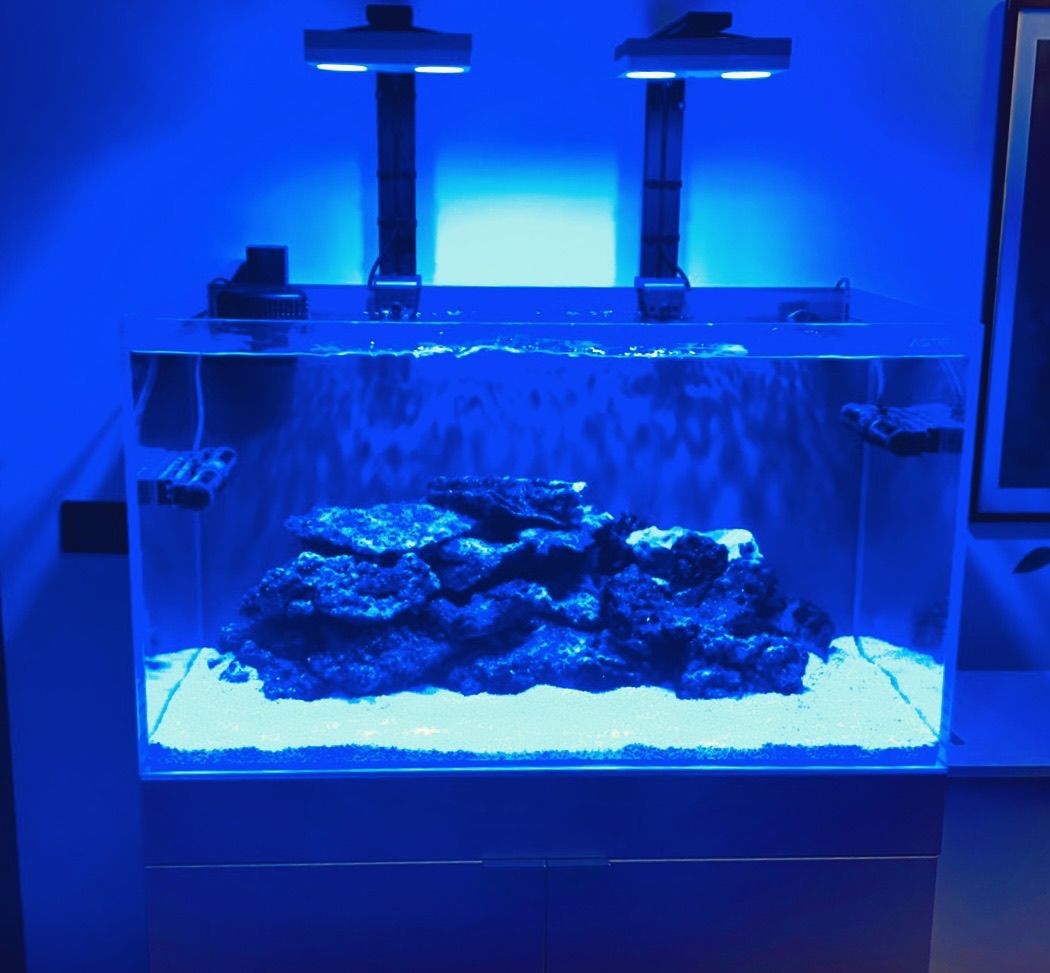
And that is exactly what I did. After placing the rock (strictly live!) and the layer of sand (Korallen aragonite), I started the pumps (the long Jebao ones, Gyre type, to give you an idea), the skimmer (Deltec 600i) and the lights (two Hydra 32HD) on a full photoperiod. At the start it looked like the sixth photo.
Then came the classic algae cycle, seventh and eighth photos, though smaller than in other setups.


Of course, following the Zeovit manual, I dosed the quantities prescribed for start-up of ZeoBak and company, which are larger at the beginning, as you can see in Korallenzucht's guide. After the fateful 14 days I, frankly, being old school, was not convinced that animals could already go in, but I had to think again. The first inhabitants, helped by values that were already good, are still in excellent shape, as you can see from photo number nine, which shows the tank five months after start-up.
At this point I'd say we're done... ah, no, I almost forgot: water changes with a good salt are essential; I change 10 per cent every 15 days using Tropic Marin Pro Reef. There, now we really are done, but keep firmly in mind what I mentioned at the start: if you have neither the time nor the wish to give the tank a quarter of an hour a day, if you don't feel like keeping on top of dozens of little blue bottles, let alone strictly respecting doses and dosing times, forget it, because it means Zeovit is not for you.
Doses and timings given by the author
| What | How much | When |
|---|---|---|
| Shaking the zeolite | A few seconds with the plunger | 1-2 times a day |
| Sand | 2-3 cm layer | Stirred every day |
| ZeoBak | 1-2 drops per 100 litres | A couple of times a week |
| Zeostart | 2 ml per 1000 litres | As per the leaflet |
| Water change | 10 per cent | Every 15 days |
| Activated carbon | About 100 ml per 100 litres | Changed once a month |
| Zeolite | 1000 ml for a 400-litre tank | Changed every 6-8 weeks |
| Reactor flow | Max 400 litres per hour | Always |
Never overdose, not even by one drop: for doses, the product leaflets are what count.
Metello Venè
Sources
- Mokaremi G., Emadi H. (2007). Zeolite application to sea water for ammonia absorbtion and its effects on growth and survival of Penaeus indicus. Iranian Scientific Fisheries Journal 16(2): 127-136.
- NOAA National Ocean Service (2026). Corals Tutorial: What is Zooxanthellae?. National Oceanic and Atmospheric Administration.
- Quick C., D'Angelo C., Wiedenmann J. (2018). Trade-Offs Associated with Photoprotective Green Fluorescent Protein Expression as Potential Drivers of Balancing Selection for Color Polymorphism in Reef Corals. Frontiers in Marine Science 5: 11.
- Benavides M., Houlbrèque F., Camps M., Lorrain A., Grosso O., Bonnet S. (2016). Diazotrophs: a non-negligible source of nitrogen for the tropical coral Stylophora pistillata. Journal of Experimental Biology 219(17): 2608-2612.
On the same topic
Snow in the tank: four clarifiers compared
ATI Easyvital, KZ Coral Snow, Modern Reef BIOReef-Snow and Resolve look alike, but they work in different ways:…
Bacterial growth: what really happens
"We dose bacteria to lower nitrates and phosphates" is only the end result, not the process. What really happens in…
The refugium: the biological lung of the reef
The skimmer removes organics before they become nitrate; the refugium absorbs what has already formed. How it works,…